First National Strike in Bolsonaro’s Government Seen as Timid
By Lise Alves, Senior Contributing Reporter
SÃO PAULO, BRAZIL – President Jair Bolsonaro’s administration faced its first national strike on Friday, June 14th, with Brazil’s main workers’ unions calling for the population to stay home to show their discontent for the government’s social security reform plans.

Organizers hoped that workers from all sectors and industries would take to the streets to protest against the federal government. And although all twenty-seven state capitals registered protests during the day, the main effect of the strike was on public transport. Of the twenty-seven capitals, nineteen registered some alteration in their bus system.
In major cities, bank branches closed, allowing customers to pay bills and withdraw money only from ATMs. Many public schools also sent students home after administrative staff and teachers failed to show up.
In Latin America’s largest city, São Paulo, workers waited hours to catch buses to work, and subway and trains were slower than usual. Many gave up, called their work, stating that they would not be able to go and went back home.
“I’ve been waiting for the past two hours and still no bus,” said Silvia Andrade to a Brazilian news crew at a bus stop in a São Paulo suburb. “I work as a maid, and I’ve called my boss and told her I am giving up and going home.”
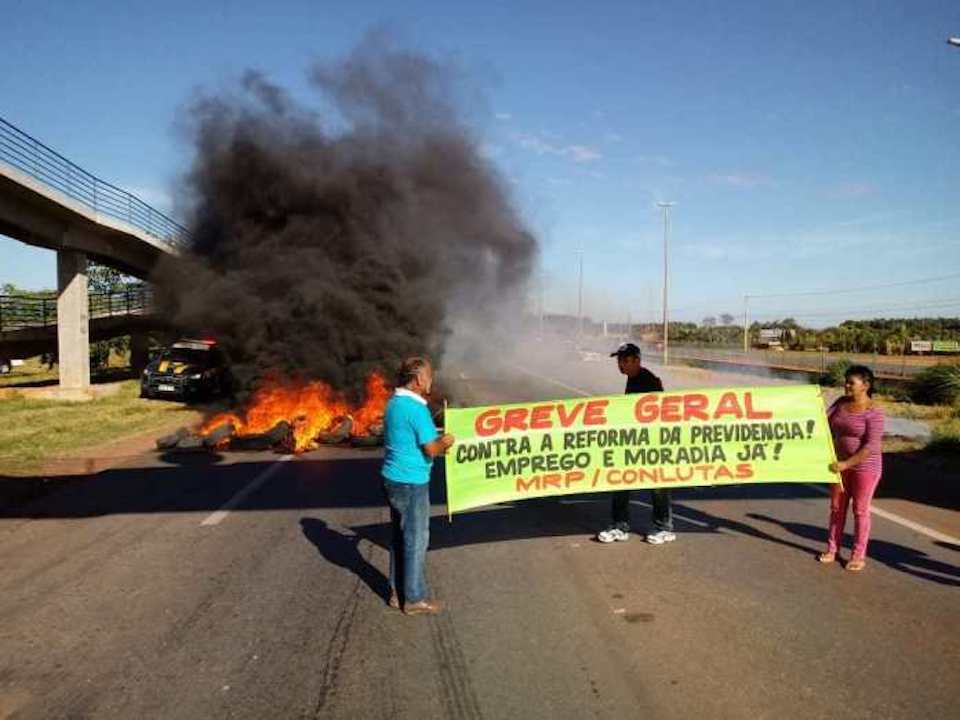
Workers coming into the city in cars also faced problems. One of the main highways into São Paulo, Rodovia Anhanguera, was blocked for more than two hours as protesters placed burning tires along the pavement to keep motorists from reaching the city.
In Rio, protests were predominantly peaceful until the beginning of the evening, when police fired tear gas at protesters trying to block one of the city’s main avenues, Avenida Brasil.
The success of the national strike, the first one since 2017, however, was disputable.
“Let’s stop the buses; the buses did not stop. Let’s stop the subways; the subways did not stop. The most they did was to interrupt one highway or another to create a sense that there are a lot of people in the congestion, but the country continues to work, ” said government leader in Congress, Joice Hasselmann.
According to the lawmaker, the anti-reform demonstrations were a “fiasco”.

Eder Silva, a consultant working in São Paulo, agrees with Hasselmann. “They (left-wing groups) only call for demonstrations and protests on weekdays. Why not on Saturday or Sunday, when you don’t disrupt the lives of those people who do not want to adhere to your cause?”
“Most of the people not going to work today are those who live far away from their jobs, who need to take two, maybe three buses or trains to get to work and couldn’t because of the strike in the public transport system,” said Silva, who admits being a Bolsonaro supporter.
“These people didn’t adhere to the strike, they simply couldn’t get to work because there was no public transportation,” he argued. “A success? No, I wouldn’t call it a success.”
According to Sergio Praça, a professor at FGV-CPDOC (Getulio Vargas Foundation – Center for Research and Documentation of Contemporary History in Brazil), Friday’s strike showed “the lack of capacity of the opposition to take advantage of government’s weakness”.
“We are living a moment of weak opposition and weak government simultaneously, and the unions lost a lot of power in the labor reform and the end of the union tax,” Praça was quoted as saying on the online news outlet R7.
Union leaders, however, called Friday’s strike a huge success. “The biggest factor in mobilization and unity is Bolsonaro. He was able to unite everyone against welfare reform,” said Vagner Freitas, president of one of Brazil’s largest workers’ union, CUT.
“The trade union centrals have never been as united as they are this time,” added Freitas.
Left-wing politicians also saw the mobilization across the country as successful. “With today’s strikes, especially in large centers, trade union, social and popular movements have demonstrated that the workers do not approve the so-called “New Social Security”, a set of measures that destroy historic rights and dismantle public welfare,” read the note issued by PT party’s Chamber of Deputies representatives.
Pro-Bolsonaro supporters are now calling for a demonstration on June 30th, in support of the social security reform and Justice Minister, Sérgio Moro. The protest, however, will be on Sunday, say organizers, so as “not to disrupt the country’s economy”.
More: Brazil news in English, every day from The Rio Times.
Editorial responsibility: Matthias Camenzind, Editor-in-Chief · Editorial standards · Report an error