Elections in Colombia: violence and murders limit the guarantees to vote
RIO DE JANEIRO, BRAZIL – Violence has intensified in the run-up to the elections in Colombia. “There is a fear that the communities will not be able to go out and vote,” warns a Colombian leader before the EU, which will observe the elections.
“At the territorial level, since there is a large presence of different armed actors, including several paramilitary groups, there is fear that the communities will not be able to vote on May 29,” says Colombian human rights defender Cristy Lozano Tautiva.
Read also: Check out our coverage on Colombia
She is a representative of the Humanitarian Action Corporation for Coexistence and Peace of Northeast Antioquia (Cahucopana).

This organization was born in 2004, as a response to the economic blockade and the confinement to which the armed actors had subjected the population since the end of the 1990s.
In this gold mining and agricultural region, massacres and bombings have been suffered; 54.9% of its population is included in the register of victims of the armed conflict.
“We have also come to warn that, in our indigenous, mining, peasant and Afro-descendant communities, the implementation of the Peace Agreement has been null,” says Lozano Tautiva, in Brussels.
With her sights set on the next election day, the Colombian leader emphasizes the hope that her people choose to move towards a stable peace that begins, in her opinion, “by trying to resolve unsatisfied basic needs.”
“THE MESSAGE SENT BY THE COMMUNITIES: FEAR”
Political, social and community leaders have been the main affected, according to data from the Electoral Observation Mission (MOE) for the legislative elections on March 13 in Colombia.
The regions most affected by the pre-election violence would be Cauca, Bogotá, Norte de Santander, Valle del Cauca and Antioquia.
“As we find ourselves in an electoral period, the levels of risk increase,” confirms Lozano Tautiva, emphasizing that the lack of guarantees for those who defend human rights, especially in rural areas, comes, however, from afar.
“I have come to transmit the message that the communities send: fear,” she insists.
The reason for the attacks is linked by Lozano Tautiva to economic interests; in her region especially, to gold.
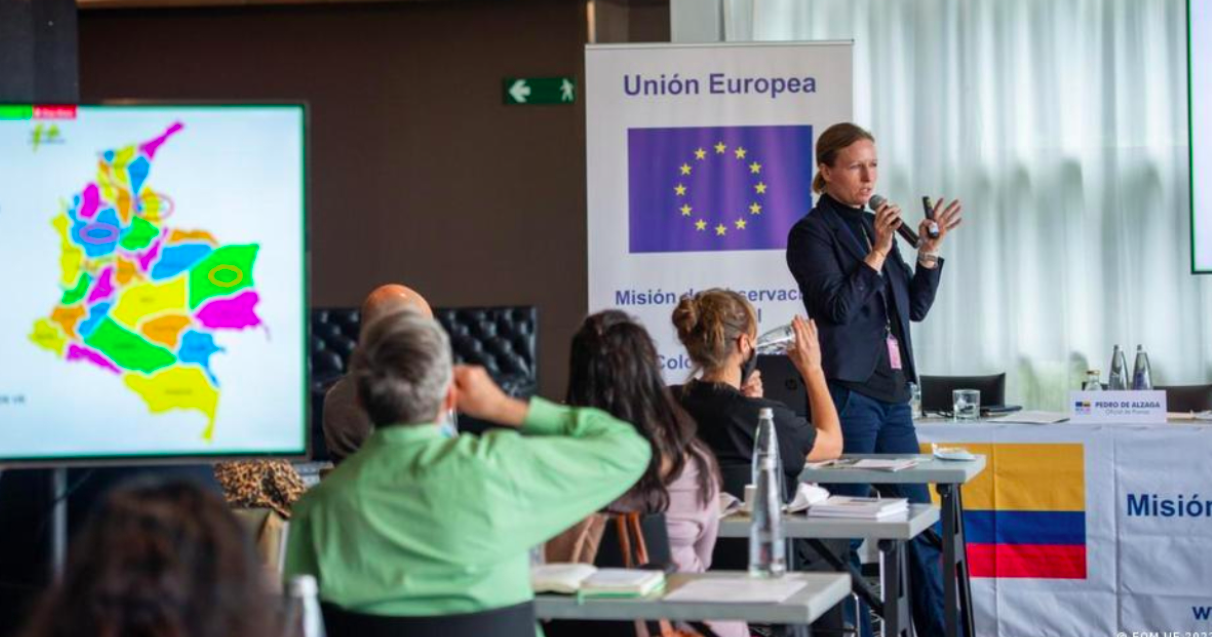
“We defend the rights of communities in territories of great economic interest, where various armed actors converge. We are an obstacle for the powers of this country and they want to silence us. To preserve their lives, there are many who have had to leave the country”, adds the Colombian human rights defender.
She herself is one of the hundreds of thousands of victims of the violence. Her father was assassinated in the selective attacks on the Patriotic Union in 1994.
So she warns to be very aware of the violence before and during the elections; of not neglecting post-electoral monitoring.
DO YOU SEE OBSERVERS DURING THE ELECTIONS IN COLOMBIA?
It should be remembered that, since the beginning of the year, 30 European observers have been permanently deployed throughout the Colombian territory.
For the following days, on May 29 and, if there is a second round, on June 19, there will be 130 observers from the EOM verifying, among other things, access to the polls.
According to the preliminary report of the legislative elections, “in most of the country, election day was peaceful, although a series of incidents recalled the backdrop of violence, especially because there were paramilitary groups blocking roads in the Magdalena”, another of the departments most affected by the conflict.
In any case, “although we are hopeful that we will be able to see a government that is different from what we have had in decades, the presence of different armed groups, including paramilitaries, makes us fear that the communities will not be able to go out and vote,” says Lozano Tautiva.
It should not be forgotten that electoral abstention was 54.2% and 51.8%, respectively, in the last two Colombian legislative elections.
IS IT BECAUSE OF FEAR AND THREATS THAT THE POPULATION DOES NOT GO TO THE POLLS?
According to informed sources in the EU, EOM personnel would be trained to detect “invisible” violence.
But, be that as it may, Lozano Tautiva illustrates, “in northeastern Antioquia they set up three paramilitary checkpoints between the villages and the urban area.”
She ends by saying that: “it will be difficult to guarantee that the entire population that has been affected by the armed conflict can go out and decide the future of the country.”
More: Colombia news in English, every day from The Rio Times.
Editorial responsibility: Matthias Camenzind, Editor-in-Chief · Editorial standards · Report an error