Cuba Envoy Denies Formal US Negotiations on Monday

DIPLOMACY · CUBA
Key Facts
- —The country Cuba is a one-party communist state about 150 kilometres (90 miles) south of Key West, Florida, under heavy US economic pressure.
- —Why it matters Washington wants political change in Havana. Whether the two governments are really talking shapes sanctions, travel rules and the risk of a military clash.
- —Why now New US Treasury rules took effect on Wednesday 30 September, ending group people-to-people trips and US bank accounts for Cuban private entrepreneurs.
- —What happened On Monday 5 October, envoy Lianys Torres Rivera said contacts include meetings, calls and WhatsApp messages, but no negotiating agenda.
- —What it means for you No formal talks means no quick easing. US conference travellers already in Cuba must leave by Friday 30 October under the wind-down rule.
- —Still open Who takes part in the contacts, what they cover, and whether either side will accept a formal agenda.
- —Prediction markets Polymarket gives a US-Cuba economic deal by 31 December 11%, down from about 21.5% a week earlier (6 October, 2:35 a.m. ET).
Cuba’s top diplomat in Washington says Havana and the United States have “channels of communication” but no formal negotiations. Lianys Torres Rivera, chargé d’affaires at the Cuban embassy, said so in an interview with Reuters on Monday 5 October. For Americans, the state of the US-Cuba talks shapes how far sanctions, travel limits and military pressure on the island go next.
A chargé d’affaires runs an embassy when no ambassador is in charge. Cuban state outlet Cubadebate republished her remarks on Monday, giving them the government’s own platform at home.
She said the latest contacts have involved meetings, phone calls and WhatsApp messages. The two sides have made no progress toward a negotiating agenda or restarting official talks, she said. She declined to give dates, topics or the names of those taking part.
“What we have with the US is channels of communication,” Torres Rivera said.
What Havana Said About Defence
Torres Rivera said Cuba remains open to a “respectful” dialogue. She added that Havana is “not naive” about the threats of President Donald Trump and has stepped up preparations to defend itself.
“Cuba has always been preparing for an aggression from the US,” she said. “And we are increasing our capabilities now more than ever before … It is to defend ourselves.”
She did not say which capabilities, or what military steps the government has taken, the independent Cuban news site CiberCuba noted.
Her “red line” is unchanged. Havana will not negotiate any change to its political system. She called Trump’s demands for the removal of Cuba’s leaders a violation of sovereignty.
She also rejected US claims that Cuba threatens American national security or meddles in US domestic politics. She described the economic squeeze as “collective punishment” of Cubans.
Washington Tells a Different Story
At the United Nations in September, Trump said Secretary of State Marco Rubio was “deep into negotiations” with Havana. Rubio, a Cuban-American former senator from Florida, leads US policy on the island.
Trump also called Cuba a failed state and predicted its government would fall, and the Cuban delegation walked out, Cubadebate reported. Later in September he said the two countries “will make a deal” (see Trump Predicts Cuba Deal Without Military Force as Havana Rebukes US at UN).
A State Department spokesperson answered the interview bluntly. “In all reality, talks are ongoing,” the spokesperson said. The official accused Havana of refusing anything that would help ordinary Cubans.
Cuban officials have drawn the same line for months. Foreign Minister Bruno Rodríguez said at the end of June that talks begun earlier this year had stalled. In early September he said none were under way or planned.
The gap over the Cuba talks is about words as much as substance. Both governments confirm that contact exists. Both still keep embassies in each other’s capitals, which leaves a working line open even at a low point.
The New US Rules Behind the Pressure
The interview came five days after the Treasury’s Office of Foreign Assets Control (OFAC), the US sanctions office, tightened the embargo. Its amended Cuban Assets Control Regulations took effect on Wednesday 30 September.
The rules remove the licence for group people-to-people educational travel and for attending or organising conferences in Cuba. They also bar indirect financial dealings with firms on the State Department’s Cuba Restricted List.
US banks may no longer keep accounts for Cuban private entrepreneurs under the old general licence. Those funds must now be blocked unless OFAC grants a specific licence.
Torres Rivera said such steps contradict Washington’s stated wish for Cuba to expand private business. The pressure lands on an island already short of power, as shown in Cuba Grid Operator Forecasts 1,920 MW Blackout Monday.
What It Means for You
US travellers. Tourism to Cuba stays banned. People-to-people group trips are now allowed only if at least one booking was made before 30 September. Family visits remain among the 12 authorised travel categories.
Conference travel. Americans who were in Cuba for a professional meeting on 30 September may stay until Friday 30 October. Refunds for cancelled conference trips are authorised until the same date.
Investors and firms. With no formal Cuba talks, an early easing of sanctions looks unlikely. Any company with Cuban exposure should check indirect links to restricted entities.
Cuban entrepreneurs and partners. Accounts that Cuban private business owners held at US banks under the old licence are now blocked. Unlocking them needs a specific OFAC licence.
What Is Not Known
Neither side has said who takes part in the contacts, how often they happen or what they cover. No date for a formal meeting has been announced, and the Cuba talks have no published agenda.
Cuba has not said which defence capabilities it is adding. It is also unclear whether Washington will tighten the rules further or offer relief in exchange for reforms.
What Prediction Markets Say
Bets on Polymarket show little faith in a breakthrough in the Cuba talks. A US-Cuba economic deal by 31 December trades at an 11% chance, down 10.5 points in a week. Volume is about US$30,500.
A thinly traded market on a US-Cuba diplomatic meeting by 31 October sits near 19%, down about 10 points in a week, on about US$12,400.
The heavily traded market on a US strike on Cuba by 31 December stands at 10.5%, down 4 points in a week, with about US$5.4 million bet. A US-Cuba military clash in 2026 is at 16.5%, on about US$265,000. A US invasion in 2026 is priced at 5%, on about US$3.5 million (prices at 2:35 a.m. ET on 6 October).
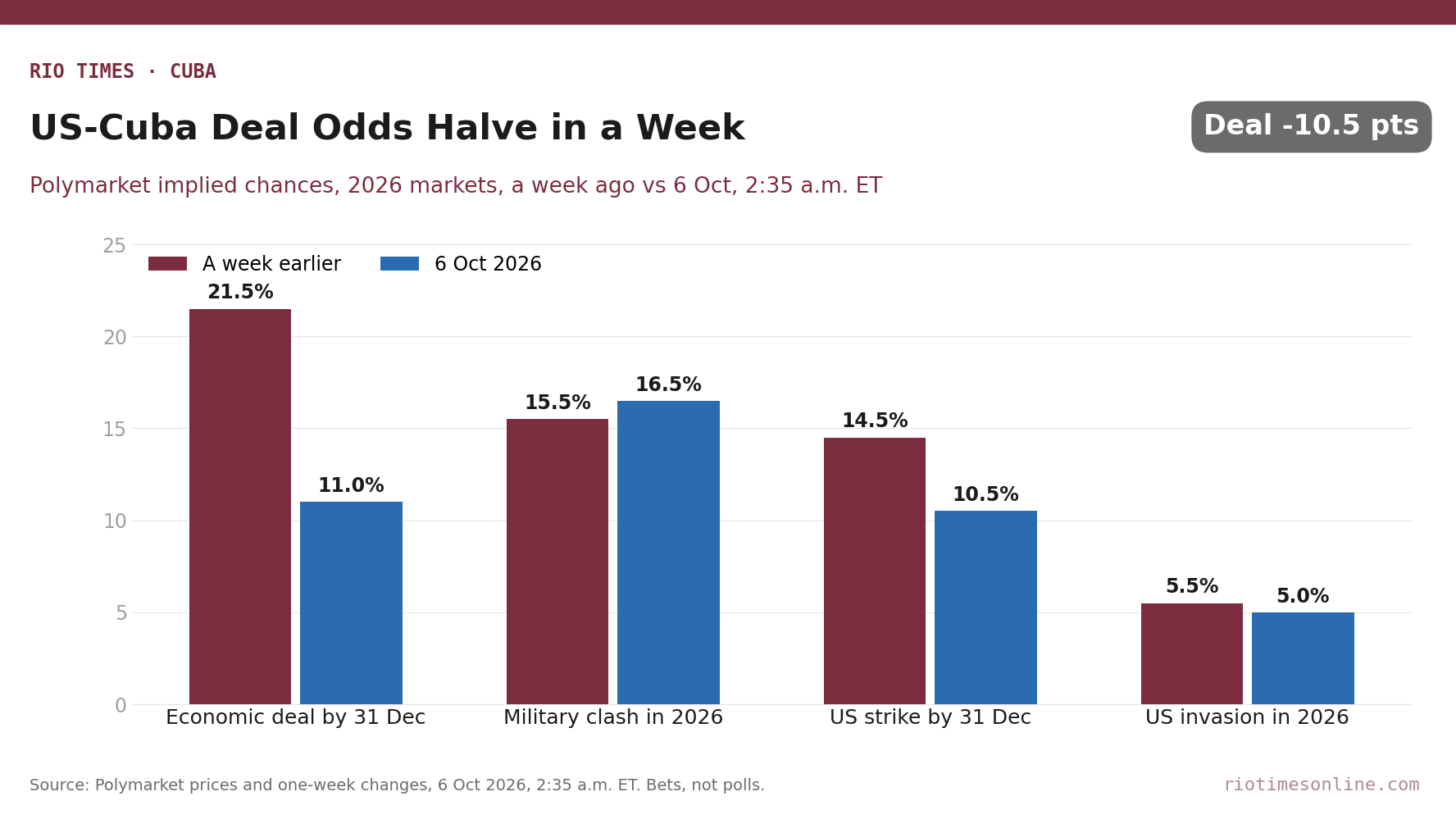
Why we show this: prediction markets turn real-money bets into a live probability that moves within minutes of the news, which is why investors, campaigns and newsrooms in the United States now follow them closely. We show them next to polls and official results, never instead of them.
Are Cuba and the United States negotiating?
Cuba says no. Its envoy in Washington says there are communication channels but no formal negotiations or agenda. The State Department says talks are ongoing.
Can Americans still travel to Cuba?
Yes, but only under authorised categories such as family visits. Tourism is banned, and since 30 September group people-to-people trips are allowed only if booked earlier.
What is Cuba’s red line?
Havana says it will not negotiate any change to its political system and rejects US demands to remove its leaders.
Sources: Cubadebate · CiberCuba · La Jornada · OFAC recent action, 29 September 2026 · Federal Register, Cuban Assets Control Regulations · OFAC FAQ 1275
This article was produced by The Rio Times’ automated newsroom system. How we use AI · Report an error · Editorial responsibility: Matthias Camenzind, Editor-in-Chief