Bolsonaro’s Party Wins 15 of Rio’s 46 Seats in Congress

ELECTIONS 2026 · BRAZIL
Runoff · Sunday, 25 October
Flávio Bolsonaro vs Lula: what happens next
First-round results, how the runoff works, the key dates and who backs whom, in one guide.
Prediction markets · who wins the runoff
Implied chance of winning Brazil’s presidency on 25 October, from traders’ prices.
Polymarket
Flávio Bolsonaro 82.5% · Lula 17.5% (US$173 million traded)
Kalshi (regulated in the US by the CFTC)
Flávio Bolsonaro 83% · Lula 18%
As of 5 October, 2:20 pm ET (19:20 Lisbon), updated every 20 minutes. Prices are bets, not polls, and can move fast.
Why we show this: prediction markets turn real-money bets into a live probability that moves within minutes of the news, which is why investors, campaigns and newsrooms in the United States now follow them closely. We show them next to polls and official results, never instead of them.
Key Facts
- —The country Brazil, Latin America’s largest economy, chose all 513 members of its lower house on 4 October. Rio de Janeiro state elects 46 of them, second only to São Paulo’s 70.
- —Why it matters Rio is home to Petrobras and most of Brazil’s offshore oil output. Its deputies help decide budgets, oil rules and trade policy from February 2027.
- —Why now The electoral court (TSE) finished the Rio count on Sunday night, with 100% of 37,675 polling sections counted by 10:22 p.m. Brasília time.
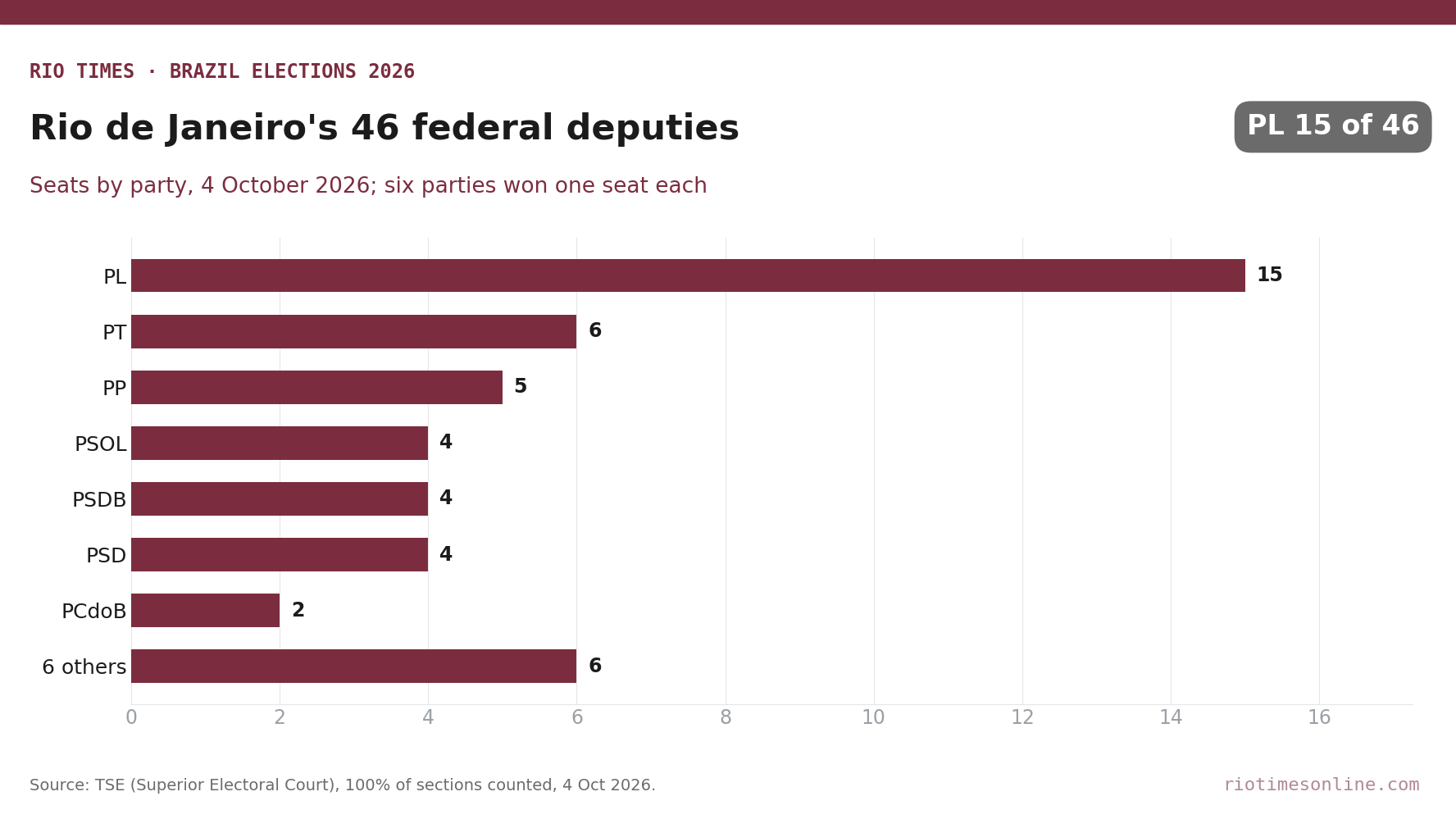
- —What happened Jair Bolsonaro’s Liberal Party (PL) won 15 of Rio’s 46 seats on 4 October, TSE figures show. Lula’s Workers’ Party (PT) came second with six.
- —The numbers The PL took 27.2% of valid votes but 32.6% of seats. Thirteen parties won seats; Dr. Luizinho (PP) topped the poll with 213,904 votes.
- —What it means for you A larger right-wing bloc from Brazil’s oil state shapes the terms any president gets on energy, tariffs and spending, which matter to US investors.
- —Still open 114,193 deputy votes for 23 candidates are held “sub judice” pending appeals (TSE, 4 October). Rulings could, in principle, move a seat between parties.
The 46 Rio de Janeiro federal deputies elected in Brazil on Sunday 4 October give the Liberal Party (PL) 15 seats, the state’s largest bloc. The PL is the conservative party of former president Jair Bolsonaro (2019–2022), chaired by Valdemar Costa Neto. For American investors, this is the delegation from Brazil’s oil state, where Petrobras has its headquarters.
President Luiz Inácio Lula da Silva’s left-wing Workers’ Party (PT), chaired by Edinho Silva, won six seats, according to final figures from the Superior Electoral Court (TSE), which runs Brazil’s elections. The new deputies take office on 1 February 2027, whoever wins the 25 October presidential runoff.
How the 46 Seats Were Shared
After the PL and the PT came the Progressistas (PP), a centre-right party chaired by Senator Ciro Nogueira, with five seats. Three parties won four each: the left-wing Socialism and Liberty Party (PSOL), a Lula ally; the centre-right Brazilian Social Democracy Party (PSDB), chaired by former Minas Gerais governor Aécio Neves; and Gilberto Kassab’s centrist Social Democratic Party (PSD).
The Communist Party of Brazil (PCdoB), a long-time partner of the PT, took two.
Six parties won a single seat: the centre-right União Brasil, the centrist Brazilian Democratic Movement (MDB), the conservative Republicanos chaired by Marcos Pereira, the centre-left Democratic Labour Party (PDT), the free-market Novo and the labour-linked Solidariedade. In all, 13 parties will represent Rio in the Chamber, the TSE results show.
Brazil elects deputies by open-list proportional representation in each state. Seats go first to parties and federations, which are formal alliances, and then to their most-voted candidates.
In Rio, the threshold for one full seat, called the electoral quotient, was 190,082 votes. Thirty-seven deputies won seats through full quotients, and nine through the leftover-seat formula.
The PL’s candidates and party label drew 2,380,229 votes, or 27.2% of the 8,743,753 valid votes. Because many small parties fell short, that share bought the PL nearly a third of the seats.
Lula’s federation of the PT, the PCdoB and the environmentalist Green Party (PV) won eight seats in total. The PT itself drew 1,068,309 votes, about 12.2% of valid votes.
Who Topped the Rio Count
Dr. Luizinho of the PP, a physician first elected to the Chamber in 2018, was the most-voted candidate with 213,904 votes. Only he and PSOL’s Rick Azevedo, a Rio city councillor with 191,371 votes, cleared the quotient on their own.
Lindbergh Farias, a former senator for the PT, came third with 181,768 votes. Luciano Vieira, who headed the PSDB list in Rio, followed with 177,887.
Altineu Côrtes, the Chamber’s first vice-president, led the PL list with 175,161 votes, ahead of party colleague Sóstenes Cavalcante, an evangelical pastor, with 170,290. Eduardo Pazuello, a retired general who was Bolsonaro’s health minister during the pandemic, was re-elected with 146,148.
On the PT side, Marcelo Freixo, former head of the federal tourism board Embratur, polled 172,969 and Anielle Franco, Lula’s former racial equality minister, 149,726. Former health minister Nísia Trindade won a seat with 67,350 votes.
Of the 46 winners, 21 were re-elected and 10 are women, CNN Brasil reported. That count was not independently confirmed against TSE candidate records.
Family Names, Near Misses and Sports Stars
The PL list carried several political heirs. Dani Cunha, daughter of former Chamber speaker Eduardo Cunha, won 116,984 votes, and Wladimir Garotinho, son of ex-governor Anthony Garotinho, won 81,797.
Not every famous name got through. Rogéria Bolsonaro, the former president’s first wife, polled 65,496 votes for the PL and finished as a substitute.
On the left, PSOL’s Tarcísio Motta, elected to the Chamber in 2022, drew 69,407 votes and also missed out. His party’s four seats went to Rick Azevedo, Talíria Petrone, Glauber Braga and Pastor Henrique Vieira, the last three all elected for PSOL in 2022.
Two sports figures won seats through the leftover formula. Former Olympic swimmer Luiz Lima (Novo) took 79,249 votes, and 1994 World Cup winner Bebeto (PP) took 52,761.
What the Result Means Before 25 October
Rio’s result mirrors the national picture, where the PL won 121 of 513 seats. Our report Brazil’s Congress: Bolsonaro’s PL Wins 121 Chamber Seats has the full national breakdown.
The balance is not one-sided, though. The PT, PSOL, the PCdoB and the PDT together won 13 Rio seats, and centrist parties hold most of the rest.
That leaves the next president needing centrist votes whichever candidate wins. Senator Flávio Bolsonaro, the former president’s eldest son and the PL candidate, and Lula meet in the presidential runoff on 25 October.
Turnout in Rio state was 76.67%, with 9,845,867 of 12,842,517 registered voters casting a ballot, against 78.92% nationally.
The governor’s race, led by the PL’s Douglas Ruas, awaits a TSE ruling on the votes of former governor Anthony Garotinho. Our earlier report: Tarcísio 62.7% in São Paulo, Rio Likely Runoff.
What It Means for You
For US investors, Rio’s bench matters because the state produces most of Brazil’s offshore oil and hosts Petrobras, whose shares trade in New York as ADRs. A large PL bloc makes it harder for any government to change oil taxes or royalty rules without bargaining.
Whoever wins on 25 October will need centrist votes to pass budgets, tax changes and trade measures, including any response to US tariffs. Markets tend to read that bargaining through the real and Brazilian bond yields.
For travellers and foreign residents, the result changes nothing in practice. Visa rules and travel to Rio are not affected, and the new Chamber only sits from February 2027.
What Is Not Known
The TSE counted 114,193 deputy votes as “annulled sub judice”, cast for 23 candidates whose registrations are under appeal. Rulings on those cases could, in principle, shift a seat between parties.
It is also unclear how Rio’s deputies will line up behind the runoff winner. Party leaders have not yet announced positions for the new legislature.
Which party won the most Rio de Janeiro federal deputies?
Jair Bolsonaro’s Liberal Party (PL) won 15 of the state’s 46 seats on 4 October, according to the TSE. Lula’s Workers’ Party won six and the Progressistas five.
Who was the most-voted candidate in Rio?
Dr. Luizinho of the Progressistas, with 213,904 votes. Rick Azevedo of PSOL came second with 191,371 and Lindbergh Farias of the PT third with 181,768.
When do the new deputies take office?
On 1 February 2027, for a four-year term. They will serve alongside whoever wins the presidential runoff on 25 October.
Sources: TSE, official results for federal deputy, Rio de Janeiro, totalled 4 October 2026; TSE, official results for governor, Rio de Janeiro; G1, list of Rio’s elected deputies; CNN Brasil; O Globo, on the Garotinho votes.
This article was produced by The Rio Times’ automated newsroom system. How we use AI · Report an error · Editorial responsibility: Matthias Camenzind, Editor-in-Chief