Brazil Elects 3 Candidates Flagged for Crime Links

POLITICS · BRAZIL
Runoff · Sunday, 25 October
Flávio Bolsonaro vs Lula: what happens next
First-round results, how the runoff works, the key dates and who backs whom, in one guide.
Prediction markets · who wins the runoff
Implied chance of winning Brazil’s presidency on 25 October, from traders’ prices.
Polymarket
Flávio Bolsonaro 87.9% · Lula 11.5% (US$180 million traded)
Kalshi (regulated in the US by the CFTC)
Flávio Bolsonaro 88% · Lula 13%
As of 11 October, 2:40 am ET (07:40 Lisbon), updated every 20 minutes. Prices are bets, not polls, and can move fast.
Why we show this: prediction markets turn real-money bets into a live probability that moves within minutes of the news, which is why investors, campaigns and newsrooms in the United States now follow them closely. We show them next to polls and official results, never instead of them.
Key Facts
- —The country Brazil held its general election on Sunday 4 October. Congress and state assemblies are settled; the presidential runoff is on Sunday 25 October.
- —Why it matters Washington has listed Brazil’s largest gang, the PCC, as a terrorist group since May. One of the winners is accused by prosecutors of ties to it.
- —Why now Folha de S.Paulo published a tally on Saturday 10 October matching flagged candidates against the final results.
- —What happened Three of 30 candidates questioned by electoral prosecutors or courts won seats: two federal deputies and one Rio state lawmaker. All deny wrongdoing.
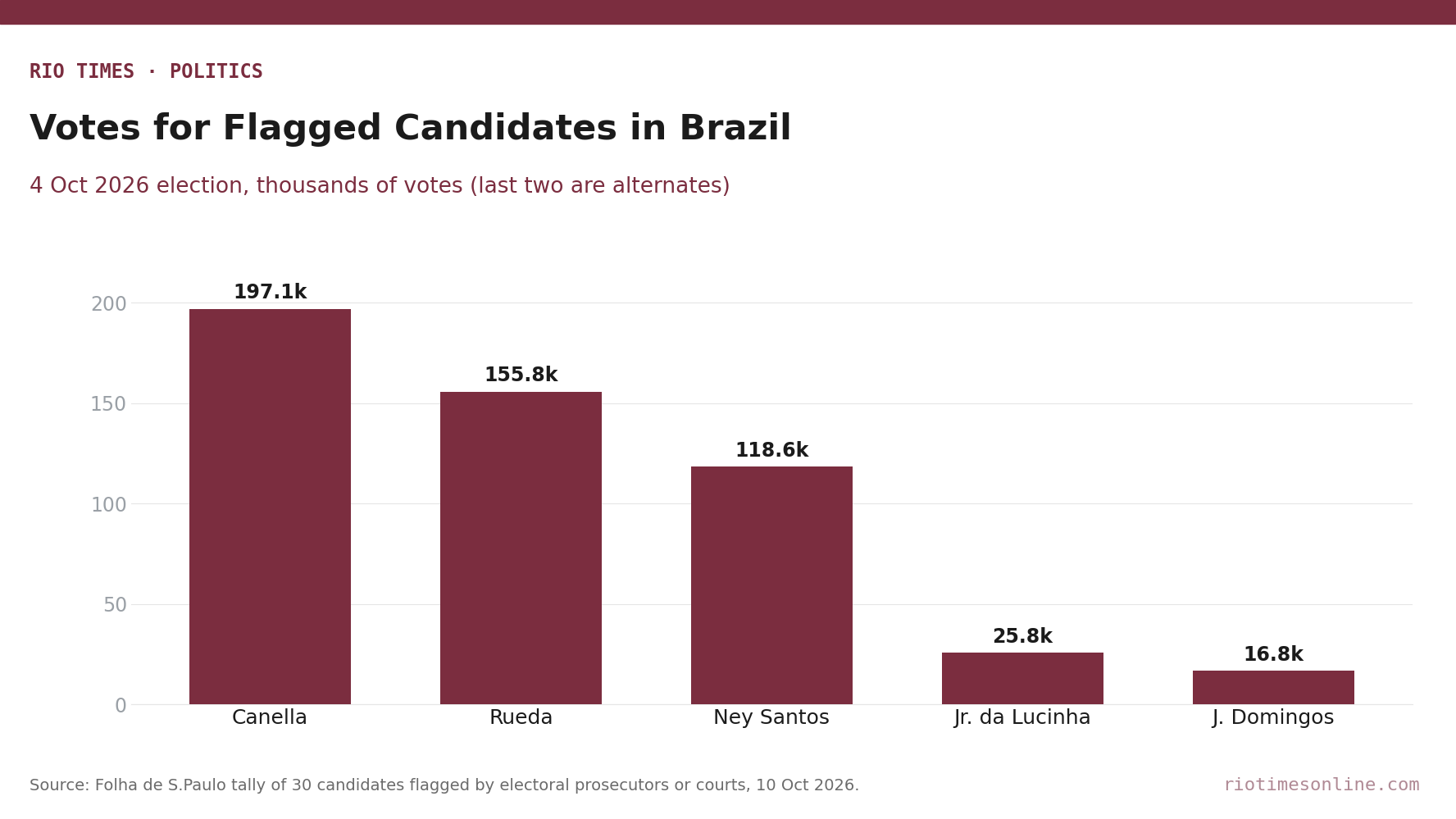
- —The numbers Márcio Canella won 197,100 votes, Antonio Rueda 155,800 and Ney Santos 118,566, according to Folha.
- —What it means for you No direct effect on travel or markets. It is a signal of how far criminal money reaches into Brazilian politics.
- —Still open The Superior Electoral Court has yet to rule on prosecutors’ appeal to bar Ney Santos from taking his seat in February 2027.
Voters in Rio de Janeiro and São Paulo elected three candidates whom Brazilian prosecutors or electoral courts had questioned over alleged organised crime links, Folha de S.Paulo reported on Saturday 10 October. Two won seats in the federal Chamber of Deputies and one in the Rio state assembly. For US readers the case matters because Washington now treats the largest of these groups, the Primeiro Comando da Capital (PCC), as a terrorist organisation.
All three deny any connection to crime. None has been convicted in the cases Folha cites, and all were cleared by the electoral courts to run.
The newspaper matched a list of 30 candidates challenged by the Electoral Prosecutor General’s office or the electoral courts against the official results of Sunday 4 October. Only three won. Two others became alternates, and the remaining 25 together drew more than one million votes.
Who Won and What They Are Accused Of
Ney Santos, whose full name is Claudinei Alves dos Santos, is a former mayor of Embu das Artes, a town in greater São Paulo. He ran for Republicanos, a centre-right party that is also home to São Paulo Governor Tarcísio de Freitas, and won 118,566 votes.
São Paulo civil police and state prosecutors investigated him over alleged links to the PCC in a scheme to launder drug money through petrol stations, Folha reported. A court ordered his arrest in 2016 and he spent time as a fugitive. The PCC is Brazil’s largest criminal faction, founded in São Paulo’s prisons.
Santos told Folha the accusations are “reheated factoids” and said investigations that began in 2010 found no evidence linking him to any criminal group and were archived by court order. His defence says the courts have always recognised his innocence for lack of evidence.
Antonio Rueda is national president of União Brasil, a large centre-right party. He won a federal seat for Rio de Janeiro with 155,800 votes. His case rests on a joint campaign with Márcio Canella rather than on accusations against Rueda himself.
Rueda’s lawyer told Folha that a candidate cannot know every ally of the people he campaigns alongside. His office said the Rio regional electoral court unanimously dismissed the accusations on Tuesday 22 September.
Márcio Canella, also of União Brasil and a former mayor of Belford Roxo in greater Rio, won 197,100 votes for the state assembly. Only Índia Armelau of the Liberal Party (PL), Jair Bolsonaro’s conservative party, did better.
According to Folha, two militia members with convictions supported Canella’s campaign. As mayor he had appointed them as municipal secretaries, even after a court ruling linked them to organised crime. His defence says he dismissed them once that ruling became final. Canella called the accusations “madness” and said he is himself threatened by militias and drug traffickers.
In July, Federal Police arrested Canella after finding a rifle in his car. Supreme Court Justice Alexandre de Moraes freed him days later under electronic monitoring. His defence says the weapon belonged to a police officer in his escort.
The Court Case That Decides One Seat
Only Ney Santos faces a live challenge to taking office. Before the vote, electoral prosecutors asked the courts to reject his candidacy. The São Paulo regional electoral court allowed him to run by a 3 to 2 vote, G1 reported, because he has no conviction confirmed on appeal. That is the threshold under the Clean Record Law.
Prosecutors appealed to the Superior Electoral Court (TSE), Brazil’s top electoral court in Brasília. The rapporteur is Justice Floriano de Azevedo Marques. As of Thursday 8 October the court had not ruled, according to G1.
In their filing, prosecutors described “solid elements” of his involvement in organised crime “with no sure signs” that it has stopped. Separately, on that same Thursday, a São Paulo appeals court unanimously overturned a 2025 conviction against him for carrying a gun with a scratched-off serial number. That ruling removes one of the cases often cited against him.
Why Washington Is Watching
On Thursday 28 May 2026, Secretary of State Marco Rubio designated the PCC and Rio’s Comando Vermelho (CV) as Specially Designated Global Terrorists. The State Department said it intended to list both as Foreign Terrorist Organisations from 5 June.
That status means US law treats material support to either group as a federal crime. It also raises the bar for banks and companies that handle Brazilian money flows.
Candidates with alleged organised crime links are not new. A separate count by the magazine piauí found 23 candidates this year investigated or formally accused of links to militias or factions, against 20 in 2022 and 10 in 2018. Thirteen of them ran in Rio de Janeiro. For more context, see our Brazil Security and Crime Explained 2026.
What It Means for You
For visitors, nothing changes. These are legislative seats, and the allegations concern finance and political alliances, not tourist areas.
For investors and compliance teams, the story is a reminder to screen Brazilian counterparties carefully, especially in fuel retail and local public contracts. The reassuring part is that Brazil’s courts and prosecutors are actively testing these candidacies rather than ignoring them. The cases also show the limits: allegations without a confirmed conviction do not stop anyone from running.
Rio’s political turbulence goes beyond this tally. Read how a court reshaped the governor’s race in Brazil Court Hands Rio to Bolsonaro’s Party in 5-2 Vote.
What Is Not Known
It is not known when the TSE will rule on Ney Santos or which way it will lean. Federal deputies take office in February 2027.
The underlying 2016 money-laundering case against him has not reached a verdict, according to piauí. The vote totals cited here are Folha’s and have not been independently checked against the electoral court’s database. None of the accusations against the three winners has been proven in court.
Frequently Asked Questions
Who are the three elected candidates with alleged organised crime links?
Ney Santos (Republicanos, São Paulo) and Antonio Rueda (União Brasil, Rio de Janeiro) won federal seats. Márcio Canella (União Brasil) won a Rio state assembly seat. All deny wrongdoing.
Can Ney Santos still be blocked from taking office?
Yes. Electoral prosecutors have appealed to the Superior Electoral Court to reject his candidacy. The court had not ruled as of 8 October.
Why does the US care about the PCC?
The State Department designated the PCC and Comando Vermelho as Specially Designated Global Terrorists on 28 May 2026 and moved to list both as Foreign Terrorist Organisations, which makes material support to them a crime under US law.
Sources: Folha de S.Paulo · G1 · piauí · US Department of State
This article was drafted with automated assistance and reviewed before publication. How we use AI · Report an error · Editorial responsibility: Matthias Camenzind, Editor-in-Chief