Argentina Races to Build Pipes Fast Enough for Vaca Muerta Oil
ARGENTINA · ENERGY
Key Facts
—The projection. Pipeline operator Oldelval expects Vaca Muerta to reach 1 million barrels of oil a day by the second quarter of 2028.
—The constraint. The story is no longer how much oil can be pumped, but how much can be shipped out; Oldelval’s capacity is fully booked from July.
—Where output stands. Argentina produces just over 850,000 barrels a day now; the energy minister has said 1 million is possible in 2026.
—The fix. A wave of pipeline projects, including the $3bn VMOS line to the Atlantic, is due to open capacity from late 2026.
—The promise. The CEO says that by 2031 Argentina will no longer face oil-evacuation bottlenecks.
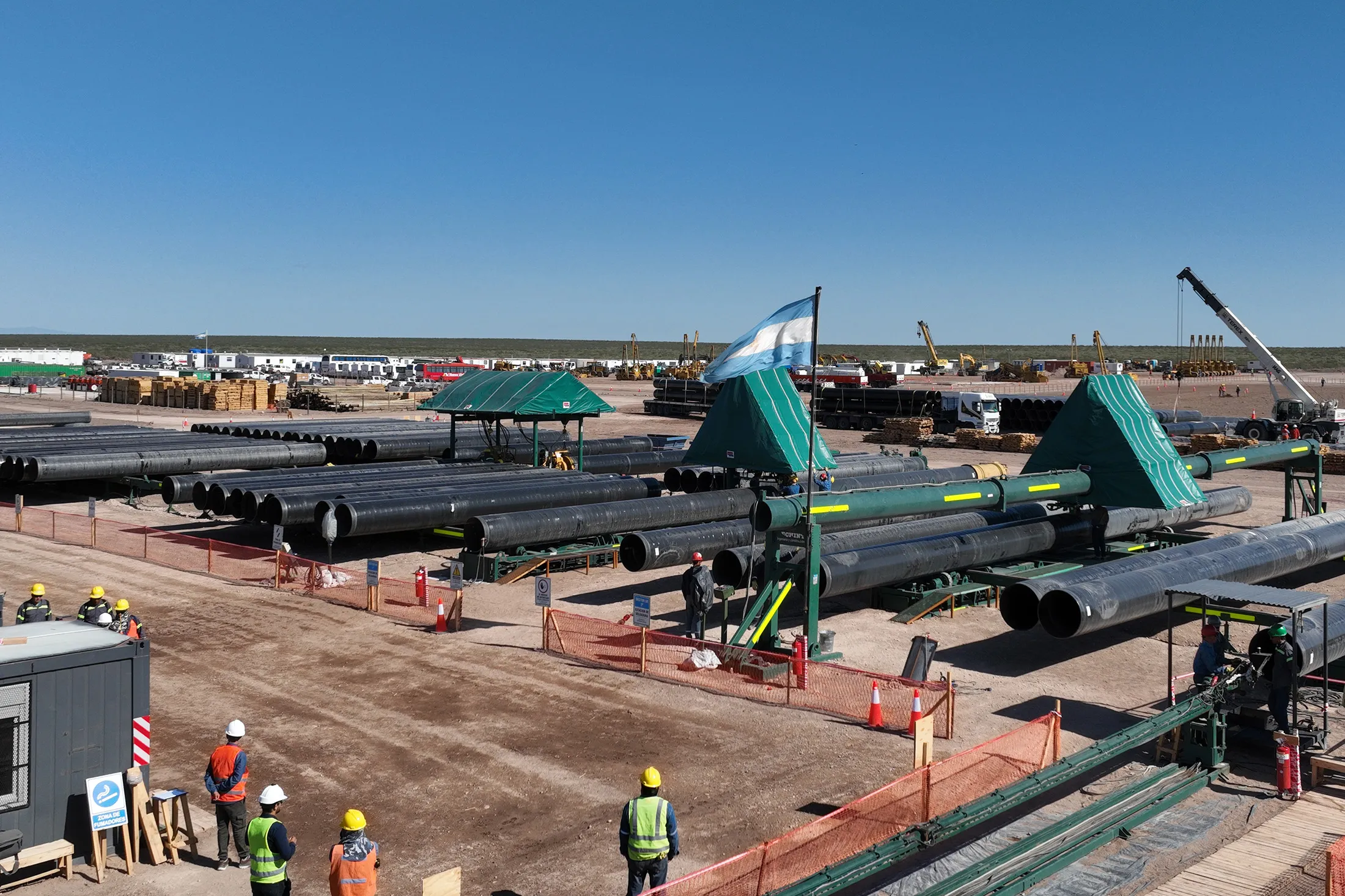
Argentina’s shale boom has flipped the central question facing its energy sector. The oil is there to be pumped; the harder problem is building enough pipe to carry it to port before the wells outrun the network.
A million barrels in sight
Vaca Muerta, the shale formation in western Argentina, is on track to produce 1 million barrels of oil a day by the second quarter of 2028, Ricardo Hösel, chief executive of the pipeline operator Oleoductos del Valle, known as Oldelval, said on June 2 at an event in Buenos Aires. The deposit, roughly the size of Belgium, has turned Argentina into a fast-growing energy producer and raised hopes it can become a major exporter.
The country currently produces a little over 850,000 barrels a day. In April, Argentina’s energy minister said national output could reach 1 million barrels as soon as 2026. Whichever timeline proves right, the formation holds the world’s fourth-largest shale-oil reserves and sits at the center of President Javier Milei’s bet on energy exports to stabilize the economy.
The real bottleneck is the pipe, not the rock
Oldelval moves crude from the Neuquén basin, where Vaca Muerta lies, to Argentina’s Atlantic export ports, and runs a $1.4bn pipeline connecting the two. That makes the company a bellwether for the sector’s true limit. As Hösel put it, the question organizing investment decisions is no longer how much can be extracted but how much can be taken out.
The warning sign is already visible: Oldelval’s transport capacity is fully booked from July. “We committed some time ago to making sure the basin would no longer face transport bottlenecks,” Hösel said, adding that by 2031 the country will have no problems with oil-evacuation capacity. The “Duplicar” project, completed in 2025, lifted the trunk corridor to the Atlantic to around 530,000 barrels a day, but rising output is closing on that ceiling.
A wave of pipelines racing the wells
Several projects are meant to open the valve. Oldelval is building bridge works to add about 200,000 barrels a day, and a new line, Duplicar Norte, awarded to Techint under a ship-or-pay contract, is designed to start at 220,000 barrels a day in late 2026 and scale to 500,000 by early 2027. The largest piece is VMOS, a $3bn, 437-kilometer pipeline from Allen to a new deepwater export terminal at Punta Colorada, financed partly by a $2bn syndicated loan from 14 international banks.
VMOS was about halfway built at the start of 2026 and is due to begin operating in December, starting near 180,000 barrels a day and rising to 390,000 in the second half of 2027. Together, the projects are meant to give the formation the network to push well past 1 million barrels a day, once the new capacity is fully online.
The risky months in between
The timetable has a tense gap. Between mid-2026, when existing capacity saturates, and December, when VMOS comes online, the basin could face several months in which what it can produce outruns what it can ship. If output reaches around 770,000 barrels a day before the new line is operating, the system would tighten again, and Oldelval has said it would need additional stopgap works to keep growth from stalling.
That makes late 2026 a hinge point. Before it, crude infrastructure runs at the edge and manages the transition; after it, with VMOS operating and Duplicar Norte ramping up, the network should comfortably outpace the wells. The projections are exactly that, projections, and depend on construction staying on schedule and the macroeconomy holding steady, both of which carry their own risks in Argentina.
Why Vaca Muerta matters beyond Argentina
For Argentina, every extra barrel that reaches the coast is foreign currency for an economy that badly needs it, and energy exports have already swung the trade balance. The Milei government is counting on Vaca Muerta to anchor its push for financial stability, which is why pipeline timetables, normally a back-office concern, have become a headline issue.
For global markets, a Vaca Muerta running near 1 million barrels a day by 2028 would make Argentina a more meaningful non-OPEC supplier at a time of geopolitical strain on oil flows. The reserves are not in doubt; the open question, as Oldelval‘s own schedule shows, is whether the steel to move them gets built fast enough.
Frequently Asked Questions
How much oil will Vaca Muerta produce?
Pipeline operator Oldelval expects 1 million barrels a day by the second quarter of 2028. Argentina currently produces just over 850,000 barrels a day nationally, and the energy minister has said 1 million is possible in 2026.
What is the main obstacle?
Transport, not geology. Oldelval’s capacity is fully booked from July, so the limit on growth is how fast new pipelines can be built to carry crude to export ports, not how much can be pumped.
What pipelines are being built?
Oldelval bridge works (about 200,000 barrels a day), the Duplicar Norte line scaling to 500,000 by early 2027, and the $3bn VMOS pipeline to the Atlantic, due to open in December 2026 and scale through 2027.
Why does it matter for Argentina?
Energy exports bring in scarce foreign currency and have already improved the trade balance. Vaca Muerta is central to President Milei’s strategy to stabilize the economy through rising energy shipments.
Connected Coverage
For more on the region’s energy and economy, see Brazil’s record oil output and Argentine firms raising record debt.
This article was produced by The Rio Times’ automated newsroom system. How we use AI · Report an error · Editorial responsibility: Matthias Camenzind, Editor-in-Chief