BRAZIL · POLITICS
Key Facts
- —The country Brazil is voting in the first round of its presidential election on Sunday 4 October 2026, with a runoff set for 25 October if no candidate wins outright.
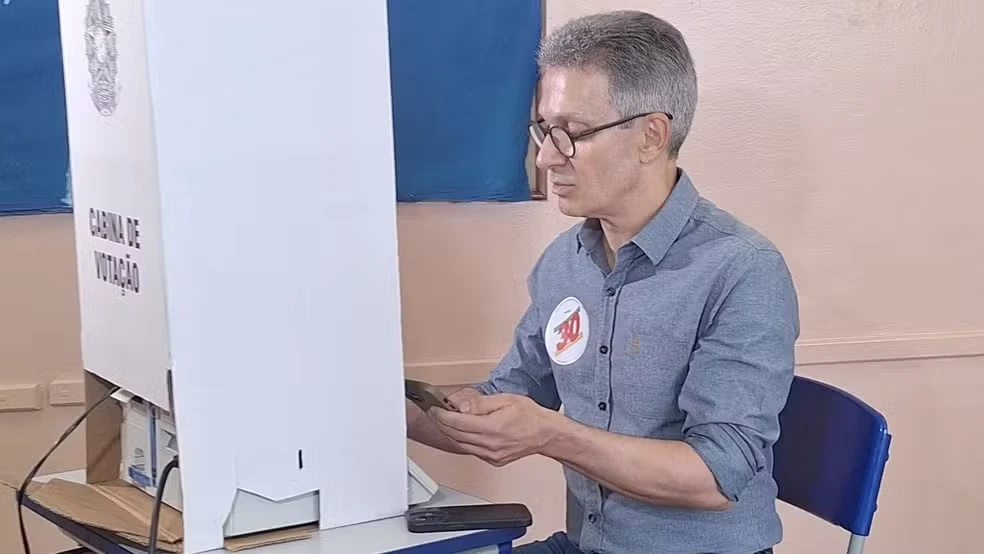
- —What happened Presidential candidate Romeu Zema, of the Novo party, voted in Araxá, Minas Gerais, with a cellphone in the booth at Escola Estadual Delfim Moreira.
- —Who is who Carlos Henrique Perpétuo Braga, president of the Regional Electoral Court of Minas Gerais (TRE-MG), said the court will look into the episode.
- —Why now Brazilian electoral law bars phones from the voting booth, and the Electoral Code sets up to two years’ detention for violating or attempting to violate ballot secrecy.
- —What it means for you The case shows how Brazil guards ballot secrecy even when the person in the booth is a presidential candidate. The Electoral Prosecutor’s Office filed an action with the electoral court on 4 October.
- —Still open The Electoral Prosecutor’s Office has filed an action, and TRE-MG is to analyse it. Whether it becomes a criminal case is open.
Presidential candidate Romeu Zema took a cellphone into the voting booth while casting his ballot in Araxá, Minas Gerais, on Sunday morning, 4 October 2026. The Regional Electoral Court of Minas Gerais (TRE-MG) says it will investigate whether the act broke electoral law.
The episode matters beyond Minas Gerais. Brazil is voting in the first round of a presidential election, and ballot secrecy is the rule that keeps votes free from pressure. A candidate breaking that rule, even by accident, draws attention to how it is applied.
Zema voted at Escola Estadual Delfim Moreira in Araxá, according to reports by Estado de Minas and other Brazilian outlets. Braga, the TRE-MG president, said the court would examine the facts. He described the use of a phone in the booth as irregular.
“First of all, the rules apply,” Braga said, according to Brazilian media reports, adding that the rules do not allow a phone in the voting booth. He called what happened “a succession of errors” and said polling-station workers are meant to prevent phones from entering the booth.
What the law says about phones in the booth
Brazil’s Electoral Law, Law No. 9,504 of 1997, Article 91-A, bars voters from carrying a mobile phone, camera or filming equipment into the voting booth. The rule targets photographs or recordings that could prove how someone voted.
That proof is what makes vote-buying and coercion possible. A voter who can show a photo of the ballot screen can be paid or pressured to vote a certain way. The phone ban is one of the safeguards against that.
The Electoral Code, Law No. 4,737 of 1965, Article 312, sets detention of up to two years for violating or attempting to violate the secrecy of the vote. Braga said the conduct can constitute a crime that carries detention. However, carrying a phone into the booth does not by itself prove that crime.
Zema says habit, court sees possible failure
Zema said he carries his phone all day and called it “almost like a finger”. He said nobody reminded him to leave it outside, so he went to vote normally. He denied photographing his ballot.
Braga did not treat the matter as only the candidate’s responsibility. He pointed to a “succession of errors” and said polling-station workers are meant to keep phones out of the booth. He also said that responsibility for any crime would need deeper investigation.
Reports differ slightly on how Zema described it. Some outlets wrote that he forgot the phone, while others quoted him on carrying it constantly. This article uses only his words as reported by Agência Brasil.
What happens next
On 4 October the Electoral Prosecutor’s Office (Ministério Público Eleitoral) filed an action with the electoral court over the episode. TRE-MG is to analyse it and decide the next procedural steps. Any criminal prosecution would still require a separate decision.
No sanction had been announced. The court has not said when the review will finish. Whether the case ends as an administrative irregularity or becomes a criminal matter is not yet known.
What it means for you
For readers in the United States, the case is a small window into how Brazil runs its vote. The country uses electronic machines nationwide, and secrecy rules are enforced at each polling station. Investors and observers following the first round will see this as a procedural story, not one that changes the count.
The outcome could still shape the debate over polling-station discipline ahead of the possible 25 October runoff. For live results and the wider picture, see our coverage of election day voting, the detentions over vote-buying and the first-round count. Our Brazil hub carries the full file.
What is not known
It is not yet clear whether the phone was used for anything, whether any photograph exists, or whether polling-station staff will face scrutiny. The court has not said whether it will refer the case to prosecutors, and no deadline has been given.
Background: Brazil Election Results 2026: Live Updates, Vote Count and Runoff Scenarios.
Background: Brazil: Split Payment, the World’s Broadest Instant Tax Collection, Will Only Be Mandatory in 2028.
Background: Fintechs and Digital Banks in Brazil 2026: Market Guide.
Frequently Asked Questions
What did Romeu Zema do in the voting booth?
He voted at Escola Estadual Delfim Moreira in Araxá, Minas Gerais, on 4 October 2026 with a cellphone in the booth. He said he did not photograph or record his vote.
Is carrying a phone into a voting booth a crime in Brazil?
Electoral law bars phones from the booth, and the Electoral Code sets up to two years’ detention for violating or attempting to violate ballot secrecy. Authorities must still decide whether secrecy was put at risk.
What did Zema say about the incident?
Zema said he carries his phone all day, “almost like a finger”, and that nobody reminded him to leave it outside. He denied photographing his vote.
Who is investigating the case?
The Regional Electoral Court of Minas Gerais, led by president Carlos Henrique Perpétuo Braga, will analyse the action the Electoral Prosecutor’s Office filed on 4 October.
Does this affect the election result?
No report reviewed suggests the episode changes the count. The investigation is a separate procedure from the election itself.
Sources: Agência Brasil, Estado de Minas, Metrópoles, Terra, Law No. 9,504/1997 and Law No. 4,737/1965 (Planalto). Retrieved 4 October 2026.
Correction — 5 October 2026: an earlier version said no charge had been announced and that the case would pass through the local electoral judge. The Electoral Prosecutor’s Office had already filed an action with the electoral court on 4 October.
This article was drafted with automated assistance and reviewed before publication. How we use AI · Report an error · Editorial responsibility: Matthias Camenzind, Editor-in-Chief