Brazil Trade Surplus Hits US$7.7 Billion in September

ECONOMY · BRAZIL
Key Facts
- —The country Brazil, Latin America’s largest economy and a top global supplier of soy, oil, iron ore, coffee and beef.
- —Why it matters Trade surpluses bring dollars into Brazil, which supports the real and the country’s ability to pay foreign debt.
- —Why now The trade ministry published September data on Tuesday 6 October, the second full month under a 25% US tariff in force since 22 July.
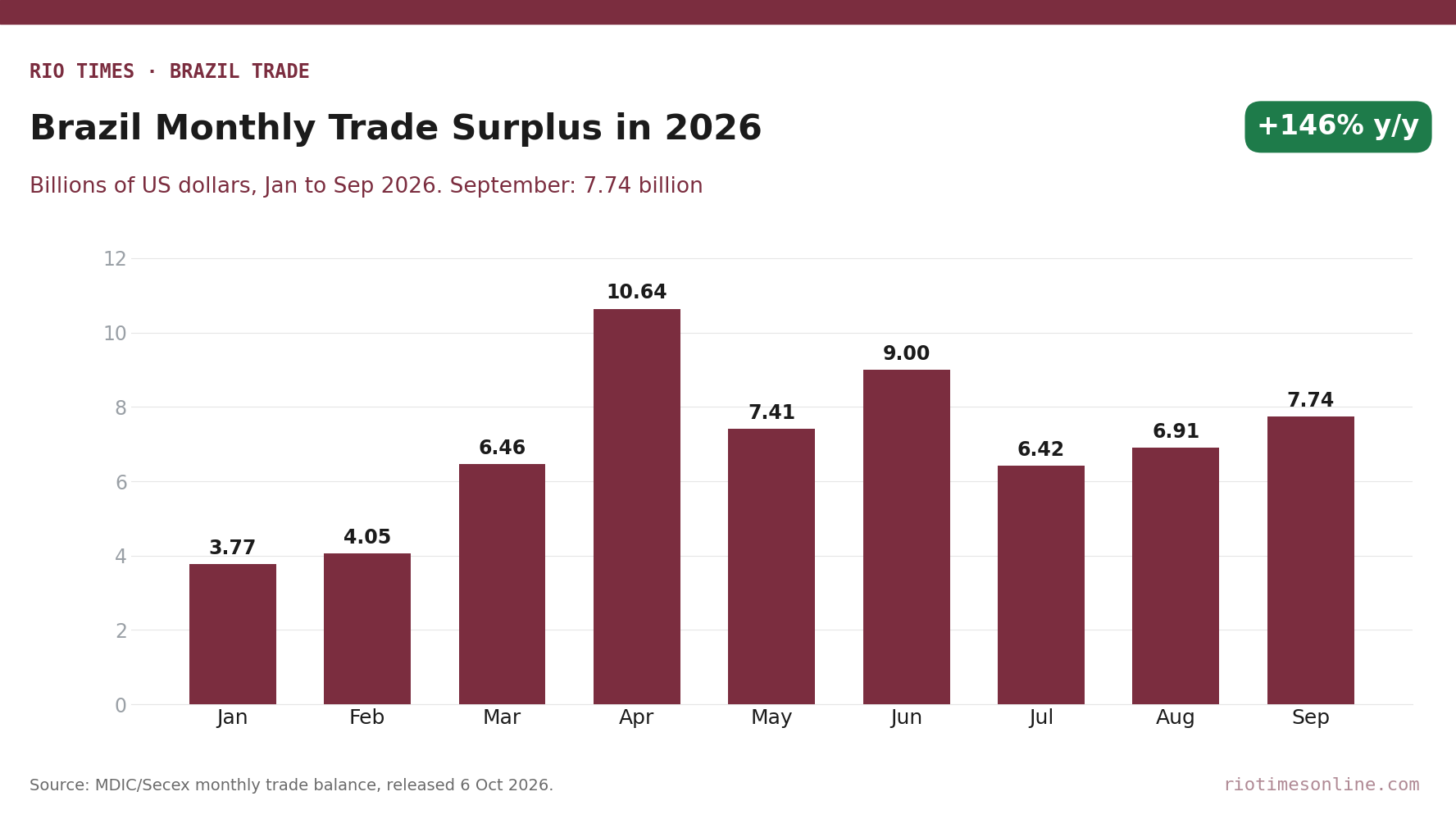
- —What happened Brazil posted a US$7.74 billion trade surplus in September 2026, up 146.4% from September 2025.
- —The numbers Exports rose 12.9% to US$34.42 billion. Imports fell 2.4% to US$26.68 billion. Exports to the US rose 31.9%.
- —What it means for you More Brazilian oil, coffee and soy is reaching buyers, including in the US, despite tariffs that raise costs for some American importers.
- —Still open The ministry cut its 2026 surplus forecast to US$84.4 billion from US$90.0 billion. Talks with Washington remain unresolved.
The Brazil trade surplus reached US$7.74 billion in September 2026, up 146.4% from a year earlier, the trade ministry said on Tuesday 6 October. Exports grew 12.9% while imports fell 2.4%.
For US readers the striking line is the United States. Brazilian sales to the US rose 31.9% to US$3.52 billion, even with a 25% American tariff in force since July.
The figures come from Secex, the foreign trade secretariat inside the Ministry of Development, Industry, Trade and Services (MDIC). It publishes the official trade balance every month.
Exports Rise as Oil and Copper Lead
Exports totalled US$34.42 billion in September, against US$30.49 billion in September 2025. Imports were US$26.68 billion, down from US$27.35 billion.
Total trade, exports plus imports, rose 5.6% to US$61.10 billion. That gives the surplus its size: sales grew while purchases from abroad cooled.
Mining and oil did most of the work. Exports from the extractive industry jumped 39.8% to US$9.44 billion. Crude oil sales rose 77.3% and copper ore 74.2%, the ministry said.
Farm exports rose 4.8% to US$7.00 billion. Soy grew 11.9% and unroasted coffee 8.7%. Manufactured goods, the largest group, gained 5.3% to US$17.67 billion, led by soymeal, fuel oil and gold.
Not everything grew. Iron ore exports fell 20.5% and fresh or frozen beef 30.6%. Sugar dropped 24.9%, corn 17.0% and passenger cars 34.3%.
The US and China Move in Opposite Directions
China remains Brazil’s biggest customer, but sales there slipped 7.6% to US$7.89 billion in September. Brazil still ran a US$0.83 billion surplus with China.
The US went the other way. Exports to the US climbed from US$2.67 billion to US$3.52 billion. Because Brazil also bought heavily from the US, it ran a US$0.91 billion deficit with the US in September.
The base matters. In September 2025 many Brazilian goods faced combined US duties of up to 50%, imposed in mid-2025 under emergency powers. In February 2026 the US Supreme Court ruled those emergency tariffs unlawful, g1 reported.
The current barrier is narrower. The Office of the US Trade Representative (USTR), the White House trade agency, imposed a 25% tariff on most Brazilian goods from Wednesday 22 July 2026 under Section 301, a US law against unfair trade practices.
USTR exempted beef, orange juice, aircraft and parts, and energy products, among others. That helps explain why crude oil could keep flowing. A separate 12.5% duty linked to forced-labour enforcement is also being contested by Brazil, g1 reported. See also Trump Tariffs Face US Court Test That Could Scrap a 12.5% Duty on Brazil.
The European Union was the month’s other big story. Sales to the bloc rose 60.1% to US$6.95 billion, while exports to Argentina fell 25.2% to US$1.36 billion.
Live Market IntelligenceBrazil — Live Market Board
Rio Times · Live Market Intelligence
Brazil — Live Market Board
-0.13%
206,646.34
-0.13%
64,975.08
+0.69%
11,139.52
+0.13%
2,897,435
+0.97%
2,596.95
+0.55%
60,220.93
+0.51%
| Instrument | Last | Change | YoY | Prev. | High | Low | Volume |
|---|---|---|---|---|---|---|---|
| IBOV | 206,646.34 | -0.13% | +21.85% | 206,911.89 | 168,310 | 167,142 | — |
| USD/BRL | 5.16 | +0.01% | -5.13% | 5.16 | 5.18 | 5.14 | — |
| SELIC | 14.00% | — | — | — | — | — | |
| PETR4 | 41.64 | -0.05% | +35.19% | 41.66 | 41.97 | 41.15 | 41,499,400 |
| VALE3 | 72.97 | +0.83% | +30.75% | 72.37 | 73.54 | 72.66 | 17,658,000 |
| ITUB4 | 38.60 | -1.03% | +4.57% | 39.00 | 39.34 | 38.39 | 29,487,800 |
| BBDC4 | 16.85 | +0.36% | +3.50% | 16.79 | 16.90 | 16.67 | 19,416,900 |
| BBAS3 | 19.37 | +0.47% | +0.73% | 19.28 | 19.44 | 19.16 | 11,069,200 |
| B3SA3 | 14.26 | -0.21% | +12.73% | 14.29 | 14.47 | 14.11 | 33,037,800 |
| ABEV3 | 14.89 | -0.80% | +21.91% | 15.01 | 15.07 | 14.81 | 16,453,100 |
| WEGE3 | 47.59 | +0.49% | +29.99% | 47.36 | 48.08 | 47.36 | 3,364,600 |
| PRIO3 | 59.14 | -0.19% | +50.67% | 59.25 | 59.81 | 58.74 | 3,325,600 |
| SUZB3 | 41.33 | +2.35% | -23.55% | 40.38 | 41.48 | 40.35 | 3,914,900 |
| RENT3 | 34.68 | -0.09% | +0.84% | 34.71 | 34.96 | 34.35 | 7,979,100 |
| AZZA3 | 15.89 | -2.63% | -53.76% | 16.32 | 16.42 | 15.82 | 1,330,300 |
| CSNA3 | 4.30 | +0.47% | -42.65% | 4.28 | 4.41 | 4.26 | 10,076,100 |
| GGBR4 | 24.69 | +2.19% | +51.38% | 24.16 | 24.85 | 24.18 | 7,047,600 |
| ENEV3 | 24.21 | -1.38% | +70.49% | 24.55 | 24.64 | 23.99 | 9,297,000 |
The Year So Far
From January to September Brazil exported US$284.65 billion, up 10.4%, and imported US$222.26 billion, up 5.0%. The nine-month surplus was US$62.40 billion, 34.8% higher than a year earlier.
Over the nine months, exports to China rose 12.0% to US$84.68 billion. Exports to the US fell 6.5% to US$27.46 billion, and Brazil’s deficit with the US reached US$4.33 billion.
The ministry also lowered its full-year outlook. It now expects a 2026 surplus of US$84.4 billion, down from US$90.0 billion in its previous forecast, against US$68.1 billion in 2025. Projected exports were cut to US$382.5 billion from US$394.4 billion.
For the August picture, see Brazil Trade Surplus Climbs in August as China Fills the US Gap.
What It Means for You
For investors, a wide Brazil trade surplus is a support for the real. It means more dollars arriving from abroad, which can cushion the currency during the run-up to the presidential runoff on Sunday 25 October.
For US importers, the data show trade adjusting rather than collapsing. Exempt goods such as crude oil keep moving, while many tariffed manufactured goods face higher costs.
For companies exposed to Brazilian commodities, the shift towards Europe and away from China in September is worth watching. One month does not make a trend.
The risk runs both ways. Brazil opened a process under its Reciprocity Law in August that could allow retaliation against US goods, g1 reported. No retaliatory measures have been announced.
What Is Not Known
The ministry’s release does not say how much of the US rebound reflects the lower tariff rate and how much reflects oil prices or one-off shipments.
It is not known whether talks between Brasília and Washington will cut the 25% tariff, or whether Brazil will use its Reciprocity Law.
The ministry did not explain in the release why it lowered its full-year forecast. Its next trade release is due on Tuesday 13 October.
Frequently Asked Questions
How big was Brazil’s trade surplus in September 2026?
Brazil posted a US$7.74 billion surplus in September 2026, up 146.4% from September 2025. Exports were US$34.42 billion and imports US$26.68 billion, according to the trade ministry.
Did Brazilian exports to the US rise despite tariffs?
Yes. Exports to the US rose 31.9% to US$3.52 billion in September, compared with a month when duties of up to 50% applied. A 25% US tariff has applied since 22 July 2026.
What is Brazil’s trade surplus forecast for 2026?
The trade ministry now expects a 2026 surplus of US$84.4 billion, down from US$90.0 billion in its previous forecast. The surplus was US$68.1 billion in 2025.
Sources: MDIC/Secex, Balança Comercial Mensal, Setembro 2026 · MDIC/Secex, monthly note (PDF) · MDIC/Secex, presentation and 2026 forecast (PDF) · USTR, Section 301 action on Brazil fact sheet · g1 · Agência Brasil
Editorial responsibility: Matthias Camenzind, Editor-in-Chief · Editorial standards · Report an error
LatAm Markets: Live Signals → — real-time movers, turnover leaders and FX across Latin America.