What submarine cables are entering and leaving Brazil?
RIO DE JANEIRO, BRAZIL – The world is connected by hundreds of submarine cables that enable Internet services in several countries, and it is no different in Brazil. According to the Submarine Cable Map portal, Brazil has 15 cables of this type, two of which have national reach, and 13 more reach other countries in the Americas, Europe, and Africa.
NATIONAL RANGE CABLES

Brazilian Festoon: The cable has a total length of 2,552 km, and its ends are located in the cities of Rio de Janeiro and Natal – however, it brings a lot of connections along the southeast and northeast regions, in capitals such as Vitória, Salvador, Aracaju, Maceió, Recife, and João Pessoa. It was built in 1996 by Embratel.
Junior: Junior is a cable built by Google in 2018. With a simpler system compared to the others, its main objective is to offer interconnections with other cables that reach countries in Latin America and the United States. Besides Santos, Junior also arrives in Rio de Janeiro.
CABLES WITH INTERNATIONAL REACH
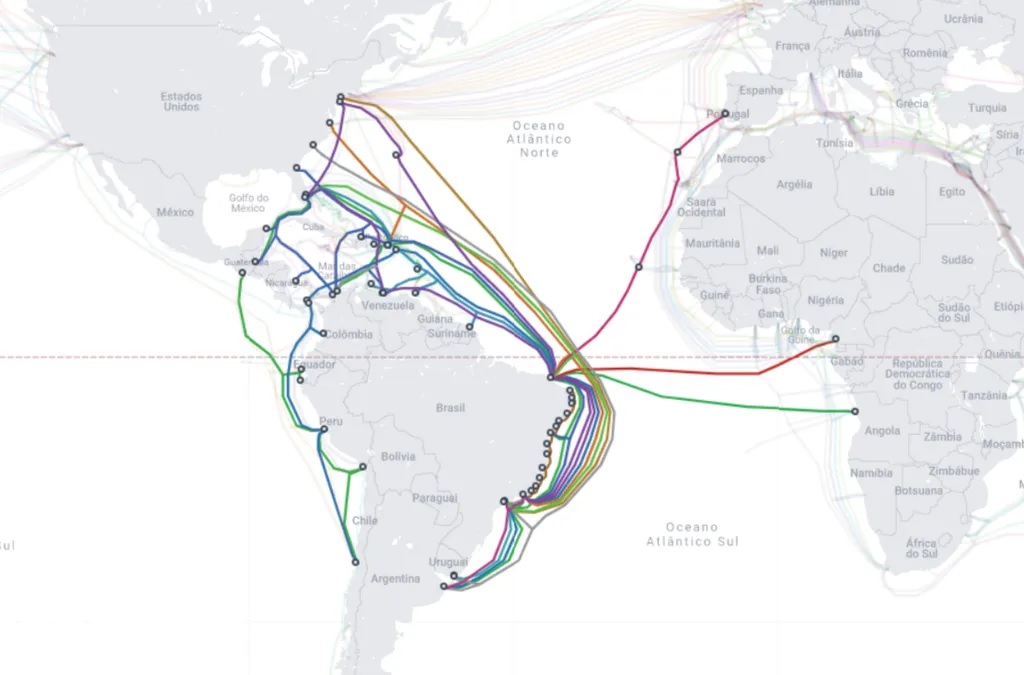
Malbec: Connects two cities in southeastern Brazil (Rio de Janeiro and Praia Grande) with Las Toninas, which is about 330 km south of the Argentinean capital of Buenos Aires. The system was inaugurated in 2021 and is managed in a co-participation model between the telephone operator GlobeNet and Meta (Facebook) – the name Malbec is inspired by the well-known variety of Argentine wines.
Seabras-1: More than 10,000 kilometers long, Seabras-1 is connected in only one place besides Praia Grande: Wall Township, which is only 86 kilometers from New York City in the northeastern United States. Its construction was completed in 2017, and its management is the responsibility of the operator Seaborn Networks and Telecom Italia Sparkle, a solutions platform belonging to the TIM group.
Monet: A 10,000 kilometers cable that connects Santos, Fortaleza, and Boca Raton – a city neighboring Miami, Florida. Its operation started in late 2017 and is the responsibility of several companies, including Algar Telecom, Angola Cables, Antel Uruguay, and Google. Its total capacity is 64 Tbps, with the primary goal of improving connectivity services between Latin America and North America.
South America-1: The system is one of the most complex among cables in Latin America since it goes around the entire continent. Its cables are more than 25,000 kilometers long, and connection points include cities like Las Toninas, Fortaleza, Boca Raton, San Juan (Puerto Rico), Barranquilla (Colombia), Punta Carnero (Ecuador), Lurin (Peru), and Valparaiso (Chile), among others. It is also one of the oldest cables in operation on the continent, active since 2001.
South American Crossing: Another cable that “embraces” South America, this cable has some connection points different from the South America-1, such as in Buenaventura (Colombia) and Colon (Panama). It is more than 20,000 kilometers long and is under the responsibility of the multinational Lumen and Telecom Italia Sparkle.
Tannat: Cable under the responsibility of Antel Uruguay and Google, it was inaugurated in 2018 and passes through the cities of Santos, Maldonado (Uruguay), and Las Toninas. It is about 2,000 kilometers long and assists in connectivity routes between the United States and key points in South America.
America Movil Submarine Cable System-1: The system is named after the Mexican telecommunications corporation and has a connection in the beach city of Cancun on the east coast of the country. Other transit points include the cities of Salvador and Fortaleza, as well as several strategic locations in Central America and the United States, such as Puerto Plata (Dominican Republic), Puerto Barrios (Guatemala), and Jacksonville (Florida, USA). It is more than 17,000 kilometers long, and its operation began in 2014 – according to information at the time, the investment reached US$500 million (R$2.5 billion).
BRUSA: As the name might suggest, BRUSA is a cable that has its two ends in Brazil and the United States, in the cities of Rio de Janeiro and Virginia Beach, respectively. More than 18,000 kilometers long, the system also passes through Fortaleza and San Juan – according to Telxius, it has a capacity of 160 Tbps, the highest recorded for interconnection in the Americas to date.
GlobeNet: The system is one of the longest in the Americas, at more than 23,000 kilometers. Launched in 2001, it also covers areas in South America, Central America, and the United States, with connections in places such as Maiquetia (Venezuela), St. Davids (Bermuda), and Tuckerton (USA). Its operation is the responsibility of the provider of the same name.
Americas-II: Cable that has the city of Fortaleza as the only Brazilian connection but constitutes a network in the northern region of South America, together with locations in Central America and the United States. With a length of a little more than 8,000 kilometers, it also reaches cities such as Cayenne (French Guyana), Port Of Spain (Trinidad and Tobago), and Holywood (Florida, USA). It has been in operation since 2000 and is under the responsibility of a total of 11 companies, which include Embratel, AT&T, and Telecom Italia Sparkle, among others.
EllaLink: With operation beginning in June 2021, EllaLink is among the newest in operation in Brazil and stands out for being one of the country’s few direct connections to Europe. Its hubs are in Fortaleza and Sines, a city located in the southern half of Portugal – however, it also passes through Madeira Island and Praia (Cape Verde).
South Atlantic Cable System: The cable was inaugurated in 2018 and has only two connection points, in the cities of Fortaleza and Sangano (Angola), but has a length of over 6,000 kilometers. It is one of Brazil’s most important links with Africa, and its management is the responsibility of Angola Cables, the country’s telecommunications company.
South Atlantic Inter Link: This cable was inaugurated in 2020 and is an important connection from Brazil to Africa, as it connects the cities of Fortaleza and Kribi (Cameroon). It is 5,800 kilometers long and managed by Cameroonian operator Camtel and China Unicom.
The following systems pass through the city of Salvador: America Movil Submarine Cable System-1, Brazilian Festoon, and South America-1 – all previously mentioned.
WHAT ARE THE SUBMARINE CABLES USED FOR?
Submarine cables are part of a complex system that links all the planet’s continents, except for Antarctica. They are the most efficient and fastest way to transmit a large amount of data and therefore enable a viable internet connection in most countries – the servers for many websites opened in Brazil are located in the United States, for example.
The cables are positioned at the bottom of the sea and represent a cheaper option than satellites that stay in Earth orbit – both in terms of installation and the periodic maintenance that needs to be carried out.
The first undersea cables were installed in the 19th century and were intended to optimize telephone services in Europe. However, with the development of communication technologies, the components gained greater capacity and today are fundamental to the functioning of the internet as it is known today.
RESPONSIBILITY FOR CABLES AND PLANS FOR THE FUTURE
In general, submarine cables are the responsibility of the various telecom operators. As their installation is usually a costly process, it is common for consortiums to be made between companies interested in the business. Usually, the agreements are made with companies in countries where the cables have connections, but this is not necessarily a rule.
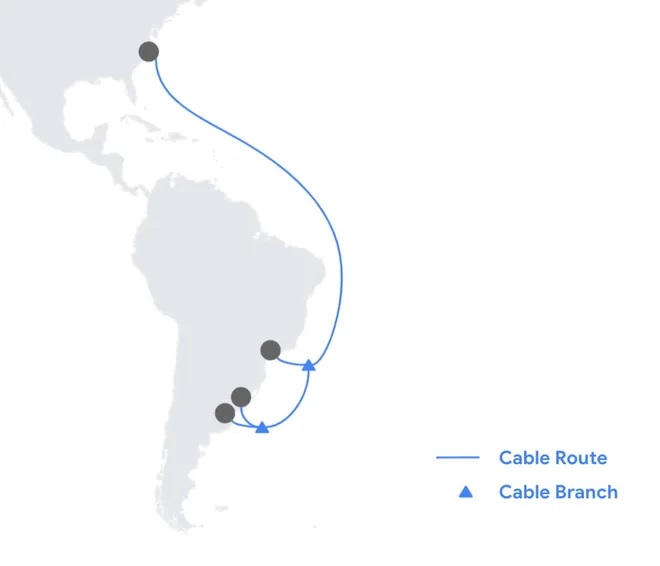
Other technology companies may also be interested in the development of submarine cable systems, as is the case of Meta (Facebook) and Google – the search giant has already been responsible for the construction of several structures and is already planning the implementation of another cable off the Brazilian coast, the Firmina.
According to information released by the company in June last year, Firmina will be the longest cable on the planet among those that can operate with only one power source located at one end – which can be very useful in case the other side has a temporary interruption, for example.
Firmina will pass through the cities of Las Toninas, Punta del Este, and Praia Grande, and then reach the East Coast of the United States, in Sunny Isles, Jacksonville, Myrtle Beach, Virginia Beach, and Wall Township. Therefore, it should consolidate itself as another alternative connection between South America and North America to provide “faster and low latency access to services such as Gmail or YouTube,” according to Google.
Its inauguration is scheduled for 2023, and the system’s name is a tribute to Maria Firmina dos Reis, considered the first Brazilian novelist.
More: Brazil news in English, every day from The Rio Times.
Editorial responsibility: Matthias Camenzind, Editor-in-Chief · Editorial standards · Report an error
LatAm Markets: Live Signals → — real-time movers, turnover leaders and FX across Latin America.