
GUIDES · LATIN AMERICA
Key Facts
- —Latin America Sloths live only in the tropical forests of Central and South America. Costa Rica and Panama both have wild sloths in national parks and forests open to visitors.
- —Two families Two-toed sloths (genus Choloepus) and three-toed sloths (genus Bradypus). Both are tree-dwelling mammals that eat mainly leaves.
- —Species Seven living species are assessed on the IUCN Red List as of October 2026: five three-toed and two two-toed.
- —Most at risk The pygmy three-toed sloth of Panama’s Isla Escudo de Veraguas is Critically Endangered. Both maned sloths of Brazil are Endangered (IUCN, October 2026).
- —Energy Three-toed sloths have the lowest field metabolic rate recorded for any mammal, per a 2016 University of Wisconsin-Madison study.
- —Ethical viewing Look, do not touch. Costa Rica’s government has run the #StopAnimalSelfies campaign against photos with wild animals since 2019.
What is a sloth? It is a slow, leaf-eating mammal that spends almost its whole life hanging in the trees of Central and South America.
For US travellers, sloths are a highlight of trips to Costa Rica and Panama.
Sloths are also a focus of Costa Rica’s campaign against wildlife selfies. This guide covers the two families, why sloths are slow, where each species lives and how to watch them without harm.
Figures come from the IUCN Red List, the Smithsonian, peer-reviewed university research and official park agencies.
What Is a Sloth, in Plain Terms
A sloth is a tree-dwelling mammal of the order Pilosa, the group it shares with anteaters. Living tree sloths are the last members of Folivora, a once much larger group of sloths that is otherwise extinct.
The two surviving lines are small, between roughly 2 and 8 kilograms (about 4.4 to 17.6 lb).
Sloths hang upside down from branches with long, curved claws. The Smithsonian’s National Zoo gives claw lengths of 8 to 10 centimetres (3 to 4 inches) for Linnaeus’s two-toed sloth.
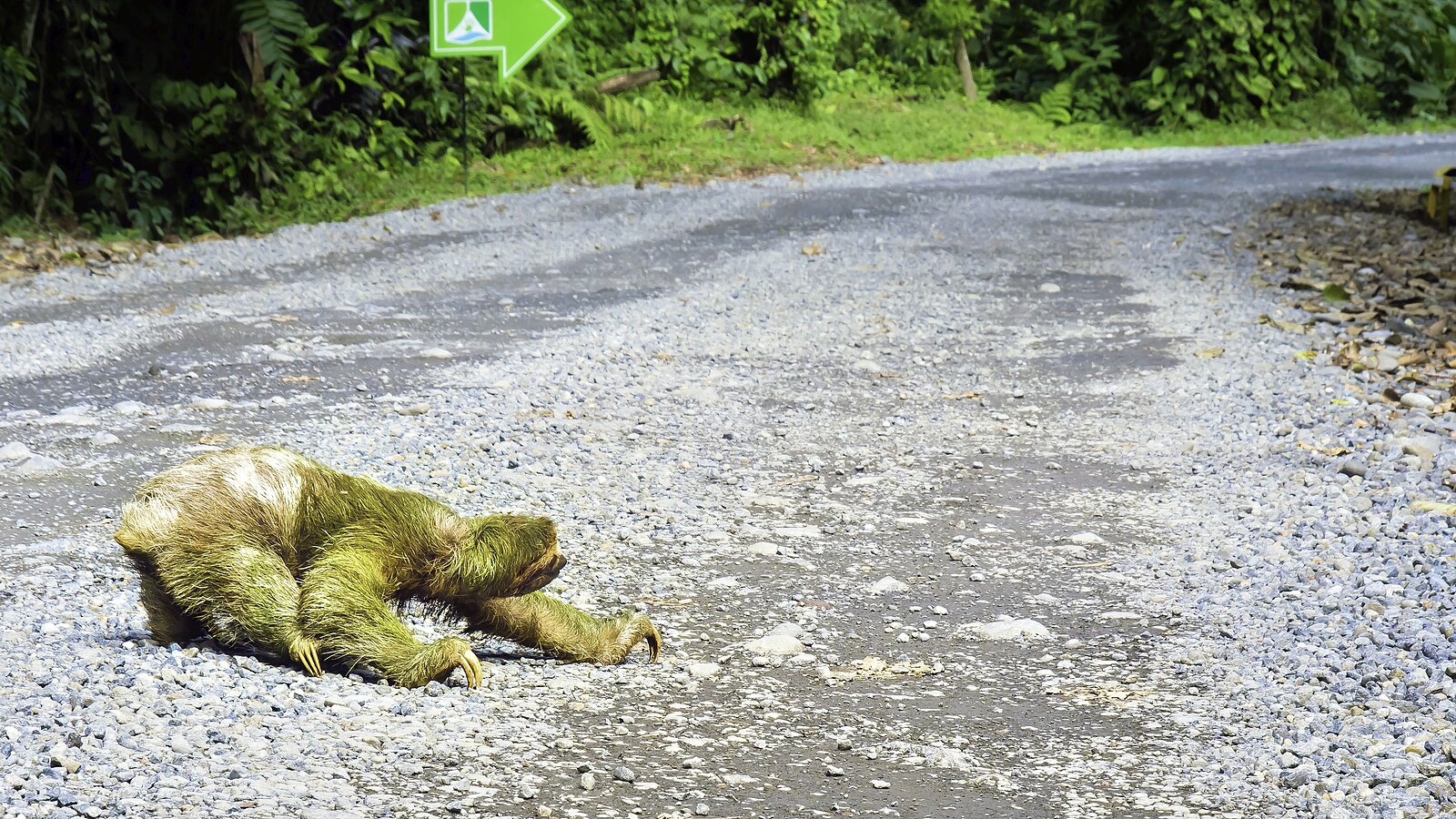
They eat, sleep, mate and give birth in the canopy, coming down mainly to defecate or to reach another tree.
The name “two-toed” or “three-toed” refers to the number of clawed fingers on the front limbs. All sloths have three toes on their hind feet.
In Spanish, sloths are called perezosos, and in Portuguese preguiças.
Two-Toed and Three-Toed Sloths Are Two Different Families
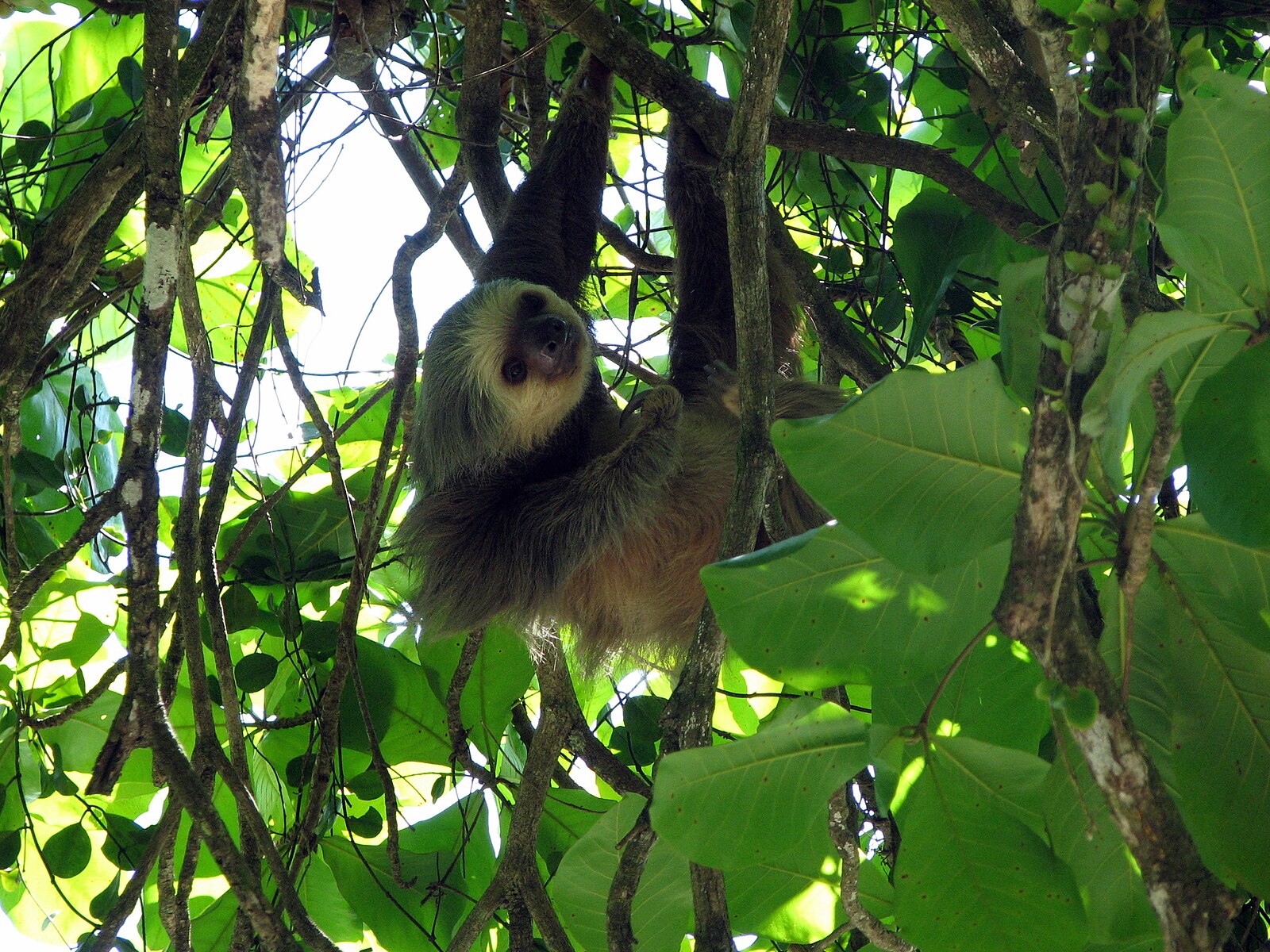
The two kinds of sloth look alike but are not close relatives. Three-toed sloths form the family Bradypodidae, with a single genus, Bradypus.
Two-toed sloths belong to the genus Choloepus, which the Smithsonian places in the family Megalonychidae.
That placement is debated: a 2019 study of ancient collagen proteins in Nature Ecology & Evolution grouped Choloepus with the extinct Mylodontidae instead. The same study paired three-toed sloths with the extinct giant ground sloth Megalonyx.
Visitors can tell the two apart in the field. Two-toed sloths are generally larger and mostly active at night.
Three-toed sloths are smaller and are often seen moving by day.
- Two-toed (Choloepus): two front claws, mostly nocturnal, eats leaves, fruit and shoots and occasionally insects or eggs (Smithsonian). Usually five to eight neck vertebrae in Hoffmann’s two-toed sloth (University of Michigan Animal Diversity Web).
- Three-toed (Bradypus): three front claws, active by day and night, a stricter leaf diet tied to Cecropia trees. About 10 neck vertebrae, letting the brown-throated sloth turn its head up to 270 degrees (Animal Diversity Web).
Seven Sloth Species and Their IUCN Status
The IUCN Red List, the global reference on extinction risk, assesses seven living sloth species as of October 2026. Four are listed as Least Concern, two as Endangered and one as Critically Endangered.
- Brown-throated three-toed sloth (Bradypus variegatus): Least Concern. The common three-toed sloth of Costa Rica and Panama, ranging from Honduras into South America.
- Pale-throated three-toed sloth (Bradypus tridactylus): Least Concern. A South American species.
- Pygmy three-toed sloth (Bradypus pygmaeus): Critically Endangered. Found only on Isla Escudo de Veraguas, an island off Panama’s Caribbean coast.
- Northern maned sloth (Bradypus torquatus): Endangered. Lives in Brazil’s Atlantic Forest.
- Southern maned sloth (Bradypus crinitus): Endangered. Also from Brazil’s Atlantic Forest, and recognised as a separate species in recent years.
- Hoffmann’s two-toed sloth (Choloepus hoffmanni): Least Concern. The two-toed sloth of Costa Rica and Panama.
- Linnaeus’s two-toed sloth (Choloepus didactylus): Least Concern. Lives in northern South America, including parts of Brazil and Peru.
The pygmy sloth was first described by Smithsonian researchers in 2001. A June 2015 Smithsonian release says it is about 40 percent lighter and 15 percent shorter than the mainland brown-throated sloth.
The island covers about 430 hectares (about 1,060 acres).
A 2012 survey published in PLOS One counted 79 pygmy sloths, 70 of them in the island’s small mangrove thickets. A later radio-collar study, led by former Smithsonian fellow Bryson Voirin, found they also use the forested interior.
He put the likely total between 500 and 1,500 animals.
Why Sloths Move So Slowly
Slowness is a strategy, not a defect. Leaves are poor in energy and hard to digest, so sloths save energy at every step.
University of Wisconsin-Madison researchers reported in 2016 that three-toed sloths have the lowest field metabolic rate recorded for any mammal.
The Smithsonian puts the metabolic rate of Linnaeus’s two-toed sloth at 40 to 45 percent of what its body weight would predict. Its body temperature runs from 30 to 34°C (86 to 93°F), dropping at night, in wet weather and at rest.
Its muscles weigh about half as much, relative to body size, as those of most land mammals.
The Wisconsin team found three-toed sloths let their body temperature swing more than two-toed sloths do, and they move less. That trade-off lets them live on a diet few other mammals could survive on.
The Smithsonian notes that two-toed sloths sleep about 15 hours during the day.
Diet, Digestion and Life in the Trees
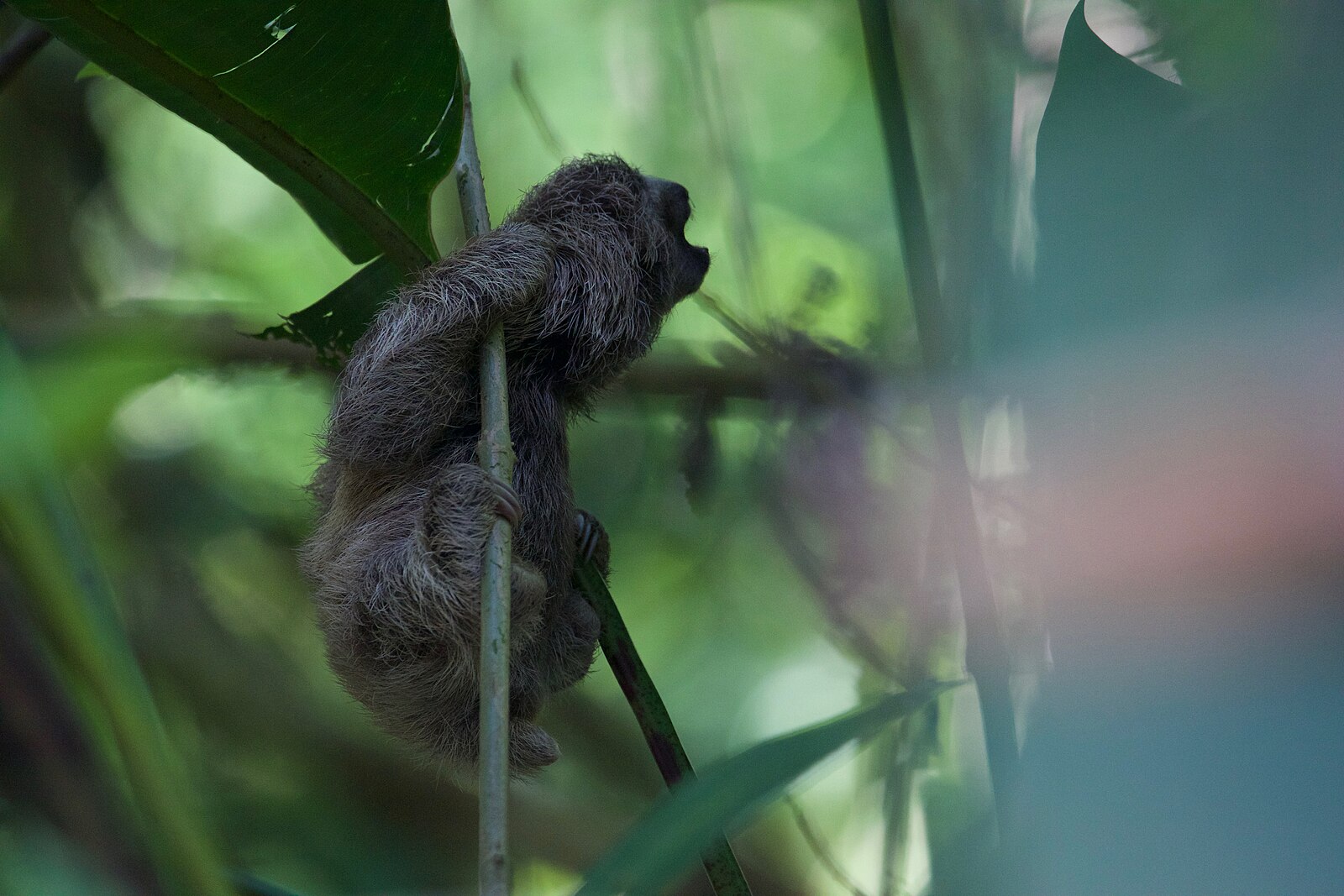
Sloths eat mostly leaves, plus buds, shoots, flowers and fruit. Their teeth grow throughout life and are worn down by plant material.
They get most of their water from food and from licking dew, according to the Smithsonian.
Digestion is extremely slow: in Linnaeus’s two-toed sloth, food stays in the gut for about one month. The animal defecates about once a week at the base of a tree. Coming down is risky, because predators such as harpy eagles and jaguars hunt sloths.
A 2014 University of Wisconsin-Madison study in Proceedings of the Royal Society B explained why they take that risk. Moths in sloth fur lay eggs in sloth dung, and the adults return to the fur and enrich it with nutrients.
Those nutrients feed algae, and the sloths eat the algae from their own coats.
Three-toed sloths carried more moths and more algae than two-toed sloths in that study. The algae also give their fur its greenish tint, which helps them hide in the canopy.
Sloths are, unexpectedly, capable swimmers, and they reproduce slowly, usually with one baby at a time.
Where Sloths Live in Latin America
Sloths live only in the Neotropics, from Honduras to Brazil, Bolivia and Paraguay. They are strictly tree-dwelling, so they depend on continuous forest.
Two species are widespread in Costa Rica and Panama, and Panama also has the pygmy sloth.
The brown-throated three-toed sloth ranges from Honduras through Panama into South America, up to 2,400 metres (about 7,900 feet). Hoffmann’s two-toed sloth lives in two separate populations.
One spans Central America and north-western South America, the other lies east of the Andes in Ecuador, Peru, Bolivia and western Brazil.
Brown-throated sloths depend heavily on Cecropia trees. A 2019 study in Costa Rica linked Cecropia density to adult survival and to the number of young.
It also found that regenerating, previously disturbed forest can still support viable sloth populations.
Habitat loss is the common pressure. The Smithsonian lists rainforest logging, hunting for meat and trafficking as threats to two-toed sloths.
For the pygmy sloth, the 2015 Smithsonian release warned of tourism development proposals and unregulated tree cutting on its island.
Where to See Sloths in Costa Rica and Panama Ethically
The best sloth sightings are of wild animals in protected forest, seen through binoculars. A local naturalist guide spots far more than a visitor alone, because a resting sloth looks like a clump of leaves.
Never touch, feed, hold or photograph yourself with a sloth.
Costa Rica
- Manuel Antonio National Park: a central Pacific park created in 1972. Costa Rica’s park service, SINAC, lists two- and three-toed sloths among its most notable animals, out of 109 mammal species, and forbids feeding wildlife. As of October 2026 the park opens 7:00 a.m. to 3:00 p.m. and closes on Tuesdays.
- Sloth Sanctuary of Costa Rica: a rescue centre on the Estrella River on the Caribbean side. Its rescue work began in 1992 and it was authorised as a rescue centre in 1997. Its stated mission is rescue, rehabilitation, research and, when possible, release.
- Toucan Rescue Ranch: a rescue centre in San Josecito, Heredia, near San José. It releases rehabilitated sloths in Sarapiquí with The Sloth Institute of Costa Rica. Each release is decided with the environment ministry, MINAE.
Costa Rica’s government launched #StopAnimalSelfies in 2019 with civil society groups and tourism companies. The campaign targets photos that show direct contact with wild animals and calls them cruel.
Tours that offer sloth holding or cuddling should be avoided.
Panama
Barro Colorado Island, in Gatún Lake in the middle of the Panama Canal, is run by the Smithsonian Tropical Research Institute (STRI). STRI calls it the most studied tropical forest in the world, with 110 mammal species.
Its laboratory opened in 1924 and passed to the Smithsonian in 1946.
Day visits must be booked in advance and leave by boat from Gamboa. Visitors must be 12 or older, and the foreign adult rate is US$125, according to STRI as of October 2026.
The pygmy sloth’s island lies in the Ngäbe-Buglé Indigenous territory, and the 2015 Smithsonian release called it only nominally protected.
What It Means for US Readers
Travellers: Choose national parks and accredited rescue centres, hire licensed guides and skip any business offering sloth holding. Drive slowly in forest areas, because sloths cross roads.
Sloths in the United States: Sloth World, an Orlando attraction that never opened, imported sloths from Guyana and Peru. Florida’s wildlife agency (FWC) says 31 of them died in December 2024 and February 2025. In July 2026 it said investigators found no evidence of neglect or abuse that would support criminal charges.
Researchers and donors: Much of what is known about sloths comes from US institutions, including the Smithsonian and the University of Wisconsin-Madison. The National Zoo in Washington says its last Amazonia exhibit sloth lived to about 49, the oldest sloth on record.
Connected Coverage
Costa Rica Ecotourism Explained: Parks, Forest Payments and 2.9 Million Visitors
Fer De Lance Snake Facts and Safety Tips
Costa Rica Travel Costs 2026 for US Visitors
What Is Not Known
How many sloths exist. There are no reliable population counts for most species, and the IUCN ratings rest on range and habitat trends rather than censuses.
For the pygmy sloth, figures run from 79 animals counted in 2012 to a high-end estimate of almost 3,200.
Where two-toed sloths sit on the family tree. Museum classifications still place them in Megalonychidae, while protein and DNA studies point elsewhere.
The answer matters for science, not for visitors.
How large the illegal sloth trade is. The Smithsonian names trafficking as a threat.
No official figure shows how many wild sloths are taken each year for pets or photos.
Frequently Asked Questions
What is a sloth?
A sloth is a slow, leaf-eating mammal that lives almost entirely in the trees of Central and South America. It belongs to the order Pilosa, with anteaters. Seven living species are assessed on the IUCN Red List as of October 2026.
What is the difference between two-toed and three-toed sloths?
They belong to different families. Three-toed sloths (Bradypus) are smaller, often active by day and eat a stricter leaf diet. Two-toed sloths (Choloepus) are larger, mostly nocturnal and also eat fruit and shoots. Both have three toes on their hind feet.
Why are sloths so slow?
Their leaf diet gives very little energy. A 2016 University of Wisconsin-Madison study found three-toed sloths have the lowest field metabolic rate recorded for any mammal. They also let their body temperature drop to save energy.
Are sloths endangered?
Some are. The pygmy three-toed sloth of Panama is Critically Endangered, and both maned sloths of Brazil are Endangered. The other four species are listed as Least Concern by the IUCN as of October 2026.
Where can I see sloths in Costa Rica?
Manuel Antonio National Park lists two- and three-toed sloths among its most notable animals. Rescue centres such as the Sloth Sanctuary of Costa Rica and Toucan Rescue Ranch rehabilitate and release sloths. A licensed guide with binoculars helps most.
Can you hold a sloth in Costa Rica?
You should not. Costa Rica runs the #StopAnimalSelfies campaign, launched in 2019, against photos showing direct contact with wild animals. Feeding wildlife is forbidden in Manuel Antonio National Park.
Sources: IUCN Red List categories, as published through the GBIF species API; Smithsonian’s National Zoo, two-toed sloth; Smithsonian, pygmy sloth release (2015); Pauli et al., The American Naturalist (2016); Pauli et al., Proceedings of the Royal Society B (2014); Garcés-Restrepo et al., Proceedings of the Royal Society B (2019); Kaviar et al., PLOS One (2012); Presslee et al., Nature Ecology and Evolution (2019); University of Michigan Animal Diversity Web; SINAC, Manuel Antonio National Park; Costa Rica Silvestre, #StopAnimalSelfies; STRI, Barro Colorado Island; Sloth Sanctuary of Costa Rica; Toucan Rescue Ranch; Orlando Shine, FWC findings on Sloth World; Florida Today, sloth deaths and import ban. All accessed 13 October 2026.
This article was produced by The Rio Times’ automated newsroom system. How we use AI · Report an error · Editorial responsibility: Matthias Camenzind, Editor-in-Chief
Expat Guide to Costa Rica
What The Rio Times publishes for foreigners who live in or move to Costa Rica.
Start here
- Fer De Lance Snake Facts and Safety Tips
- Best Places to Live in Costa Rica for Expats 2026
- Costa Rica Income Tax Bill Would Charge Residents 15% on Five Kinds of Foreign Investment Income
- Costa Rica Permanent Residency and Citizenship: How the Rules Work
City guides
Coming up in Costa Rica
- Humbe Plays Parque Viva in Costa Rica on 18 October 18 Oct
- The Rasmus play San José on 20 October 20 Oct
- Rosario Flores brings Gira 2026 to San José 24 Oct
- Reggae giants Cultura Profética play Belén 25 Oct 25 Oct
Understand Costa Rica