Venezuela Is Printing Cash Again, and It Still Adds Up to US$4.47 a Head

VENEZUELA · ECONOMY
Key Facts
Notes in circulation: 1.94 billion pieces at the end of August 2026, according to the Central Bank of Venezuela’s own statistical file.
Growth: the circulating cone rose from 990.2 million notes in January to 1,391.2 million in August — up 40.5 percent in seven months.
Total value: 99.4 billion bolívares, or about US$125.0 million at the BCV’s own rate of 794.9917 per dollar on 31 August — down from US$148.7 million in January, when the circulating cone was 29 percent smaller.
Per person: roughly US$4.47 for each of Venezuela’s some 28 million inhabitants, and about 50 notes of the current cone — 69 if the frozen old-cone pieces are counted too.
Largest note: 500 bolívares, worth 63 US cents.
Dead weight: 547.9 million of the notes counted are 500,000 and 1,000,000 bolívar pieces from the previous cone. The figure has not moved once this year. Together they are worth about US$500,000.
Venezuela is putting banknotes back into circulation at a pace it has not shown all year. It is losing anyway: the circulating note family is forty percent larger than in January, and in dollars the country’s entire stock of cash is worth sixteen percent less.
The Central Bank of Venezuela does not announce how much cash it prints. It publishes a spreadsheet. The file, updated monthly and buried three clicks deep in the statistics section of its website, is the only public count of how many banknotes exist in a country where physical money all but disappeared. It measures notes in circulation, and its own footnote says the figure includes cash held by the public and by the banks. It is not a record of how much the mint prints, and a rise can mean notes leaving central bank vaults as much as new ones being made.
The August 2026 edition, downloaded by The Rio Times on 5 September, shows the note supply expanding faster than at any point recorded in the file, which covers the months of this year.
At the end of August there were 1,939.1 million banknotes in circulation. Of those, 1,391.2 million belong to the current cone — the 5 to 500 bolívar notes people actually use. In January the figure was 990.2 million. That is an increase of 40.5 percent in seven months, and it was front-loaded: 125 million notes were added in March alone, 76 million in April and 67 million in July, before the pace fell back to 19 million in August.
Printing the Big Notes
The growth is not spread evenly, and where it is concentrated says more than the headline figure.
The two smallest denominations have not moved at all. The 5-bolívar note has stood at 80.5 million pieces every month this year; the 10 at 200.0 million. Together they are 280.5 million notes — a fifth of the circulating cone — and the central bank has not added a single one since at least January. At 794.99 bolívares to the dollar, a 5-bolívar note is worth six-tenths of a US cent.
Everything above that has grown, and most of the growth is at the top of the range. The 100-bolívar note went from 152.0 million pieces in January to 318.6 million in August, a rise of 110 percent. The 500 — the largest note Venezuela issues — more than doubled, from 27.0 million to 57.3 million. The 50 rose 73 percent.
The pattern — small denominations flat, growth concentrated in the largest notes — is the one central banks typically show under high inflation. The 100 and the 500 together now carry 60.5 billion bolívares of the 99.4 billion in circulation — 61 percent of the face value on 27 percent of the notes of the current cone.
Forty Percent More Notes, Sixteen Percent Less Money
And the effect of it, measured in dollars, has been negative.
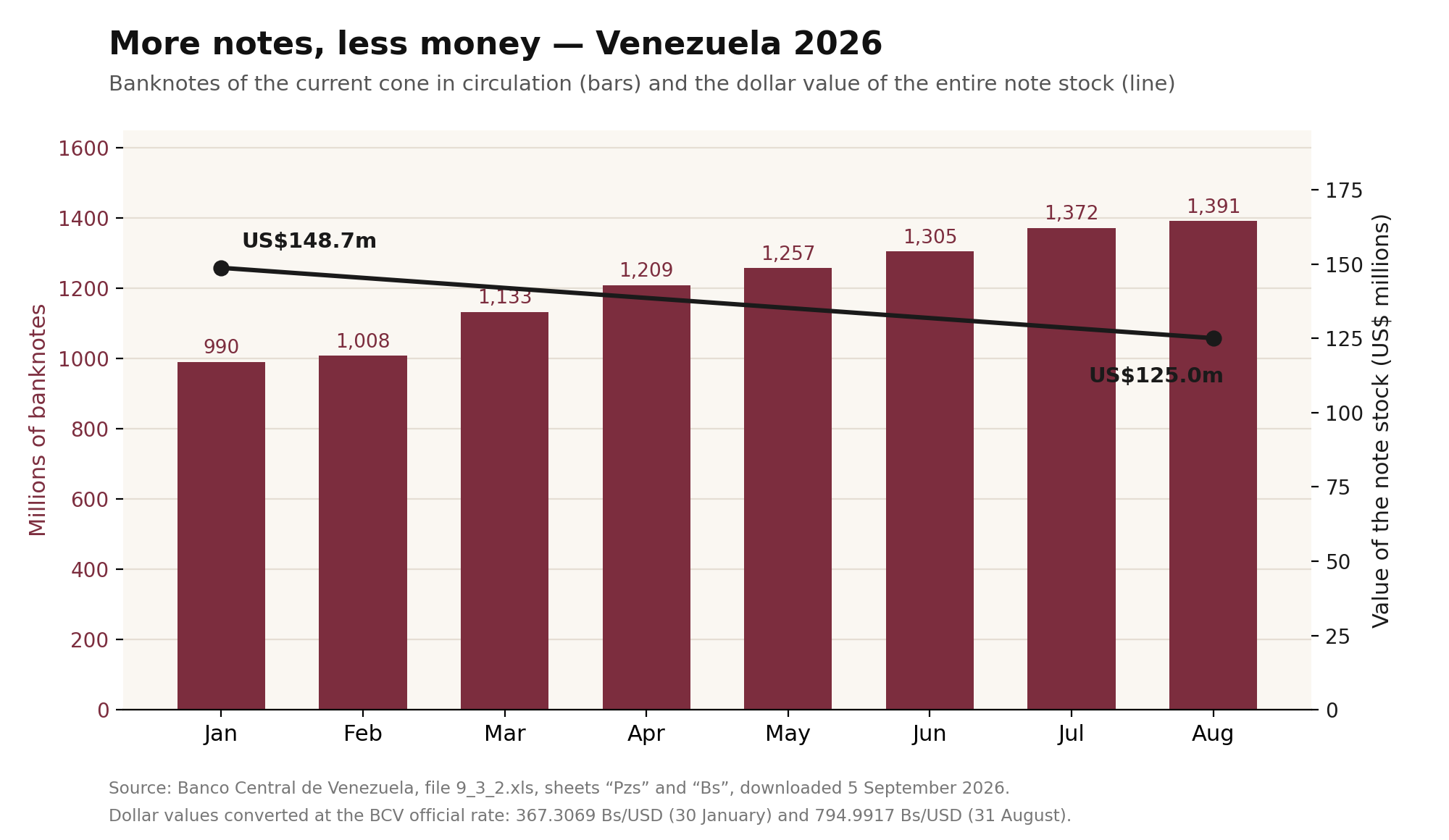
The 99.4 billion bolívares in notes convert, at the BCV’s own reference rate of 794.9917 for 31 August, to US$125.0 million. Divided among a population of roughly 28 million, that is US$4.47 each — about fifty banknotes per person, most of them worth a few cents.
At the end of January the same table showed 54.6 billion bolívares. At the official rate of 367.3069 in force at the time, that was US$148.7 million, or US$5.31 a head. In seven months the central bank added 401 million banknotes to the circulating cone, and the dollar value of the country’s cash fell by 15.9 percent. Venezuelans hold 40 percent more notes of the current cone each than they did in January — 49.7 against 35.4 — and less money.
The arithmetic is not complicated. Over the same seven months the official rate went from 367.31 to 794.99 bolívares per dollar — the dollar up 116 percent, the bolívar down 54 percent against it. Print forty percent more paper into a currency that halves in value and the result is a smaller pile of money in more hands.
For comparison, Brazil holds on the order of US$300 per inhabitant in notes and coins, and Mexico around US$1,500. Both of those figures include coins, which Venezuela’s table does not. Even so, Venezuela’s entire stock of banknotes would not cover the annual budget of a mid-sized Latin American municipality.
That is the whole story of the bolívar in one table. The presses run and the ground moves faster.
The 547.9 Million That Never Move
One column of the file behaves differently from all the others.
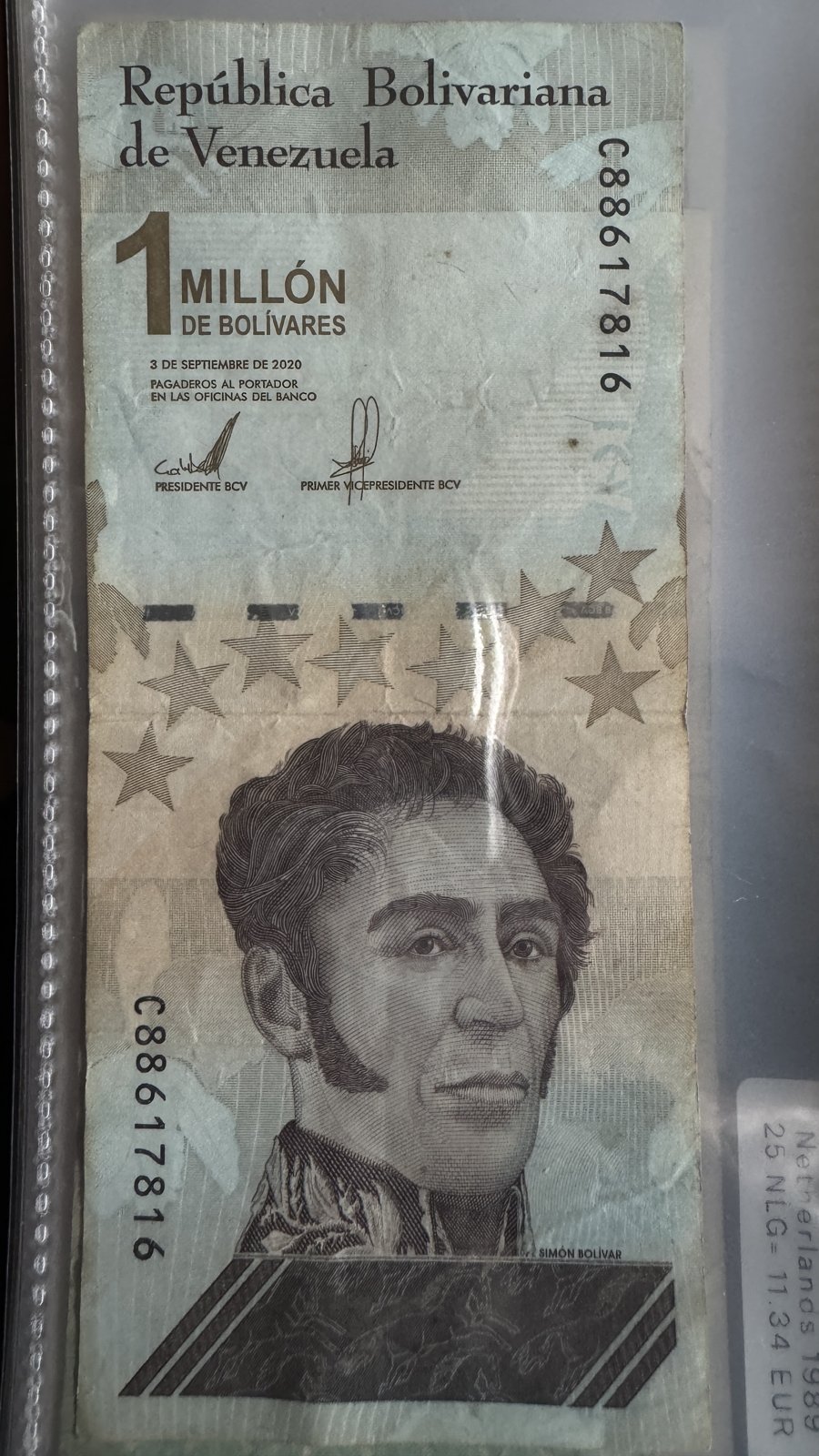
Alongside the current cone, the table still carries the 500,000 and 1,000,000 bolívar notes of the previous family: 299.986329 million and 247.889293 million pieces. Those two figures are identical in every month of 2026 — January through August, to the sixth decimal place. Either nothing has moved, or the column is no longer being maintained. The file does not say which.
Their combined face value is 397.9 million bolívares, or about US$500,000 for 547.9 million pieces. That is less than a tenth of a US cent per note. They make up 28 percent of every banknote the central bank reports as circulating, and four-tenths of one percent of the value.
These are the survivors of Venezuela’s last demonetisation. In Gaceta Oficial 42.952 of 29 August 2024, the central bank ruled by Resolution 24-08-01 that the bolívar soberano notes of 10,000, 20,000, 50,000 and 200,000 would circulate only until 25 September 2024, and that holdings of 200,000 and below could be deposited at banks until three o’clock on 30 September. The 500,000 and 1,000,000 notes sat above that ceiling and were not cancelled. They remain, on paper, legal tender. In the central bank’s own table they have not moved all year.
What the File Does Not Say
The table does not say how many of the 547.9 million notes of the previous cone are still physically in anyone’s hands, or why the figure has not changed in 2026. It reports a number, not what stands behind it.
The table also carries no revision history. It is published at a fixed address, overwritten each month, with no note of what changed. A reader downloading it today cannot tell which figures have been restated since they were first issued — only what the central bank says today.
More: Venezuela news in English, every day from The Rio Times.
Frequently Asked Questions
How many banknotes are in circulation in Venezuela?
1,939.1 million pieces at the end of August 2026, according to the Central Bank of Venezuela’s own file. Of those, 1,391.2 million belong to the current bolívar family; the remaining 547.9 million are 500,000 and 1,000,000 bolívar notes of the previous cone, a figure that has not changed in any month of 2026.
How much is Venezuela’s cash worth in dollars?
About US$125.0 million in total, at the central bank’s own reference rate of 794.9917 bolívares per dollar for 31 August 2026. Spread over roughly 28 million inhabitants that is US$4.47 a head. In January the same stock was worth US$148.7 million, or US$5.31 a head.
Is Venezuela printing more money?
The number of notes in circulation is rising fast: the current family grew from 990.2 million pieces in January 2026 to 1,391.2 million in August, an increase of 40.5 percent. The table records notes in circulation, including cash held by banks, so part of that rise may be existing notes leaving central bank vaults rather than newly printed ones.
What is the largest Venezuelan banknote worth?
The 500-bolívar note, the highest denomination issued, is worth about 63 US cents at the official rate for 31 August 2026. The smallest note in circulation, 5 bolívares, is worth six-tenths of a US cent.
Which Venezuelan banknotes are no longer legal tender?
Under Resolution 24-08-01, published in Gaceta Oficial 42.952 on 29 August 2024, the bolívar soberano notes of 10,000, 20,000, 50,000 and 200,000 circulated only until 25 September 2024. Denominations of 200,000 and below could be deposited at banks until three o’clock on 30 September 2024. The 500,000 and 1,000,000 notes were not named in the resolution and were not cancelled.
Why does Venezuela have so little cash?
Because the bolívar loses value faster than notes can be issued. Between the end of January and the end of August 2026 the official rate moved from 367.31 to 794.99 bolívares per dollar. Over the same seven months 401 million notes were added to circulation, and the dollar value of the country’s entire banknote stock still fell by 15.9 percent.
Sources: Banco Central de Venezuela — Billetes y Monedas (file 9_3_2.xls, sheets “Pzs” and “Bs”, downloaded 5 September 2026) · Gaceta Oficial 42.952 — Resolución BCV 24-08-01 · BCV reference rate, 31 August 2026
Exchange-rate reference: 794.9917 bolívares per US dollar, the official BCV rate for 31 August 2026. Population figure: approximately 28 million.
This article was produced by The Rio Times’ automated newsroom system. How we use AI · Report an error · Editorial responsibility: Matthias Camenzind, Editor-in-Chief
In depth