USA & Canada Intelligence Brief — Saturday, September 5, 2026
Executive Summary
USA & Canada Intelligence Brief for September 5: CENTCOM strikes three Iranian oil tankers as fuel prices hit records, the Pentagon takes a 35% equity
USA & Canada Intelligence Brief — Saturday, September 5, 2026
Key Facts
- The retaliation. U.S. Central Command said Friday it struck three Iranian oil tankers, one disabled off Kharg Island, after Iran’s Revolutionary Guard fired missiles at two American Navy vessels; CENTCOM chief Admiral Brad Cooper warned that further Iranian strikes would draw an even sharper response: “If you shoot at two of our ships, we will impose an even higher economic cost — taking out three of yours.”
- The bill. AAA’s national average diesel price hit a record $5.85 a gallon on Friday, edging past the $5.82 record set in June 2022, while Brent crude closed the week at $96.28 a barrel, its highest since July 24.
- The fine print. Reporting this week detailed that the Pentagon’s Office of Strategic Capital holds a 35 per cent stake, at no cost, in the company Washington granted 100-year rights to 65 billion barrels of Venezuelan oil on September 1; Senator Jack Reed called it “a blatant abuse of power and taxpayer dollars.”
- The mail. Elections Alberta confirmed some referendum ballot packages mailed from September 1 arrived incomplete, and moved its mail-ballot application deadline up two weeks to September 25 after roughly 290,000 requests.
- The countdown. Canada’s roughly C$27.6-billion retaliatory tariffs take effect Monday, September 8, with no reported resumption of the trade talks that collapsed August 22.
- The crowd. The Transportation Security Administration said it expects to screen more than 17 million passengers over the Labor Day travel period — a near-record volume, running just below last year’s all-time high.
Washington fought its week on two fronts without formally declaring either one. In the Gulf, a retaliation policy so precise it comes with its own exchange rate — two of ours costs you three of yours — disabled Iranian tankers on Friday; on Main Street, the diesel that moves the country’s freight broke a four-year-old price record the same day, and a Labor Day weekend built for travel arrived anyway.
Read in English and French, across U.S. and Canadian outlets and our own Washington and Ottawa desks.
Washington: The War’s Bill Comes Due At The Pump
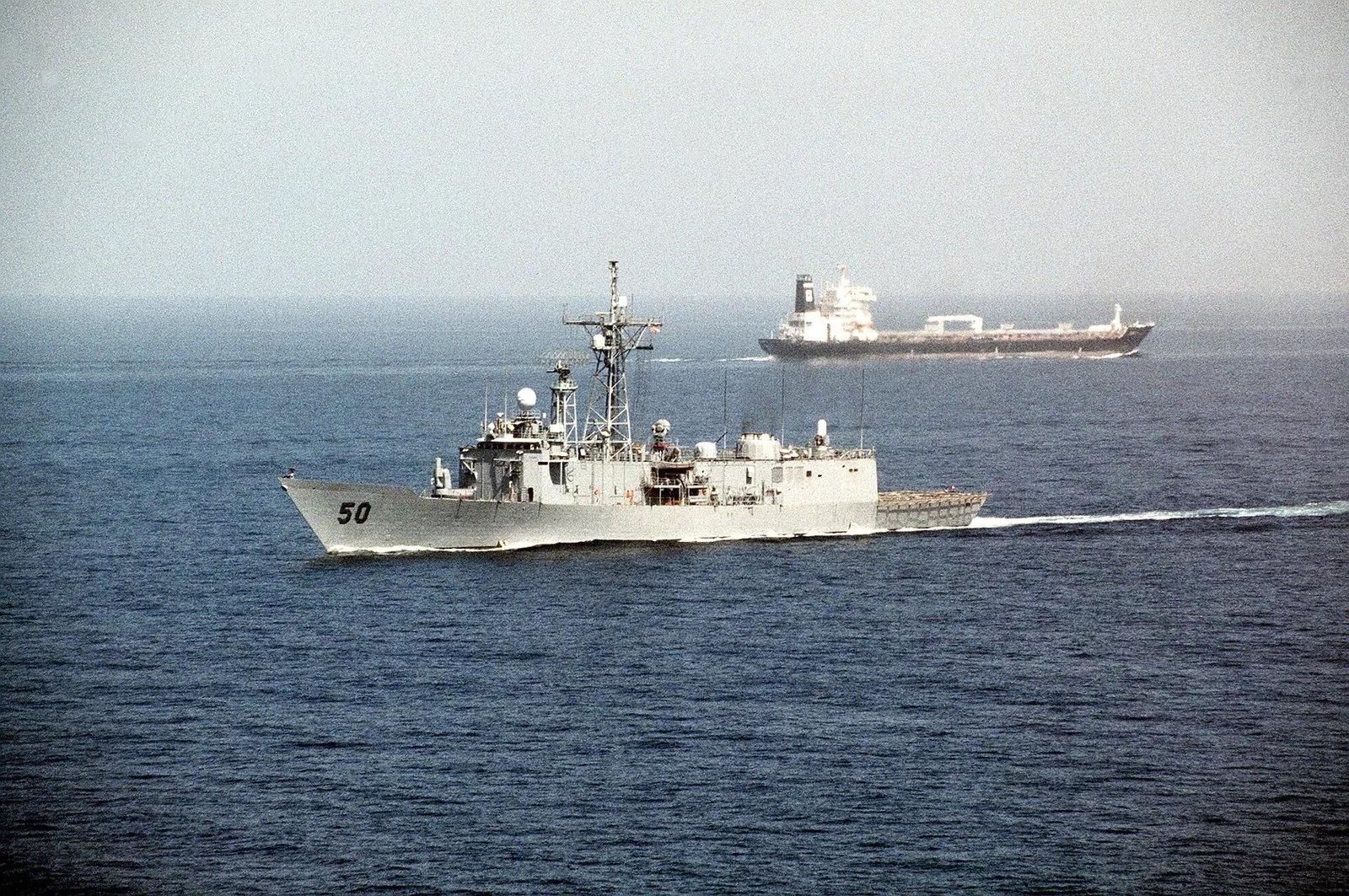
U.S. Central Command said Friday it struck three Iranian oil tankers, disabling one off Kharg Island, hours after Iran’s Islamic Revolutionary Guard Corps fired ballistic missiles at two American Navy vessels in Gulf waters. Admiral Brad Cooper, the command’s chief, described the arithmetic of the response in a public statement: “If you shoot at two of our ships, we will impose an even higher economic cost — taking out three of yours,” a formula CENTCOM has now applied for the first time since the six-month-old confrontation began.
Brent crude closed the week at $96.28 a barrel, its highest since July 24, and the domestic bill for that arrived with it: AAA’s national average diesel price hit $5.85 a gallon on Friday, past the $5.82 record set in June 2022, while regular petrol averaged $4.15 against $3.20 a year earlier. Vice President JD Vance told reporters gasoline “could have been much, much higher were it not for our efforts,” declining to say whether $3-a-gallon petrol remains an administration promise or simply a memory.
Democratic Senator Mark Kelly, whose Arizona farms and freight lines carry the cost directly, said diesel “fuels our supply chains and powers our farms and food production” and that the increase moves straight into grocery bills. A White House spokesperson answered a related but different question, saying the president remains “committed to unleashing American energy dominance, cutting costs, and putting more money back in the pockets of hardworking American families” — a sentence about direction, not about Friday’s receipt.
Caracas: The Fine Print On A “Historic” Deal
The oil agreement Washington and Caracas signed on September 1 spent this week acquiring the details it launched without. North American Blue Energy Partners, the firm owned by Venezuelan businessman Alejandro Betancourt and granted 100-year rights to 65 billion barrels across 17 fields, is 35 per cent owned — at no cost — by the Pentagon’s Office of Strategic Capital, while the State Department separately holds a guaranteed right to buy a fifth of everything the fields produce at cost, exempt from Venezuelan tax, plus a veto over board appointments and first refusal on the rest.
Defense Secretary Pete Hegseth and Secretary of State Marco Rubio signed for a government that is, for the first time in this arrangement, a paid-up equity partner in a foreign oil company rather than simply its regulator or its customer. Senator Jack Reed, the top Democrat on the Armed Services Committee, called it “a blatant abuse of power and taxpayer dollars” that turns “the U.S. military into an investor in Venezuelan oil”; opposition figures around María Corina Machado have raised the mirror-image objection, that an unelected government in Caracas has signed away a resource for a century that no future elected one may be able to reclaim.
Live Market IntelligenceCommodities — Live Market Board
Rio Times · Live Market Intelligence
Commodities — Live Market Board
-0.03%
| Instrument | Last | Change | YoY | Prev. | High | Low | Volume |
|---|---|---|---|---|---|---|---|
| GOLD | 4,461 | +1.78% | +33.20% | 4,383 | 4,503 | 4,421 | 139,824 |
| SILVER | 65.59 | +1.26% | +73.05% | 64.77 | 66.98 | 64.81 | 46,406 |
| BRENT | 88.88 | -0.03% | +34.42% | 88.91 | 90.07 | 88.12 | 29,713 |
| WTI | 83.11 | -0.11% | +31.57% | 83.20 | 84.35 | 82.40 | 166,848 |
| COPPER | 6.61 | +0.03% | +46.70% | 6.61 | 6.71 | 6.61 | 39,543 |
| LITHIUM | 75.20 | +1.47% | +62.95% | 74.11 | 75.80 | 75.08 | 89,275 |
| IRON ORE | 161.91 | — | +58.10% | 161.91 | 161.91 | 1 | |
| SOY | 1,184 | +3.20% | +17.05% | 1,148 | 1,199 | 1,168 | 163,179 |
| CORN | 480.50 | +10.02% | +29.34% | 436.75 | 480.75 | 459.50 | 341,248 |
| WHEAT | 655.00 | +3.93% | +29.70% | 630.25 | 657.75 | 631.50 | 128,793 |
| COFFEE | 317.25 | -5.51% | +0.67% | 335.75 | 321.20 | 313.55 | 21,747 |
| SUGAR | 16.43 | -1.79% | -3.01% | 16.73 | 17.11 | 16.22 | 171,992 |
| COCOA | 5,719 | +3.18% | -34.96% | 5,543 | 5,779 | 5,574 | 26,773 |
| ORANGE JUICE | 138.55 | -0.47% | -45.38% | 139.20 | 141.05 | 137.50 | 703 |
| COTTON | 85.03 | +2.33% | +26.78% | 83.09 | 82.90 | 81.96 | 16,546 |
| BEEF | 223.60 | -3.93% | -5.18% | 232.75 | 226.40 | 223.00 | 16,126 |
| CATTLE | 339.10 | -3.16% | -1.82% | 350.17 | 345.50 | 338.60 | 10,164 |
| USD/BRL | 5.16 | +0.01% | -5.13% | 5.16 | 5.18 | 5.14 | — |
Alberta: A Referendum Straining Its Own Machinery
Elections Alberta confirmed this week that some of the special ballot packages it began mailing September 1 arrived incomplete, missing one or more of the ten questions voters must answer on October 19. Deputy Chief Electoral Officer Dallas Stoesz described the packages as glued “like notepads” that separated in transit, and said roughly 290,000 mail-ballot applications — an unprecedented volume — had already forced the agency to move its own deadline forward two weeks, to September 25.
The count that follows will not be simpler: officials say tallying all ten questions by hand, with the separation question counted first, will run through the night under a strict 48-hour rule and is not expected to finish before 1 to 4 a.m. on October 20. “There are no breaks,” one Elections Alberta official said. “It is straight through” — an apt description of a province trying to settle its constitutional future using the same administrative machinery that cannot yet guarantee a complete ballot survives the mail.
Ottawa: Three Days Until The Tariffs Bite
Monday brings the deadline this week’s rhetoric mostly avoided. Canada’s roughly C$27.6 billion in retaliatory tariffs on American goods take effect September 8 regardless of whether Ottawa and Washington are actually negotiating, and nothing reported this week suggests they are — Prime Minister Mark Carney’s complaint that the American position has softened and Commerce Secretary Howard Lutnick’s rebuttal accusing Canada’s government of playing politics were both arguments about tone, not evidence that the talks which broke down August 22 have resumed.
Canadian businesses now have three days to plan for tariffs on steel, aluminium and a long list of consumer goods, stacked on top of the 50 per cent American duties already in force. A dispute that has generated more press conferences than negotiating sessions this month is about to generate its first real invoice.
Main Street: Near-Record Crowds, Record Costs
The Transportation Security Administration said it expects to screen more than 17 million passengers over the Labor Day travel period — a near-record volume, running just below last year’s all-time high — Americans travelling in numbers that argue for an economy still willing to spend, even as the government’s own fuel data argues for one that is feeling the spending. A fifth of a tank now separates last Labor Day from this one, and neither the record crowds nor the record prices are being treated as news by the people living through both.
Every dollar of leverage abroad still has to clear customs at home first.
What This Means From Latin America
A $96 barrel of Brent is not an abstraction for most of Latin America: it is diesel for buses in São Paulo, fertiliser for soy across the Pampas, and a fuel-subsidy line item several finance ministries would rather not defend in public this quarter. The Venezuela deal sharpens the same discomfort from a different angle — Washington’s own announcement of the agreement invoked the Monroe Doctrine by name, and a region that has spent two centuries hearing that phrase used to justify decisions made about its resources elsewhere will read a Pentagon stake taken at no cost as confirmation of something, not as rhetoric.
Mexico, in particular, should treat this week’s Canada-U.S. standoff as a preview rather than a spectator sport. The fourth round of USMCA review talks on automotive content opens this month, and Washington has just demonstrated, in a separate negotiation, that a stated softening in tone costs a trading partner nothing in the way of an actual deadline — Ottawa’s tariffs proceed Monday no matter what anyone said this week, and Mexico’s own negotiators are watching closely how little a friendly word turns out to be worth.
What We Are Watching
- The Supreme Court’s mail-voting response — challengers have until September 8 to answer the Justice Department’s request to lift a lower-court block, with no ruling yet issued.
- Canada’s retaliatory tariffs — whether the September 8 list takes effect unamended, and whether it finally forces a resumption of actual talks rather than statements about them.
- Alberta’s mail-ballot deadline — September 25, and whether Elections Alberta’s fixes reach the “couple of handfuls” of affected voters in time.
- Further Gulf escalation — whether Iran answers the tanker strikes, and what Admiral Cooper’s warning of an “even higher economic cost” does to Brent next.
- The diesel and petrol trend line — whether prices keep climbing into a midterm year already sensitive to the cost of living.
- Quebec’s language mailout litigation — the legal challenge a Montreal lawyer has said he intends to file this month.
More from the Rio Times Intelligence Desk on September 5, 2026: Africa · Asia · Europe. For how these stories developed, see the USA & Canada Intelligence Brief for September 4 and September 3.
North American trade policy and its bearing on this hemisphere runs through our pillar coverage of The United States & Canada.
Frequently Asked Questions
Why did the U.S. strike Iranian oil tankers this week, and how does that connect to record gas prices?
U.S. Central Command said Friday, September 4, 2026, it struck three Iranian oil tankers after Iran’s Revolutionary Guard fired missiles at two American Navy vessels, part of a six-month-old confrontation over the Strait of Hormuz. Brent crude closed the week at $96.28 a barrel and AAA’s national diesel average hit a record $5.85 a gallon the same Friday, both driven by the wider conflict’s disruption of Gulf shipping.
What exactly does the Pentagon get from the new Venezuela oil deal, and who is objecting?
The Pentagon’s Office of Strategic Capital holds a 35 per cent stake, granted at no cost, in North American Blue Energy Partners, the firm given 100-year rights on September 1, 2026 to 65 billion barrels of Venezuelan oil across 17 fields; the State Department separately can buy a fifth of production at cost. Senator Jack Reed, the top Democrat on the Senate Armed Services Committee, has called the arrangement “a blatant abuse of power and taxpayer dollars.”
What went wrong with Alberta’s referendum mail ballots?
Elections Alberta confirmed this week that some special ballot packages mailed from September 1, 2026 arrived with one or more of the referendum’s ten questions missing, a fault officials attributed to notepad-style glued packages separating in transit. The agency moved its mail-ballot application deadline up to September 25 after roughly 290,000 applications, well ahead of the October 19 vote.
What happens on September 8, and why does it matter for Canada-U.S. trade?
Canada’s roughly C$27.6 billion in retaliatory tariffs on American goods are set to take effect Monday, September 8, 2026, regardless of the public arguments this week between Prime Minister Mark Carney and Commerce Secretary Howard Lutnick. No talks have resumed since the negotiations collapsed on August 22, meaning the tariffs are on track to apply on top of the 50 per cent American duties already in force.
Sources: Reuters, CNN, NBC News, CNBC, Al Jazeera, Fox Business, The Washington Post, NPR, The White House, Elections Alberta, CBC News, Global News, CBS News, Mediaite · 1-5 September 2026.
This article was produced by The Rio Times’ automated newsroom system. How we use AI · Report an error · Editorial responsibility: Matthias Camenzind, Editor-in-Chief