Uruguay, the country of four cows per person, seeks greener livestock farming
RIO DE JANEIRO, BRAZIL – In Uruguay, a country with virtually no industry and almost four cattle per capita (around 12 million animals), the agricultural sector is responsible for 75% of greenhouse gas (GHG) emissions and livestock accounts for 62% of the total.
Consequently, a large part of the emissions are methane, derived from the digestion of cows, which “has an important weight in climate change”, says to AFP Cecilia Jones, coordinator of the Agricultural Unit for Sustainability and Climate Change of the Ministry of Livestock (MGAP).

Therefore, in order to address the issue of global warming, the country must look at livestock farming.
In this context, Uruguay has been carrying out the Livestock and Climate project since 2020 with technical support from the United Nations Food and Agriculture Agency (FAO) and funding from the Global Environment Facility (GEF).
Its objective is to reduce direct and indirect GHG emissions, “sequester” carbon in the soil and reverse land degradation processes, while increasing productivity “through climate-smart practices,” Soledad Bergós, the project’s national coordinator, told AFP.
The impact of the proposed changes will be known by 2024, when the final results of the project will compare emissions and accumulated soil carbon with those measured at the beginning of the initiative.
“Sustainable” production
“These have to be all pregnant,” says Rosa Correa, 56, as she watches a group of about 20 cows in her field in Cerro Pelado, in the department of Lavalleja, one of the 62 cattle ranches participating in the project.
The synchronization of calving – putting the cows within reach of a bull to mount them – and pregnancy, as well as the weaning of calves, are some of the practices that she and her husband Alejandro Rodríguez (55) began to implement on the advice of FAO technicians.
It is “one of the ways to increase productivity in a sustainable way”, explains Rosa to AFP, since more kilos of meat (calves) are generated from the same cattle.
Rosa and Alejandro and their daughters run an 800-hectare cattle ranch that has been in the family for 35 years.
Thanks to the project, they have reorganized a way of working that had been going on for generations, changing processes – such as cattle and pasture management measures – without the need for extra expenses.
Looking at the pasture
“In Uruguay, livestock farming has been the main agricultural activity for 400 years, and its characteristic is that it is mostly carried out on natural pastures,” Bergós points out.
The agronomist recalls that this is an “extremely valuable resource”. Although only 8% of the world is covered by productive temperate grasslands, in Uruguay they occupy almost 50% of the territory.
The existence of this ecosystem in which extensive, open-air cattle ranching takes place is “the flip side” of the activity as an environmental pollutant, says Jones.
Field management is vital to the project, since a pasture in good condition sequesters more carbon and offsets the emissions from the cattle ranching itself. “So we are adding one more value to the meat from natural pastures,” says the MGAP director.
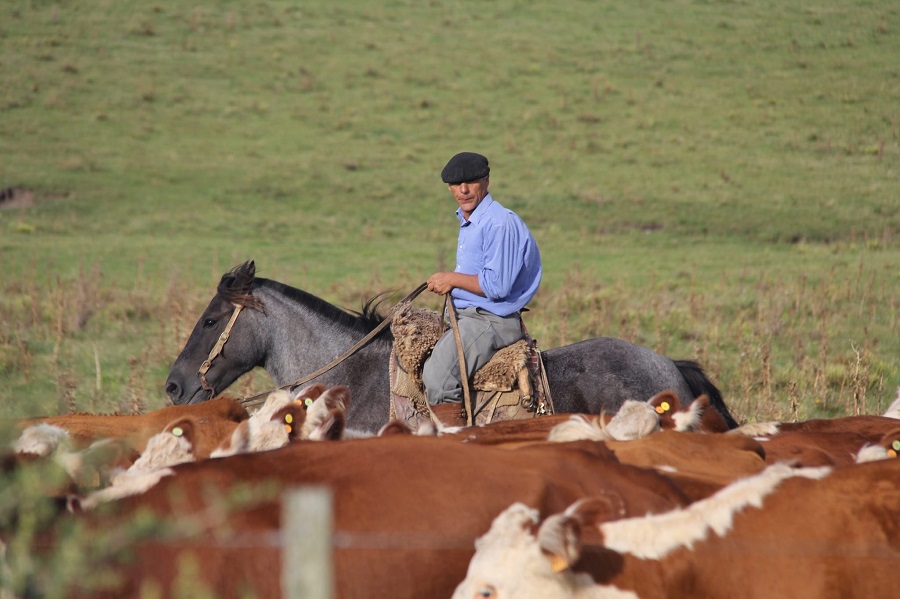
Rosa says that one of the lessons learned from the project has been “learning to look down”, in reference to the pasture. “We were guided a lot by the state of the cattle and we didn’t look at the seasonality of the pasture, the growth, the seasons,” she explains.
“The more leaves and length the pasture has, the better quality it is. We learned to regulate the pasture,” like the “carrying capacity” the field has: how much cattle it supports according to the season.
Meat and Bill Gates
Cattle raising as an environmental pollutant was in the spotlight in Uruguay some weeks ago due to statements made by Bill Gates, who said that rich countries should consume synthetic meat to combat climate change.
Rosa says that the idea went down badly among producers. “There are people who say ‘cattle don’t pollute, other things pollute much more’.
The truth is that producers live where they work and the fact that they are exposed to extreme weather events, such as droughts or floods, says Bergós, makes them very aware of the environmental impact.
“Before we were interested” in the issue “but we didn’t have knowledge about how we could help,” Rosa slides. “It’s important that we can all get on board with this.”
Source: AFP/EFE
More: Latin America news in English, every day from The Rio Times.
This article was produced by The Rio Times’ automated newsroom system. How we use AI · Report an error · Editorial responsibility: Matthias Camenzind, Editor-in-Chief