By Luís Manuel Brás Bernardino*
China is, by many specialists, recognized as a global actor in the framework of International Relations. As a result of a foreign policy denominated by the ‘Going Out Strategy’, launched officially in 2001, China has recently emerged to this reality.
More specifically, since 2013, after the presentation of its new global connectivity strategy designated by the ‘Belt and Road Initiative, rising not only as an important economic, political, and diplomatic player but also in security, namely in Africa, where its presence is undeniable.

Chinese citizens and economic interests in Africa have grown substantially since 2001, given the expansion of Chinese trade relations with the African States (and Organizations), financing projects related to infrastructure construction, and establishment of economic agreements of medium/long-term strategic partnerships.
Most of the time, these partnerships are based on the supply of strategic natural resources to China, such as petroleum, natural gas, or even the acquisition of extensive agricultural production land parcels, fostering the African economy and increasingly contributing to regional and continental security in Africa.
Nowadays, in this continent, many countries and regional organizations are involved intrastate armed conflicts.
Furthermore, many are devastated by jihadist terrorism, illegal traffic, and banditry or maritime piracy throughout their coastline, resulting in a sentiment of regional insecurity.
It is safe to state that the conflict in the African continent is a problem that surpassed the regional or continental dimension, becoming a global issue, with an obvious impact on the world economy.
In this context, the rising number of violent attacks against workers and Chinese interests in Africa led to an awareness of the Chinese community (and its political executives) of the need for protection, associated with the economic loss from which these kidnaps and safety incidents originate.
These aspects are some of the key factors that persuaded the Chinese government to react and invest in a security reinforcement of its citizens and economic and financial interests in Africa, which appears to be a ‘new’ Chinese Military Strategy.
THE NEW STRATEGY
In a time span of a decade, the Popular Republic of China went from an uncompromising non-involvement to a selective and incremental engagement in bilateral, regional and global cooperation in peace and safety matters.
Namely, through the creation of cooperation and bilateral/multilateral assistance programs integrated into the ‘new’ framework of Foreign Policy of Defense, maintaining the uncompromising principle of non-interference in the foreign countries’ internal matters.
Over decades, such behaviors have made of China a not-so-relevant actor in matters of security and Defense in Africa.
According to this new paradigm, China has applied a strategic approach based on two main vectors: firstly, to defend its economic and safety interests, and secondly, to expand its influence in Africa and, consequently, in the world.
The growing engagement of China in peace operations in Africa acted as a pretext to accelerate the construction of the Blue Waters Navy, to increase its presence in the Indic and Pacific Oceans, having established its first overseas military base in 2017, in Djibouti, Africa.
On the other hand, China has widened its military presence involving bilaterally African countries through the execution of joint military exercises.
They have reinforced military training and advisory, established protocols for supplying information systems related to cybersecurity, and increased the sale (and counterpart donations) of arms and related material.
Finally, they have created military infrastructure construction programs, ensuring a reinforcement of cooperation in defense with almost every African country.
The bilateral aspect is reinforced, multilaterally, through the increasingly privileged and strategic relation with AU and ARO and through the newly created China-Africa Forum for Security, combining both aspects of cooperation in a bi-multilateral strategic approach.
Nowadays, this approach covers almost all of the African continent and is related to States and Regional Organizations.
Currently, China has embassies across 50 African States and is represented in every ARO, guiding the relations of China with AU and the Regional Economic Communities, since this cooperation has become more and more institutionalized and strategic for China.
This framework has created opportunities to align China and Africa with bi-multilateral standards and agreements, resulting in a strategic partnership between Organizations and the African States.
This involves several fields of cooperation, namely the economic, financial, safety, and defense fields, included in the Action Plan of 2019-2021.
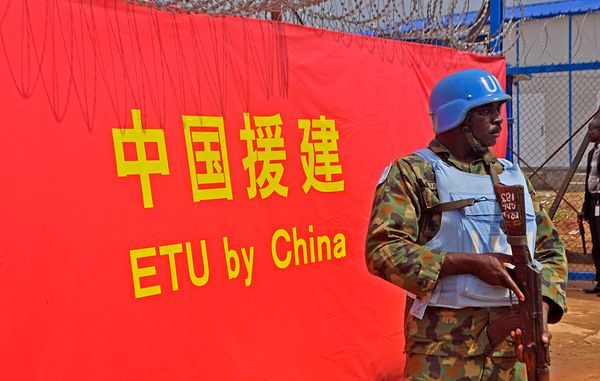
In 2022, China occupied the 9th place in terms of contributions of troops for the UN missions, with a total of 2,235 soldiers and officers.
Currently, it is the largest contributor of troops among the five permanent members of the UNSC.
In the last years, China has increased its contribution to the peacekeeping operations budget of the referred organization, representing 15.2% of the UN Department of Peacekeeping Operations budget, occupying 2nd place after the USA (27.9%).
Regarding the bilateral aspect, which still constitutes the most crucial vector of Defense cooperation in Africa, we have observed a significant increase in joint military exercises and visits to Chinese Navy ports.
This is done primarily through participation in UN-led anti-piracy operations in the Horn of Africa, where Chinese naval visits to African countries from the naval base in Djibouti have become increasingly frequent.
Therefore, the presence of security contractors, that is, Chinese security companies that have established themselves in the African security context, can be observed.
While respecting the principle of non-interference, they aim to bridge, on one hand, the failures of the African government in what concerns the safety of Chinese workers and companies and, on the other hand, reinforce the cooperation and influence across Africa.
This resulted in a contribution to the Chinese Defense Economy and a source of employment for the 50 million PLA military reservists who are integrated into these semi-statal security companies.
The employment of these security companies complements the Chinese security strategy in Africa, benefiting the statal and regional security, as well as China itself, given the level of revenues this field of the economy can generate.
CONCLUDING REMARKS
Recently, the development of the Chinese Military Strategy has been based on a dynamic of selective involvement, privileging the principle of non-interference in foreign countries’ internal matters.
However, this bi-multilateral strategy has led China to be more interventionist and to assume itself as the main actor in regional security and defense in Africa.
This aspect, in what we denominate by a ‘new’ Military Strategy, combines elements of continuity and some innovative features.
They are characterized by a greater interference in the multilateral framework of Peacekeeping Operations, the reinforcement of the presence of Chinese private military companies, and the reinforcement of cooperation and military advisory, besides the increase in the sale of arms and in the number of technical assistance and military technology programs in African countries.
In the future, we believe the Chinese influence will grow and expand across the African continent.
This will result in the engagement of naval operations across the Atlantic Ocean and the interference in ground operations in the UN and AU framework, progressively strengthening its relevance and military presence in Africa, as an important part of a globalization strategy in its Foreign Policy of Defense.
*Luís M. Brás Bernardino is an Infantry Colonel in the Portuguese Army with the Staff Course and more than 35 years on duty with global missions, mainly in Africa.
Editorial responsibility: Matthias Camenzind, Editor-in-Chief · Editorial standards · Report an error