Bitcoin Holds Above US$76,000 as Brazil’s Crypto Deadlines Approach
Key Facts
- Bitcoin closed at about US$76,404, up 0.33%, holding its level after the Federal Reserve’s first rate increase since 2023.
- Ether rose 1.28% to roughly US$2,447 and Solana 3.00% to about US$101.60, while XRP slipped 0.27% to around US$1.2959.
- Brazil’s central bank bars crypto settlement of cross-border payments from 1 October, a rule that explicitly covers dollar-pegged stablecoins.
- The licensing transition window for existing operators closes on 29 October, after which firms without authorisation must stop trading in Brazil.
- Brazilians bought US$6.9 billion of crypto in the first quarter, of which more than 98% was stablecoins according to the central bank.
- First-half purchases reached US$14.68 billion, an increase of 135%, confirming that the Brazilian market is growing faster than the rules governing it.
Today’s Focus
Bitcoin did the least interesting thing it could have done this week, which was very nearly nothing. It closed at about US$76,404 on Thursday, up 0.33%.
That came a day after the Federal Reserve raised rates for the first time since 2023. A rate rise is normally unhelpful for assets that pay no yield.
The rest of the majors were mixed. Ether rose 1.28% to roughly US$2,447, Solana 3.00% to about US$101.60, and XRP slipped 0.27%.
The more consequential news for Latin America is regulatory and dated. Brazil’s central bank bars crypto settlement of cross-border payments from 1 October.
A second deadline follows on 29 October, when the transition window for existing operators closes. Firms without authorisation must stop trading after that.
Both rules land on stablecoins rather than on bitcoin. That matters because stablecoins are more than nine-tenths of regional trading volume.
What matters today. Two Brazilian deadlines fall within six weeks and both bite on stablecoins. That is the region’s real crypto story this quarter.
01 The session in one read
A flat session after a hawkish central bank decision is a result rather than a non-event. Bitcoin absorbed the news without giving ground.
Solana was the strongest major at 3.00%. It had fallen below its Monday close earlier in the week and recovered that level on Thursday.
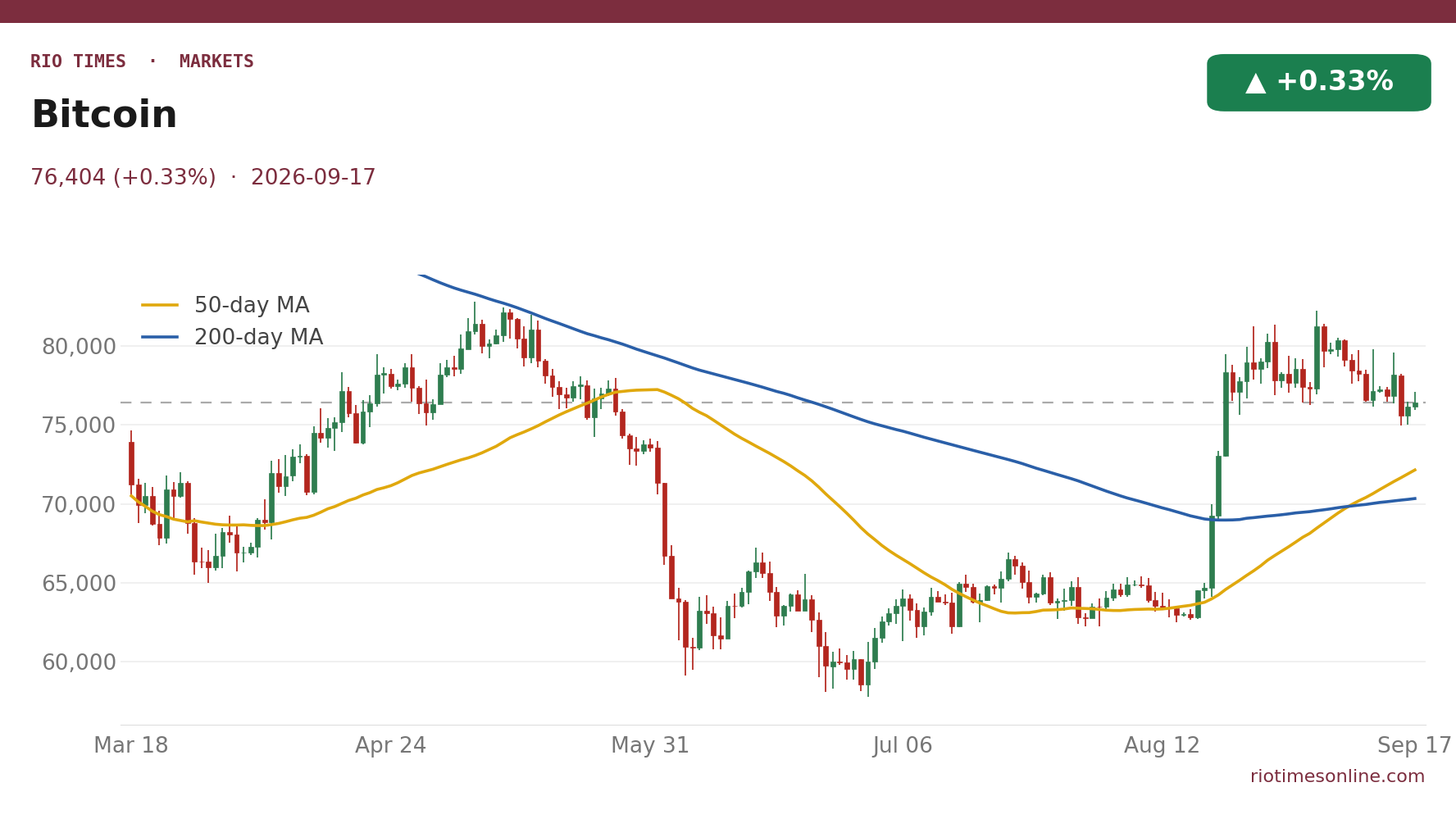
Bitcoin has traded in a range through September without establishing direction. The fifty-day average has flattened along with it.
That consolidation has lasted several weeks now. Ranges of this kind usually end with a move large enough to be worth waiting for.
02 The board
| Asset | Level | Session | Read |
|---|---|---|---|
| Bitcoin (BTC) | US$76,404 | +0.33% | Held its level after the rate decision |
| Ether (ETH) | US$2,447 | +1.28% | Outpaced bitcoin on the session |
| Solana (SOL) | US$101.60 | +3.00% | Recovered its Monday close of US$102.50 |
| XRP | US$1.2959 | -0.27% | The only major to fall |
| S&P 500 | 7,637.76 | +1.14% | Equities rebounded harder than crypto |
| US 10-year yield | 4.947% | -1.18% | Eased from 5.006% |
Crypto underperformed equities on the rebound. That is unusual and suggests the asset class is still digesting the rate decision.
The dispersion between the majors was wide for a quiet day. A three percent gain in Solana against a fall in XRP is not a market moving together.
Live Market IntelligenceCrypto — Live Market Board
Rio Times · Live Market Intelligence
Crypto — Live Market Board
-0.26%
| Instrument | Last | Change | YoY | Prev. | High | Low | Volume |
|---|---|---|---|---|---|---|---|
| BTC | 63,384 | -0.26% | -47.24% | 63,552 | 64,346 | 63,305 | 22,774,743,040 |
| ETH | 1,886 | +0.26% | -58.90% | 1,881 | 1,920 | 1,879 | 7,916,475,392 |
| SOL | 75.89 | -0.40% | -60.44% | 76.20 | 76.99 | 75.39 | 1,473,821,056 |
| XRP | 1.01 | -1.15% | -69.07% | 1.02 | 1.02 | 1.01 | 1,144,044,416 |
| BNB | 609.60 | -1.12% | -26.81% | 616.50 | 619.30 | 609.23 | 1,266,706,432 |
| ADA | 0.18 | -1.98% | -78.22% | 0.19 | 0.19 | 0.18 | 238,085,632 |
| DOGE | 0.07 | -1.56% | -70.00% | 0.07 | 0.07 | 0.07 | 553,256,192 |
| AVAX | 6.38 | +1.04% | -74.11% | 6.32 | 6.42 | 6.21 | 248,470,560 |
| LINK | 8.77 | -0.06% | -62.73% | 8.77 | 8.87 | 8.68 | 317,054,880 |
| DOT | 0.78 | -0.75% | -81.11% | 0.79 | 0.80 | 0.78 | 43,490,492 |
| LTC | 45.08 | -0.85% | -65.45% | 45.47 | 45.59 | 44.98 | 143,727,712 |
| BCH | 213.85 | +0.10% | -65.44% | 213.64 | 215.69 | 212.54 | 137,956,688 |
| TRX | 0.34 | +0.28% | -4.73% | 0.33 | 0.34 | 0.33 | 436,576,064 |
| XLM | 0.16 | -1.33% | -64.46% | 0.16 | 0.16 | 0.16 | 89,559,864 |
| HBAR | 0.07 | -0.53% | -74.67% | 0.07 | 0.07 | 0.07 | 22,546,186 |
| NEAR | 1.65 | +2.42% | -40.55% | 1.62 | 1.68 | 1.61 | 187,591,264 |
| ATOM | 1.40 | -2.36% | -70.15% | 1.44 | 1.44 | 1.40 | 18,626,964 |
| AAVE | 89.06 | +0.93% | -72.33% | 88.24 | 90.20 | 88.19 | 129,099,704 |
03 What moved it
The Federal Reserve raised its target range to 3.75-4.00% on Wednesday, the first increase since July 2023. Equities fell and then rebounded sharply.
Crypto did neither with much conviction. Bitcoin’s 0.33% gain is well inside its normal daily range.
Several pieces of industry news landed on the same day without moving prices. A United States derivatives regulator freed passive software providers from broker registration requirements.
An identity and payments company launched a self-custodial application across more than 150 countries. A ratings and analytics group agreed to acquire a blockchain security firm.
04 The Latin American read
Brazil is the region’s largest crypto market and its rules are about to change twice. From 1 October, payment firms may not settle cross-border remittances in crypto, explicitly including dollar-pegged stablecoins.
On 29 October the transition window closes for operators that have not obtained authorisation. The licensing regime itself became operative on 2 February 2026.
Minimum capital requirements run from 10.8 million to 37.2 million reais, roughly US$2.1 million to US$7.2 million, depending on classification. That is a meaningful barrier for smaller exchanges.
The scale involved explains the attention. Brazilians bought US$6.9 billion of crypto in the first quarter, of which more than 98% was stablecoins.
05 The names to watch
Stablecoins dominate Latin American crypto volume in a way they do not elsewhere. Regional estimates put dollar-pegged tokens above 90% of turnover.
Argentina is the clearest case. Peso-denominated crypto trading is overwhelmingly stablecoin-based, which reflects currency substitution rather than speculation.
El Salvador remains the region’s only sovereign holder of bitcoin. Its reserve stands at 7,778 coins worth about US$602.6 million.
Remittances are the underlying use case across the region. Stablecoins have moved from a marginal share of flows to a material one in three years.
06 The outlook
The Brazilian deadlines will reshape the regional market more than any price move this quarter. A ban on crypto settlement of cross-border payments removes one of the main commercial uses of stablecoins.
Some operators will leave rather than meet the capital requirements. Consolidation into fewer, larger, licensed firms is the predictable outcome.
That is not necessarily bad for the asset class. Regulated markets attract institutional money that unregulated ones cannot.
For prices, the Federal Reserve remains the larger variable. Sixteen of eighteen officials expect another increase before the end of the year.
Higher American rates raise the opportunity cost of holding an asset that pays nothing. That has been the drag on crypto all quarter.
Against that sits the steady expansion of regulated channels. Each new licensed venue widens the pool of money that can legally reach the asset class.
07 What to watch
- 1 October in Brazil: Crypto settlement of cross-border payments becomes prohibited, stablecoins included.
- 29 October in Brazil: The transition window closes and unauthorised operators must stop trading.
- Capital requirements: Minimums of 10.8 to 37.2 million reais, about US$2.1 to US$7.2 million, will push smaller exchanges out.
- Stablecoin share of volume: Above 90% regionally, so Brazilian rules reach most of the market rather than a corner of it.
- The next Federal Reserve move: Most officials expect another increase before December, which is the larger price variable.
Frequently Asked Questions
What was the bitcoin price on 17 September 2026?
Bitcoin closed at about US$76,404, up 0.33%. Ether rose 1.28% to roughly US$2,447 and Solana 3.00% to about US$101.60.
What changes in Brazil on 1 October 2026?
Payment firms may no longer settle cross-border remittances in crypto, a rule that explicitly includes dollar-pegged stablecoins.
What happens on 29 October 2026?
The transition window closes for existing operators. Firms that have not obtained authorisation must stop trading in Brazil.
How large is Brazil’s crypto market?
Brazilians bought US$6.9 billion of crypto in the first quarter of 2026, of which more than 98% was stablecoins. First-half purchases reached US$14.68 billion.
How much bitcoin does El Salvador hold?
Its reserve stands at 7,778 coins, worth about US$602.6 million as of 18 September 2026.
Why are stablecoins so dominant in Latin America?
They are used for dollar access and remittances rather than speculation. Regional estimates put dollar-pegged tokens above 90% of crypto turnover.
Sources: RT end-of-day series for BTC, ETH, SOL and XRP; Banco Central do Brasil Resolutions 519, 520, 521 and 561; CoinDesk on the cross-border settlement ban; Notabene on the licensing regime and capital requirements; Bitcoin.com on first-quarter Brazilian purchase data; Bitcoin Treasuries for El Salvador holdings.
This article was produced by The Rio Times’ automated newsroom system. How we use AI · Report an error
Read More from The Rio Times