Africa’s Richest Country Per Head Is an Archipelago of 100,000 People
SEYCHELLES · ECONOMY
Key Facts
- —The income figure GDP per capita reached about US$17,670 in April 2026, highest in Africa. Total GDP was US$2.32 billion in 2025.
- —The debt path Public debt fell to 53.6% of GDP in 2025, heading to 50% medium-term target. IMF supports the plan.
- —The rating Fitch rates Seychelles BB, below investment grade but high for a small African nation.
- —The catch Seychelles sits in the world’s second largest tuna basin, which supplies about a fifth of global tuna.
- —The instrument In 2018, Seychelles issued the world’s first sovereign blue bond for marine projects. The structure has been copied widely.
- —The outlook IMF projects GDP growth of 3.4% in 2027, driven by tourism, fisheries, and financial services.
The Seychelles blue economy has an unusual result: the highest GDP per person in Africa, about US$17,670. It rests on tuna, tourism, and a debt ratio falling to near 50 percent.
The archipelago has about 100,000 residents. That makes it both a real success and an awkward model.
What the Seychelles blue economy actually consists of
Three sectors carry the country. Tourism supplies the foreign exchange, fisheries supply the exports and industrial base, and offshore financial services supply the fee income.
Seychelles is small, but its fisheries are big. It sits in the world’s second largest tuna basin.
That basin makes about a fifth of the global catch.
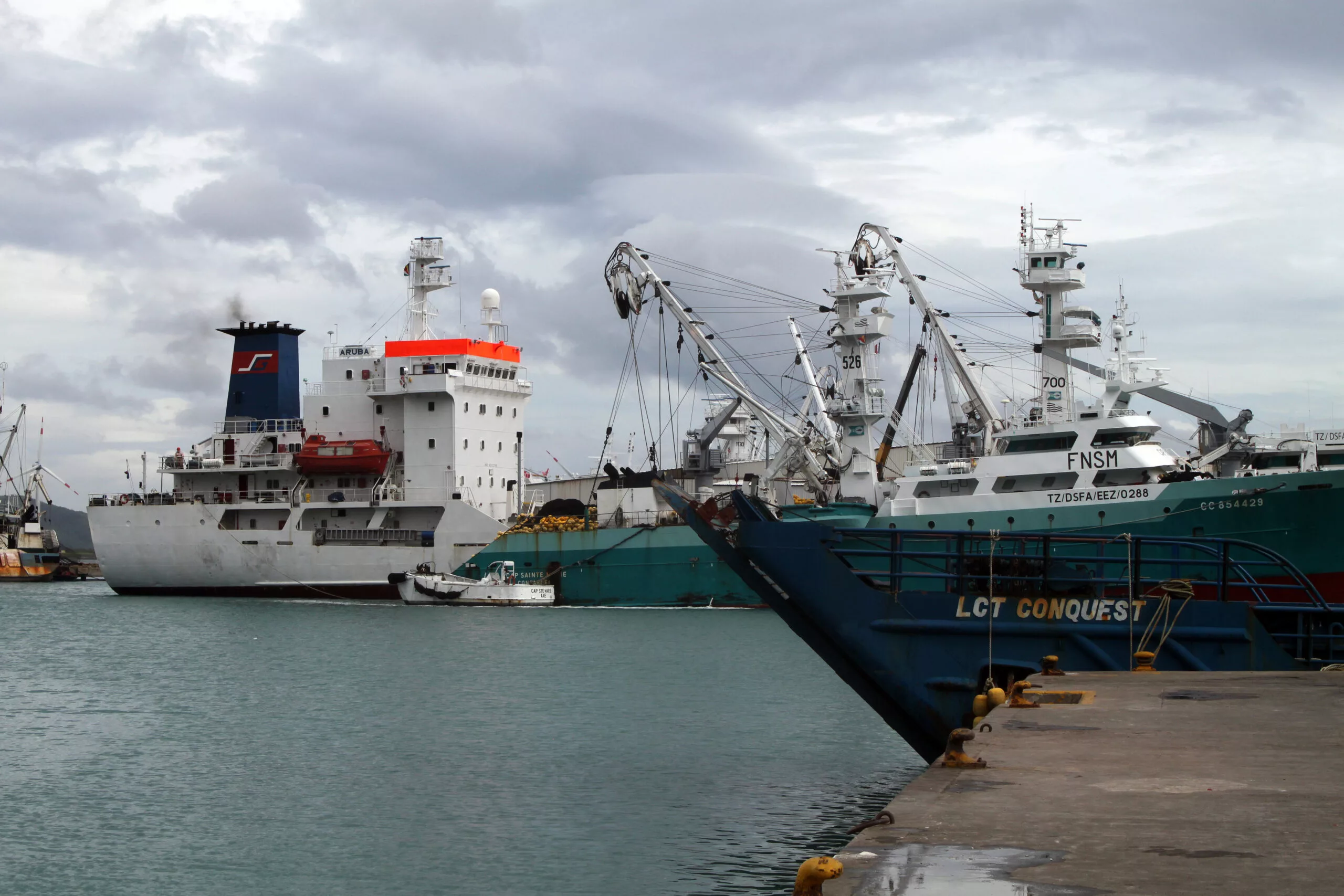
Port Victoria handles most of the tuna caught in the region. About 85 percent of purse-seine tuna in the south-west Indian Ocean is transhipped through the port.
That makes the archipelago a processing and transhipment hub rather than merely a fishing nation. Canning, cold storage and vessel servicing capture more value than the fish itself.
Tourism does the rest. High-value, low-volume visitors produce a per-head income figure that most of the continent cannot approach.
The debt story is the real achievement
Seychelles defaulted in 2008 and spent ten years rebuilding investor trust. Public debt is now 53.6 percent of GDP.
The target is 50 percent of GDP by 2029, under an IMF-supported plan.
Fitch Ratings holds the sovereign at BB. That is still below investment grade, and it is a long way above where the country sat after the default.
The consolidation has been achieved without the social rupture that usually accompanies it. Tourism receipts recovering faster than expected did much of the work.
For frontier investors this is the point of interest. A small open economy that restructured, consolidated and kept market access is a rarer object than a large one that did not.
The blue bond, and what it did and did not do
In 2018 Seychelles issued the world’s first sovereign blue bond, raising US$15 million earmarked for marine conservation and sustainable fisheries. The instrument has since been imitated from Belize to Ecuador.
The amounts were small in absolute terms. The significance was deep-seated: it established that ocean assets could be financed the way forests and carbon already were.
Latin American readers will recognise the lineage directly. Ecuador’s Galapagos debt conversion and the regional blue bond market both descend from work Seychelles helped pioneer.
The honest caveat is that these instruments finance conservation rather than transform a budget. They are a tool, and they were never a solution to a debt stock.
What the issue did change was the country’s standing. A sovereign that had defaulted a decade earlier was suddenly the reference case for a new asset class.
The vulnerabilities behind the headline number
A GDP per capita figure divided among roughly 100,000 people is sensitive to shocks that would barely register elsewhere. One weak tourist season or one fisheries dispute moves the national accounts.
The country imports almost all its food and fuel. High income per head coexists with total exposure to shipping costs and commodity prices.
Climate risk is not abstract here. Coral bleaching and shifting tuna migration would hit the two largest sectors simultaneously.
Offshore financial services carry a reputational tail as well. The jurisdiction has worked to align with international standards, and the sector remains sensitive to any change in the global listing regime.
Why small island states are worth watching
Seychelles is a laboratory for instruments that later scale. Blue bonds, debt-for-nature conversions and marine spatial planning were tested here before they reached larger balance sheets.
It also shows geography can help, not hurt. The country’s ocean area is more than 1.3 million square kilometers.
That area is a resource base. The country has used it that way.
That framing is spreading. Mauritius is legislating for its own ocean economy, and Mauritius recently secured United Nations backing for an extended seabed claim off Rodrigues.
The competitive question for the region is who captures the processing rather than who owns the water. Seychelles has answered it more successfully than most.
What to watch next
The first issue is the debt ratio nearing 50 percent. Will the government hold the line at that point?
The second is the tuna season and any change in regional fishing access agreements, which set the throughput at Port Victoria.
The third is air connectivity, including the talks with Angola that opened this week without flights being agreed.
Frequently Asked Questions
Does Seychelles have the highest GDP per capita in Africa?
GDP per capita hit about US$17,670 by April 2026. That is the highest in Africa, says the IMF.
The total economy was around US$2.32 billion.
How much of Seychelles debt has been repaid?
Public debt fell to 53.6 percent of GDP in 2025. Under an IMF-supported plan it is heading toward a 50 percent medium-term goal.
Why is tuna so important to Seychelles?
This country is in the world’s second largest tuna basin. That basin makes about 20 percent of global tuna.
About 85 percent of the purse-seine tuna caught in the region is transhipped through Port Victoria.
What is a blue bond?
It is a debt instrument whose proceeds are earmarked for marine and fisheries projects. Seychelles issued the world’s first sovereign version in 2018.
What credit rating does Seychelles hold?
Fitch Ratings carries the sovereign at BB, which is below investment grade but high for a small African issuer.
Connected Coverage
- The Indian Ocean ocean-economy race also runs through Mauritius winning a seabed extension. For the wider regional resource agenda see the region’s resource agenda, and for the continental contest see Africa: The New Scramble.
This article was produced by The Rio Times’ automated newsroom system. How we use AI · Report an error · Editorial responsibility: Matthias Camenzind, Editor-in-Chief
LatAm Markets: Live Signals → — real-time movers, turnover leaders and FX across Latin America.