
ASIA · ANALYSIS
Key Facts
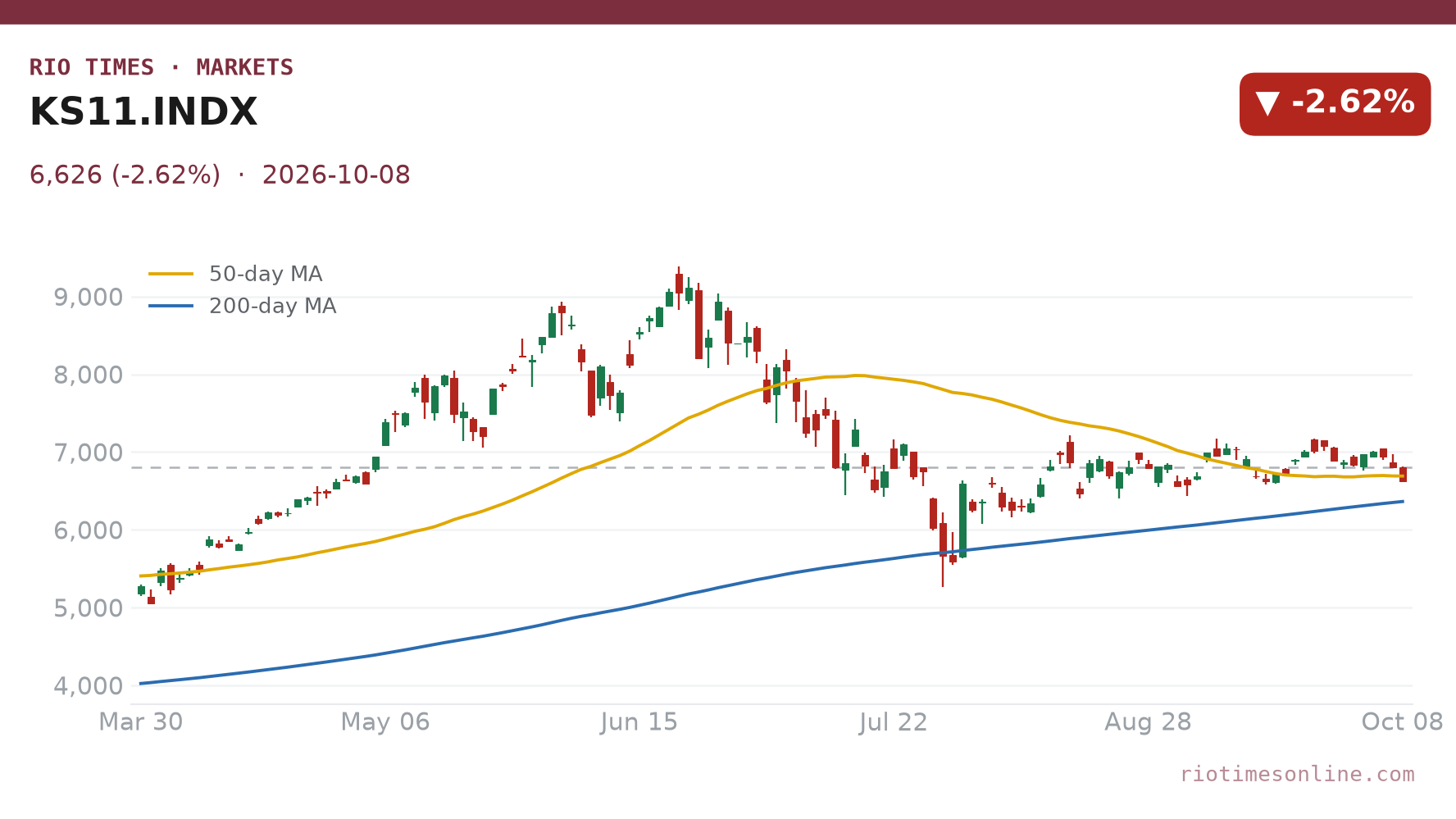
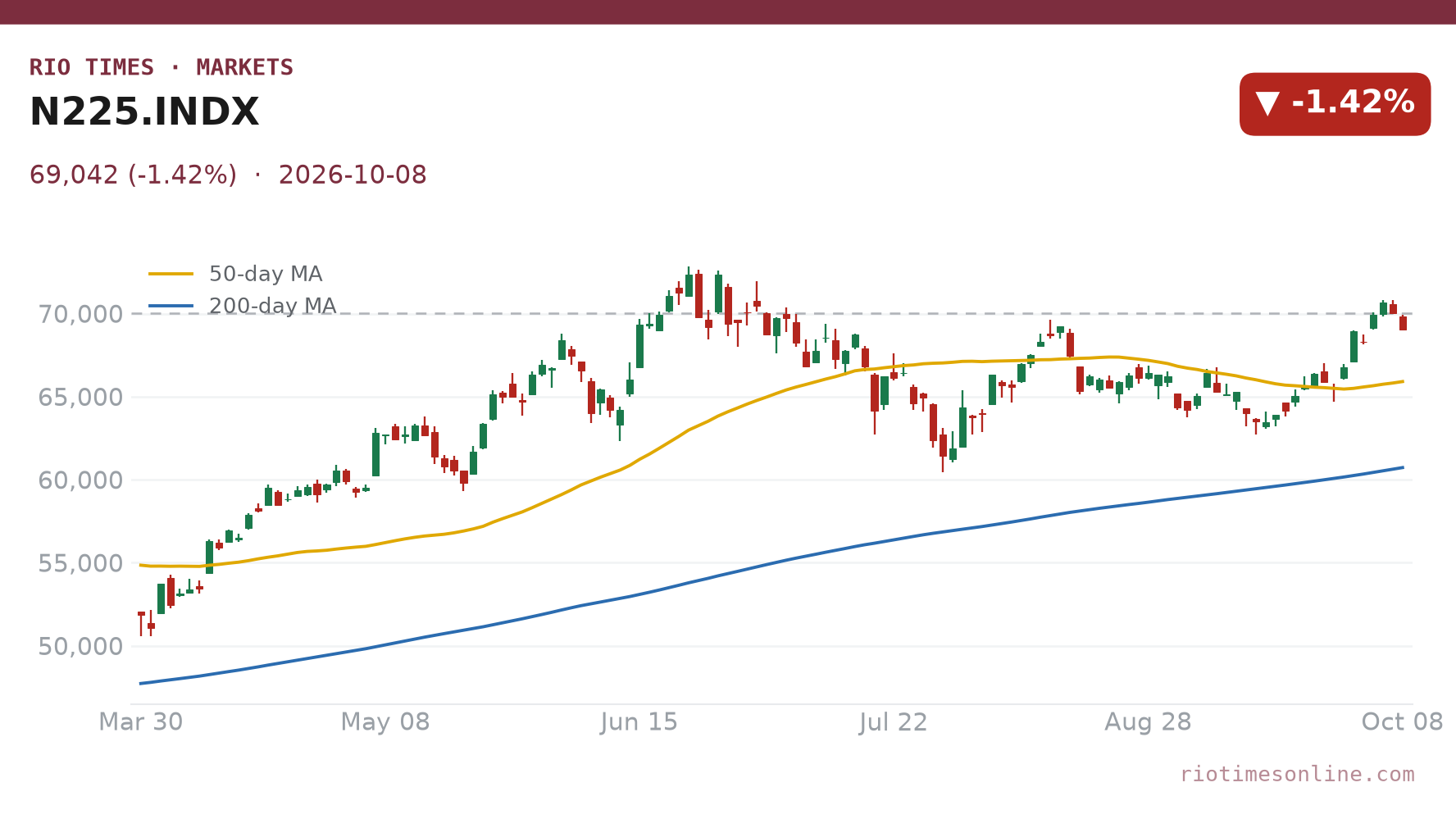
- —What is happening Asian stocks fell on 8 October 2026: Japan’s Nikkei 225 lost 1.4%, South Korea’s Kospi 2.6% and China’s Shanghai Composite 0.8%, while US crude rose.
- —Why it matters Japan, South Korea, India and China buy most of their oil abroad, so dearer crude lifts costs and squeezes company profits.
- —The numbers US crude (WTI) rose about 3.5% to roughly US$91.4 a barrel in US trading, and the 10-year US Treasury yield stood at 5.23%.
- —Who is who Brazil and Colombia are net oil exporters in Latin America; Mexico exports crude but imports refined fuel.
- —Prediction markets Polymarket prices a 62.5% chance that WTI touches US$95 in October and 35% for US$100 (US$1.33 million traded; read 5:17 pm ET, 8 October 2026).
- —What it means for you US holders of Asian ETFs and ADRs face higher energy costs and high US yields at once; Petrobras and Ecopetrol shares rose on the day.
Asian stock markets fell on 8 October 2026 as oil prices rose again, with the Nikkei 225 down 1.4%, the Kospi down 2.6% and the Shanghai Composite down 0.8%. For US readers the link is direct: American portfolios hold Asian ETFs and ADRs, and the same oil move lifts producers in Latin America.
Asia imports most of the oil it burns. When crude rises, the bill lands on households, airlines, chemical makers and governments within weeks. This analysis explains how that works, who is most exposed, and why Brazil and Colombia sit on the other side of the trade.
What Happened on 8 October
Japan’s Nikkei 225 fell 1.4% to 69,042, and South Korea’s Kospi fell 2.6% to 6,626, the biggest drop of the major Asian indices (RT market data). The Shanghai Composite slipped 0.8% to 3,811.90, and Hong Kong’s Hang Seng also lost more than 1%.
Oil moved the other way. In US trading, West Texas Intermediate (WTI), the US benchmark, rose about 3.5% to roughly US$91.4 a barrel, according to the Bloomberg market wrap carried by Swissinfo. The US Oil Fund (USO), an exchange-traded fund that tracks WTI futures, gained 2.6% on RT data.
Oil has swung sharply since the summer. The Associated Press reported on 11 September that crude was moving on whether the United States and Iran could agree to let tankers leave the Persian Gulf freely again.
Why Oil Hurts Asian Equities
The first reason is trade. Japan and South Korea have almost no domestic crude, and India and China depend heavily on imports too. A dearer barrel widens their import bills and weighs on their currencies. The yen traded near 157.9 per US dollar on 8 October, so oil priced in dollars costs Japanese buyers even more.
The second reason is costs. Fuel feeds into transport, plastics, fertiliser and food. Airlines, shipping lines, refiners and petrochemical producers feel it first. If firms pass the cost on, headline inflation rises, and central banks have less room to cut interest rates.
The third reason is US interest rates. The 10-year US Treasury yield was 5.23% on 8 October, according to the same Bloomberg wrap, which also reported that Federal Reserve Governor Christopher Waller expects more rate hikes. High US yields make dollar bonds more attractive than Asian stocks, and they lower the value of future profits, which hits technology shares hardest. Chip stocks fell more than 3% in US trading on the day, and the Kospi and Nikkei both lean heavily on chip makers.
Live Market IntelligenceCommodities — Live Market Board
Rio Times · Live Market Intelligence
Commodities — Live Market Board
-0.03%
| Instrument | Last | Change | YoY | Prev. | High | Low | Volume |
|---|---|---|---|---|---|---|---|
| GOLD | 4,461 | +1.78% | +33.20% | 4,383 | 4,503 | 4,421 | 139,824 |
| SILVER | 65.59 | +1.26% | +73.05% | 64.77 | 66.98 | 64.81 | 46,406 |
| BRENT | 88.88 | -0.03% | +34.42% | 88.91 | 90.07 | 88.12 | 29,713 |
| WTI | 83.11 | -0.11% | +31.57% | 83.20 | 84.35 | 82.40 | 166,848 |
| COPPER | 6.61 | +0.03% | +46.70% | 6.61 | 6.71 | 6.61 | 39,543 |
| LITHIUM | 75.20 | +1.47% | +62.95% | 74.11 | 75.80 | 75.08 | 89,275 |
| IRON ORE | 161.91 | — | +58.10% | 161.91 | 161.91 | 1 | |
| SOY | 1,184 | +3.20% | +17.05% | 1,148 | 1,199 | 1,168 | 163,179 |
| CORN | 480.50 | +10.02% | +29.34% | 436.75 | 480.75 | 459.50 | 341,248 |
| WHEAT | 655.00 | +3.93% | +29.70% | 630.25 | 657.75 | 631.50 | 128,793 |
| COFFEE | 317.25 | -5.51% | +0.67% | 335.75 | 321.20 | 313.55 | 21,747 |
| SUGAR | 16.43 | -1.79% | -3.01% | 16.73 | 17.11 | 16.22 | 171,992 |
| COCOA | 5,719 | +3.18% | -34.96% | 5,543 | 5,779 | 5,574 | 26,773 |
| ORANGE JUICE | 138.55 | -0.47% | -45.38% | 139.20 | 141.05 | 137.50 | 703 |
| COTTON | 85.03 | +2.33% | +26.78% | 83.09 | 82.90 | 81.96 | 16,546 |
| BEEF | 223.60 | -3.93% | -5.18% | 232.75 | 226.40 | 223.00 | 16,126 |
| CATTLE | 339.10 | -3.16% | -1.82% | 350.17 | 345.50 | 338.60 | 10,164 |
| USD/BRL | 5.16 | +0.01% | -5.13% | 5.16 | 5.18 | 5.14 | — |
Who Is Most Exposed
South Korea and Japan combine heavy oil imports with large technology sectors, so they face both the cost shock and the rate shock. That helps explain the Kospi’s larger fall. India is another large importer, and its Sensex fell about 1.5% during Thursday’s session on RT data. China imports a great deal too, but its domestic market is driven more by local demand and policy, and its fall was smaller.
Not every Asian company loses. Oil producers and some state-owned energy groups can gain when prices rise. But stock indices are dominated by banks, manufacturers, consumer firms and technology companies, so the broad index usually falls when oil jumps.
Latin America on the Other Side
Higher crude moves income toward exporters. Brazil’s Petrobras, listed in New York as PBR, rose 2.9% to US$24.69 on 8 October. Colombia’s Ecopetrol (EC) rose 1.9% to US$16.95 (RT, closing data).
Brazil and Colombia both produce more crude than they use, so a higher price raises export income and government revenue. The gain is not automatic. Brazil can hold down domestic fuel prices, which limits what Petrobras earns at home. Mexico also exports crude, but it imports much of its gasoline and diesel, so its benefit is smaller.
What Prediction Markets Say
On Polymarket, traders put a 62.5% probability on WTI touching US$95 at some point in October 2026 and 35% on US$100. They put 94.5% on a dip to US$90, and 59.5% on a dip to US$85. More than US$1.3 million has been traded on this market. Prices are as of 5:17 pm ET on 8 October 2026.
Why we show this: prediction markets turn real-money bets into a live probability that moves within minutes of the news, which is why investors, campaigns and newsrooms in the United States now follow them closely. We show them next to polls and official results, never instead of them.
What It Means for You
If you own a Japan, South Korea, India or broad Asia-Pacific fund, expect oil to be one of its swing factors while the Gulf stays unsettled. The same oil move can help Latin American energy shares in your portfolio. Check how much of a fund sits in technology and in energy importers before drawing conclusions from one day of trading.
What Is Not Known
Reports point to several drivers for the oil rise on 8 October, including the US–Iran standoff, and none is confirmed as the sole cause. Nor is it clear whether the move will last, or whether it will feed into core inflation in Asia. How far the Fed will raise rates is also open; Governor Waller’s expectation is one view, not a decision.
What to Watch
The next US consumer price report is due on Wednesday 14 October 2026 at 8:30 am ET (12:30 UTC). A hot reading would add pressure on bond yields and on Asian shares. Weekly US crude inventory data follow on Thursday 15 October. Watch also the yen near 158 per dollar, and any news on tanker passage through the Persian Gulf.
Frequently Asked Questions
Why do higher oil prices hit Asian stock markets?
Most large Asian economies import most of their crude, so dearer oil raises transport, factory and food costs and weakens trade balances. It can also keep US interest rates high, which lowers the value of future profits and weighs on shares.
Which Asian markets fell on 8 October 2026?
The Nikkei 225 fell 1.4% to 69,042, the Kospi 2.6% to 6,626 and the Shanghai Composite 0.8% to 3,811.90, according to RT market data.
How much did oil rise on 8 October 2026?
West Texas Intermediate rose about 3.5% to roughly US$91.4 a barrel in US trading, according to the Bloomberg market wrap carried by Swissinfo.
Which Latin American companies gain from higher oil prices?
Producers such as Brazil’s Petrobras and Colombia’s Ecopetrol benefit from higher crude. Their New York-listed shares rose 2.9% and 1.9% on 8 October 2026.
What are prediction markets saying about oil?
On Polymarket, traders gave a 62.5% chance that WTI touches US$95 in October 2026 and 35% for US$100, as of 5:17 pm ET on 8 October. These are bets, not forecasts by officials.
Sources: RT market data (8 October 2026); Swissinfo/Bloomberg market wrap, 8 October 2026; Associated Press, 11 September 2026; Polymarket (WTI October market); US Bureau of Labor Statistics release calendar via RT. See also the Asia Intelligence Brief of 8 October 2026.
This article was produced by The Rio Times’ automated newsroom system. How we use AI · Report an error · Editorial responsibility: Matthias Camenzind, Editor-in-Chief
LatAm Markets: Live Signals → — real-time movers, turnover leaders and FX across Latin America.