Nine states in Brazil and the Federal District record no Covid-19 deaths in 24 hours
RIO DE JANEIRO, BRAZIL – Data released by the Ministry of Health show that nine states and the Federal District have not recorded deaths from Covid-19 in 24 hours. São Paulo, Minas Gerais, Goiás, Sergipe, Piauí, Rondônia, Amapá, Roraima, Acre and the Federal District had no deaths from the virus in this period.
The country recorded yesterday (8) the lowest moving average of deaths by the disease in 2021. There are 269.2 deaths on the moving average, besides 10.7 thousand cases. This is a 21% drop compared to the last 14 days and 91% compared to the pandemic’s peak in April.
The Unified Health System (SUS) has applied more than 281 million doses of vaccine. According to the ministry, Brazil has 88% of the target population vaccinated with the first dose and 70% with the complete vaccination scheme – with the second or single dose of the immunizer.

WILL BRAZIL FOLLOW IN THE FOOTSTEPS OF OTHER COUNTRIES?
Brazil can currently be pleased about low infection rates and few Covid deaths. However, if other countries are taken as a comparison, it must be assumed that the joy could be short-lived.
Brazil could soon be suffering the same fate as Chile, Israel, Iceland, the UK, Portugal, and others before them.
In Chile e.g. 89.5% of the target population has been injected with two doses, 5 million booster doses have been administered, and 75% of children between 6 and 17 years of age have already received their first dose of the vaccine. And still, the numbers are getting worse again.
The positivity rate, the percentage of positives out of the total number of PCRs performed, exceeded the 3% barrier for the first time in three months in Chile and reached 3.06% on October 26, at a time when the country is experiencing a resurgence of Covid-19 despite much higher vaccination rates than Brazil.
Or take Israel. It was the first country in the world to fully vaccinate 69% of its 9.3 million residents over 16 years of age against Covid-19. The Pfizer/BioNTech vaccine distribution began in December 2020, and people were considered fully protected one week after the second injection.
However, in mid-August, it was reported that Israel had one of the highest daily infection rates in the world, doubling in just two weeks to an average of nearly 7,500 cases per day, meaning that almost one in 150 people is infected with the virus.
This meant that in August, half of the severely ill patients in Israel were those who had previously received double doses of the vaccine. The number of infections had increased tenfold from mid-July to mid-August, and reported deaths rose from 5 in June to 248 just two months later.
LATEST U.K. DATA
Latest U.K. data suggests that anyone vaccinated more than a few months ago is at a much higher risk of Covid-19 infection and, therefore, more likely to be infected than their unvaccinated counterparts. The vaccinated now pose the most significant risk for Covid transmission.
The agency says most of those vaccinated have much higher infection rates, and its latest graph provides a snapshot:
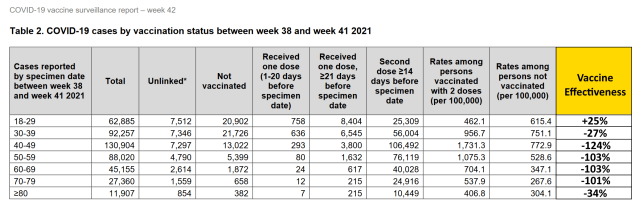
All vaccinated people over 30 in the U.K. now have much higher infection rates than their unvaccinated peers. However, this says nothing about how this has happened or how it will develop.
The last British age group to be vaccinated was 18- to 29-year-olds, half of whom were fully vaccinated about nine weeks ago. Although they are still doing better than the unvaccinated age group, they have lost most of their relative resistance to infection. If they continue their development, this advantage will be gone entirely by week 12.
The age group that was vaccinated earliest was the 30-39 age cohort. Half were fully immunized by about week 27 and had lost their increased resistance to infection by week 39 (again, about 12 weeks later). At least in these two cohorts, vaccine-induced immunity appears to have been reduced to zero in less than three months.
Unfortunately, it does not stop there, as the data show that those vaccinated slipped into negative territory, raising the question of how all previously vaccinated cohorts are doing now.
The entire cohort of 40- to 79-year-olds who have been vaccinated is trending strongly negative, now below minus 50%, meaning that the infection rate among them is more than double that of their unvaccinated peers, with no end in sight; given the persistent and strongly negative trend among all adult cohorts, it is impossible to guess where or when the bottom might be reached.
More: Brazil news in English, every day from The Rio Times.
This article was produced by The Rio Times’ automated newsroom system. How we use AI · Report an error · Editorial responsibility: Matthias Camenzind, Editor-in-Chief