Mexico Markets: IPC & the Peso — August 13, 2026
Key Facts
- The IPC closed higher Mexico’s benchmark S&P/BMV IPC rose 0.29% to 65,755.97 points on Wednesday, August 12, 2026.
- The peso firmed the currency strengthened about 0.11% to 17.0607 per US dollar, close to its strongest level in a year.
- Softer US inflation was the driver cooler American core prices eased pressure on the Federal Reserve to raise rates again, which helps Mexican assets.
- Banks led the gainers Banorte rose 1.5% and Grupo México added 0.9%, while Walmex fell 1.1% and Cuervo lost 4.2%.
- Mexico led the region alongside Colombia the IPC matched Colombia’s COLCAP at +0.29% and beat Brazil’s Ibovespa (−0.23%), Chile’s IPSA (−1.31%) and Argentina’s Merval (−0.76%).
- Why it matters a calmer Fed narrows the interest-rate gap that has weighed on the peso, supporting both the currency and Mexican shares.
Today’s Focus
Mexican shares closed higher on Wednesday, with the benchmark S&P/BMV IPC index gaining 0.29% to settle at 65,755.97 points. The peso also firmed, by about 0.11% to 17.0607 per US dollar.
The driver was a US inflation report showing core prices, which strip out volatile food and energy costs, rising 0.2% on the month, exactly as forecast. That should give the American Federal Reserve, the US central bank, room to leave its policy rate unchanged rather than raising it again.
For Mexico, a less hawkish Fed is doubly good news: it narrows the gap that has kept pressure on the peso and supports the interest-rate narrative that has underpinned Mexican equities. A US central bank that stops tightening removes a headwind from the whole emerging-market complex.
What matters today. Softer US inflation let Mexican assets breathe, lifting the IPC and the peso together.

01 The session in one read
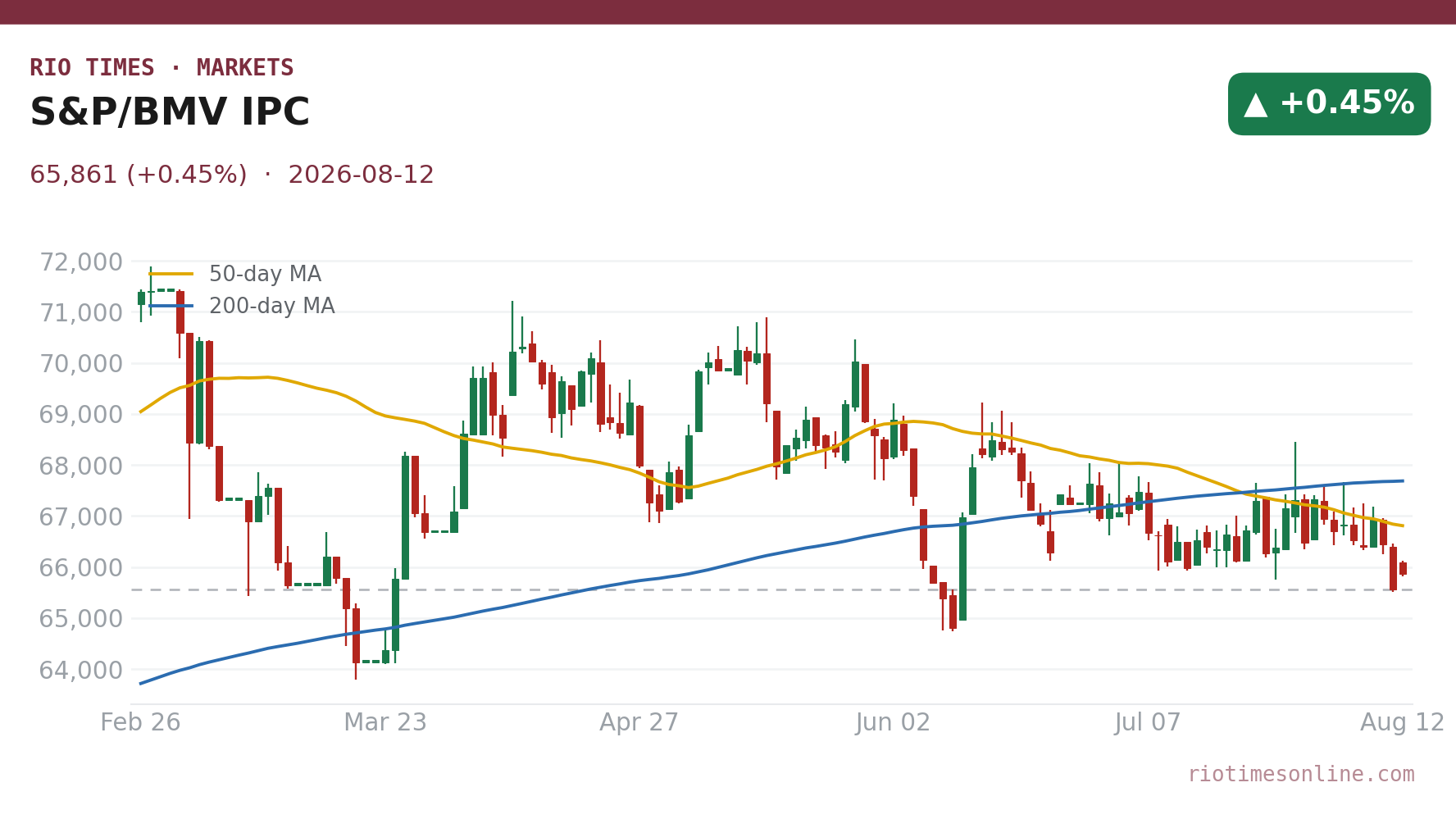
Mexican stocks put in a quietly confident session on Wednesday, with the S&P/BMV IPC — the country’s benchmark share index of its 35 most valuable listed companies — climbing 0.29% to close at 65,755.97 points. The peso, Mexico’s currency, followed suit, firming about 0.11% to 17.0607 per US dollar.
The trigger came from north of the border. Fresh data showed US core inflation, which excludes food and energy, at 0.2% on the month and 2.5% on the year, matching economists’ forecasts. That eased pressure on the Federal Reserve to keep pushing interest rates higher, a relief for every emerging market that borrows or trades in dollars.
Mexico is particularly sensitive to this dynamic because its central bank, Banxico, has been moving more cautiously than the Fed. A pause in US tightening gives Banxico room to breathe and strengthens the case for holding local rates steady without the peso coming under attack.
The session’s gains were broad but modest, concentrated in financials and mining names rather than the consumer staples that had been dragging. Volume in the most-traded names was lighter than recent sessions, suggesting conviction is still building. The key variable to watch is whether the peso can hold below the 17.10 level, a psychological barrier that has capped rallies before.
02 The day’s numbers
| Measure | Level | Change | Read |
|---|---|---|---|
| S&P/BMV IPC | 65,755.97 | +0.29% | 8.8% below 52-week high; range 57,623.87–72,111.41 |
| USD/MXN | 17.0607 | −0.11% | 9.6% below 52-week high; range 17.0157–18.8725 |
| S&P 500 | 7,748 | +0.26% | Just 0.1% below its record high |
| Nasdaq | 26,588 | +0.54% | Tech-led US gains supported risk appetite |
| VIX | 14.55 | −4.78% | Falling volatility index signals calmer markets |
The IPC’s 0.29% advance was enough to keep it comfortably above its 52-week low of 57,623.87, but it remains 8.8% below the high of 72,111.41 set last year. That positioning means Mexican equities are not yet pricing a full recovery, leaving room for further gains if global conditions stay supportive.
The peso’s close at 17.0607 was strikingly close to the 52-week low of 17.0157 in USD/MXN, a level that has acted as support for the dollar. Holding below 17.10 would be a technical signal that the currency’s recovery has legs. Rio Times · Live Market Intelligence
Live Market IntelligenceMexico — Live Market Board
Mexico — Live Market Board
Instrument Last Change YoY Prev. High Low Volume
IPC MEX
64,214.36
-1.38%
+12.17%
65,110.57
66,121
65,405
108,886,187
USD/MXN
17.06
-0.24%
-8.58%
17.10
17.08
17.01
—
WALMEX
48.07
-0.62%
-14.38%
48.37
48.65
48.02
10,781,446
GMEXICO
223.28
+0.35%
+73.59%
222.50
226.18
222.17
1,325,556
FEMSA
201.19
-0.24%
+25.67%
201.67
206.71
199.56
750,706
CEMEX
19.32
+0.89%
+19.10%
19.15
19.35
19.04
14,327,054
GFNORTE
193.98
+1.18%
+14.36%
191.71
195.79
191.83
1,579,115
BIMBO
60.98
-0.96%
+11.89%
61.57
61.46
60.29
1,048,115
TELEVISA
9.71
+0.21%
+12.78%
9.69
9.75
9.60
577,851
AMX
19.80
-0.95%
+12.53%
19.99
20.05
19.70
58,058,525
GAP
366.23
+0.43%
-21.21%
364.68
370.85
362.82
226,946
ASUR
275.04
+1.25%
-15.28%
271.64
275.08
271.31
15,451
OMA
233.50
+0.62%
-6.48%
232.06
235.00
230.62
555,693
KOF
188.04
+0.86%
+18.94%
186.44
188.56
185.52
425,273
GRUMA
252.90
+0.11%
-21.85%
252.61
254.74
250.36
90,048
KIMBER
39.74
+0.43%
+8.85%
39.57
40.09
39.33
490,551
AMX ADR
23.38
-0.23%
+22.25%
23.43
23.49
23.06
1,347,445
03 Why it moved — soft US inflation
The American Bureau of Labor Statistics reported that core consumer prices rose 0.2% on the month in July, in line with forecasts. That number, which strips out food and energy swings, is the measure markets watch most closely for underlying inflation pressure. The Federal Reserve’s own 2% target is set on the separate PCE price index.
Traders read the data as meaning the Fed can justify leaving its benchmark rate where it is, rather than delivering another hike. The VIX, Wall Street’s fear gauge, dropped 4.78% to 14.55, confirming investors were less worried about a policy shock.
For Mexico, the chain reaction runs through currency markets first. A less aggressive Fed means the dollar loses some of its appeal, which lets the peso strengthen. A firmer peso, in turn, helps local companies by lowering the cost of dollar-denominated debt and imported inputs.
The rally in the IPC was reinforced by the same global risk-on mood that pushed the Nasdaq up 0.54%. Mexican assets often trade as a leveraged proxy for appetite toward the whole Latin American and emerging-market universe.
04 The day’s movers
| Driver | Level / Move | Change | Note |
|---|---|---|---|
| Banorte (GFNORTEO) | Most-traded | +1.6% | Banks lead; turnover $42 million |
| Grupo México (GMEXICOB) | Most-traded | +0.9% | Mining giant gained on metal prices; $44m |
| América Móvil (AMXB) | Most-traded | −0.6% | Telecoms heavyweight slipped; $95m |
| Walmex (WALMEX) | Most-traded | −1.4% | Retailer fell; $59m |
| Cuervo (CUERVO) | Biggest loser | −4.2% | Tequila maker extended recent decline |
| ASUR (ASURB) | Airport operator | +1.5% | Airports recovered after a soft patch |
The session’s most-traded names, by dollar turnover of their local shares, were América Móvil at $95 million, Walmex at $59 million, and Grupo México at $44 million. Banorte followed closely at US$42 million, its 1.5% gain marking it as the day’s standout among large caps.
Banorte, one of Mexico’s largest banks, often leads the IPC when bond yields fall, because banks benefit directly from a more stable rate environment. Grupo México, the country’s biggest mining company, rose 1.0% as industrial metals held firm. On the losing side, Walmex — the Mexican unit of Walmart — dropped 1.4%, continuing a trend of consumer-staple weakness that has weighed on the index this quarter.
05 The regional scoreboard
| Index | Country | Change |
|---|---|---|
| S&P/BMV IPC | Mexico | +0.45% |
| Ibovespa | Brazil | −0.23% |
| S&P 500 | United States | +0.26% |
| IPSA | Chile | −1.31% |
| Merval | Argentina | −0.76% |
Mexico led the main Latin American gauge on Wednesday, edging past Brazil’s Ibovespa, which slipped 0.23%. Chile’s IPSA was the clear regional laggard, down 1.31%, while Argentina’s Merval lost 0.76% as that market continued to digest its own domestic pressures.
The broader message is that the soft US inflation number buoyed most global equity markets, but the reaction was uneven. Mexico, with its tight financial links to the US and a peso that benefits from any dollar softening, was among the clearest beneficiaries.
06 The technical picture
The IPC’s close at 65,755.97 keeps it above the 65,000 mark, a level that has served as psychological support in recent weeks. The index is now testing the upper end of a range that has capped rallies since the second quarter.
The peso is the more interesting technical story. At 17.0607, USD/MXN sits almost exactly at its 52-week low — traders call this a key support level for the dollar, meaning it has been hard for the greenback to push below this zone. A decisive break lower in USD/MXN would argue for further peso strength, while a bounce back above 17.10 would suggest the rally has stalled.
07 What to watch
- US retail sales on Friday: The next major read on the American consumer; a strong number could revive Fed hawkishness and pressure the peso
- Peso’s 17.02–17.10 range: A break below could spark momentum buying in Mexican assets; a rebound above 17.10 would check the rally
- Thursday’s CFTC positioning data: Shows whether speculative traders are adding to peso longs, a sentiment gauge for the currency
- Banorte’s move: The bank’s gain on Wednesday needs follow-through; if financials continue to lead, the IPC’s recovery could broaden
Background: Mexico’s Industrial Production Grew 1.7% in June, but the Half Was Flat.
Background: Mexico’s Foreign Direct Investment Climbs 10.4% as Nearshoring Holds Up.
More: Mexico news in English, every day from The Rio Times.
Frequently Asked Questions
What is the S&P/BMV IPC?
It is Mexico’s main stock index, tracking the 35 largest and most liquid companies listed on the Bolsa Mexicana de Valores, the Mexican stock exchange.
Why did the peso strengthen against the dollar?
Softer US core inflation reduced expectations that the Federal Reserve will raise rates further, weakening the dollar and making the peso more attractive.
Which Mexican stocks moved the most?
Banorte rose 1.5% to lead gainers, while Cuervo fell 4.2% to lead losers. América Móvil was the most-traded name with $95 million in turnover.
How far is the IPC from its record?
The IPC closed at 65,755.97 on August 12, about 8.8% below its 52-week high of 72,111.41 and well above its low of 57,623.87.
This article was produced by The Rio Times’ automated newsroom system. How we use AI · Report an error
In depth
LatAm Markets: Live Signals → — real-time movers, turnover leaders and FX across Latin America.
Read More from The Rio Times