Mexican Peso Hits Its Weakest Since December 2025, Down Over 1% Against the US Dollar
ECONOMY · MEXICO
Key Facts
- —The country Mexico, Latin America’s second-largest economy, whose peso floats freely and is one of the most traded emerging-market currencies.
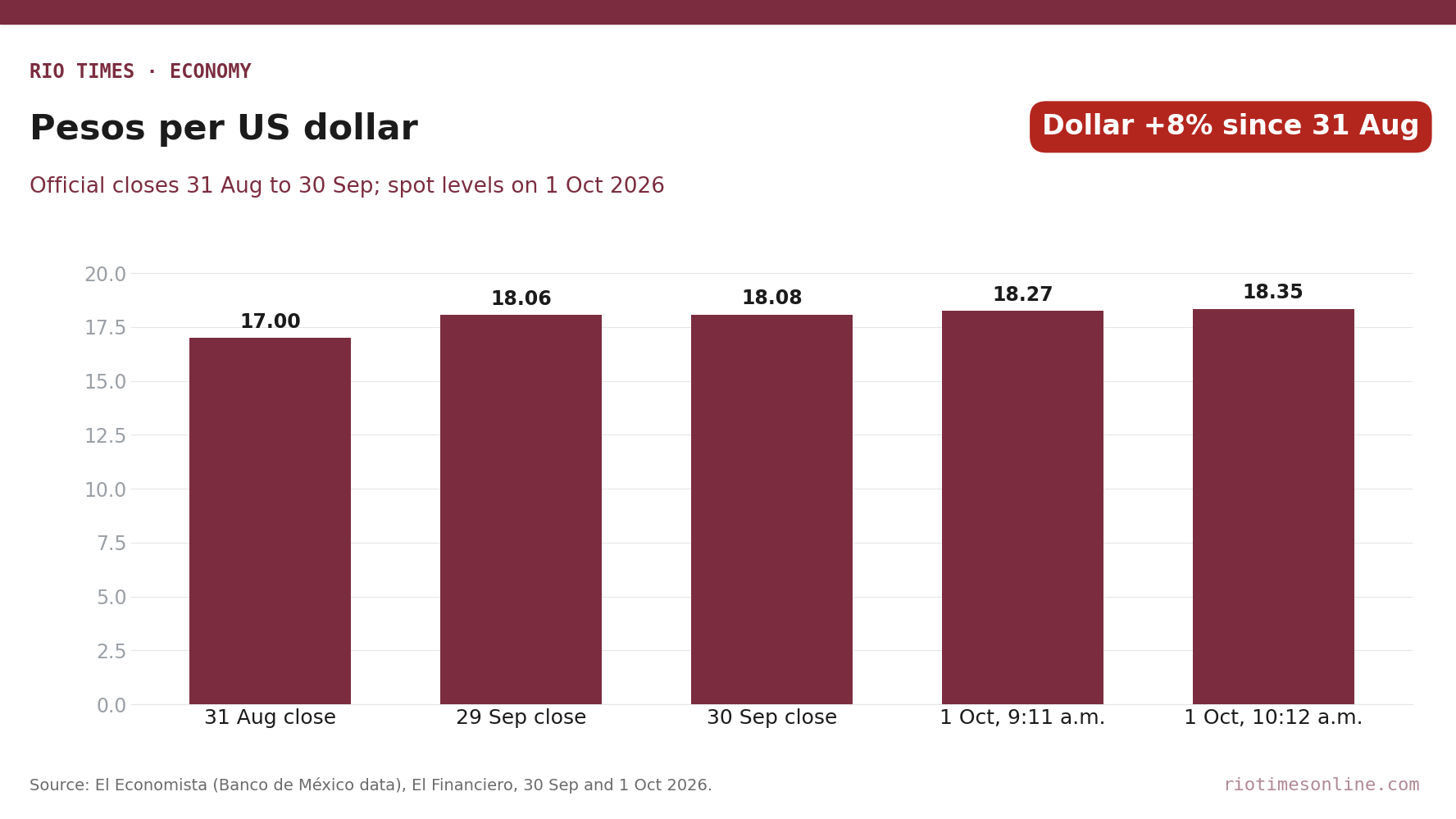
- —What happened On Thursday 1 October 2026 the peso weakened past 18.26 per US dollar, its weakest since December (El Economista), and to about 18.35 by 10:12 a.m. Mexico City time (El Financiero).
- —The numbers Wednesday’s official close was 18.0808; by mid-morning the loss exceeded 1 percent. In September the peso lost 6.38 percent, its worst month since June 2024.
- —What it means for you Dollar earners and remittance receivers get more pesos per dollar. Importers, travellers abroad and anyone paying dollar debts face higher peso costs.
- —Still open Thursday’s official close, Friday’s US jobs report and the next Federal Reserve decision on 27–28 October.
The Mexican peso started October with another drop, trading at 18.2661 per US dollar at 9:11 a.m. on Thursday 1 October. The financial daily El Economista said that was its weakest level since December, and the slide continued later in the morning.
The move came a day after the peso closed September with its steepest monthly loss in more than two years. Rising oil prices and fresh tension between Washington and Tehran pushed investors towards the dollar.

A loss of more than 1 percent by mid-morning
Measured against the official close of 18.0808 published by Banco de México, the central bank, the peso had lost 18.53 centavos by 9:11 a.m. That equals 1.02 percent, El Economista calculated.
The dollar traded between 18.0679 and 18.2900 per dollar in the early session. The newspaper said the peso was on course for a fourth straight daily fall.
By 10:12 a.m. the rate stood at about 18.35, some 27 centavos weaker than Wednesday’s close, the business daily El Financiero reported. It ranked the peso as the day’s weakest major currency, ahead of Chile’s peso.
Oil, Iran and US interest rates
Oil prices rose close to 2 percent on Thursday morning after China suspended exports of refined fuels, El Economista reported. The ICE dollar index, which measures the dollar against six major currencies, was up 0.42 percent.
The brokerage Monex linked the move to renewed tension between Washington and Tehran. “The peso gives up ground, in line with other emerging currencies,” it said in a note, also citing worries about supply chains and inflation.
Behind the daily swings sits US monetary policy. The US Federal Reserve raised rates in September, while Banco de México held its own rate at 6.50 percent, as Banxico Holds Rates at 6.5% and Splits From the Fed reported.
A smaller gap between Mexican and US rates makes peso assets less rewarding to hold. The yield on the 10-year US Treasury bond rose from 4.60 percent to 5.29 percent during September, El Economista said.
What September already did
The Mexican peso lost 6.38 percent in September, from 16.9971 per dollar on 31 August to 18.0808 on 30 September. Gabriela Siller of Banco Base said it was the worst month since June 2024.
The official close went above 18 per dollar on 29 September for the first time since March, as covered in Mexican Peso Breaks 18 per Dollar as US Yields Hit Their Highest Since 2007. The business outlet Expansíon reported that day that the 30-year US yield had reached its highest since 2002.
Why this is not yet a crisis
The fall looks large against a very strong summer, when the rate was below 17 per dollar. As of 30 September the peso was only 0.40 percent weaker than at the start of 2026, El Economista said.
Volatility in the third quarter was 6.97 percent on an annualised basis, lower than in the second quarter, according to Banco Base. The pressure so far is broad dollar strength, not a Mexico-specific shock.
For households, the effect cuts both ways. Families receiving dollar remittances gain purchasing power, while imported goods and fuel can become dearer if the weaker peso lasts.
What Is Not Yet Known
Thursday’s official Banco de México close was not available at the time of writing. The mid-morning levels cited here can still reverse before the session ends.
Friday’s US non-farm payrolls report is the next test for Fed expectations. The Fed meets again on 27 and 28 October, and Banco de México decides on 5 November.
Sources: El Economista, 1 October 2026 (market report, 9:11 a.m.); El Economista, 30 September 2026 (month-end report citing Banco de México data and Banco Base); Expansión, 29 September 2026; El Financiero, 1 October 2026 (10:12 a.m.); Monex note cited by El Economista.
In depth
LatAm Markets: Live Signals → — real-time movers, turnover leaders and FX across Latin America.
Read More from The Rio Times