Mexico Markets: IPC & the Peso — September 29, 2026
Key Facts
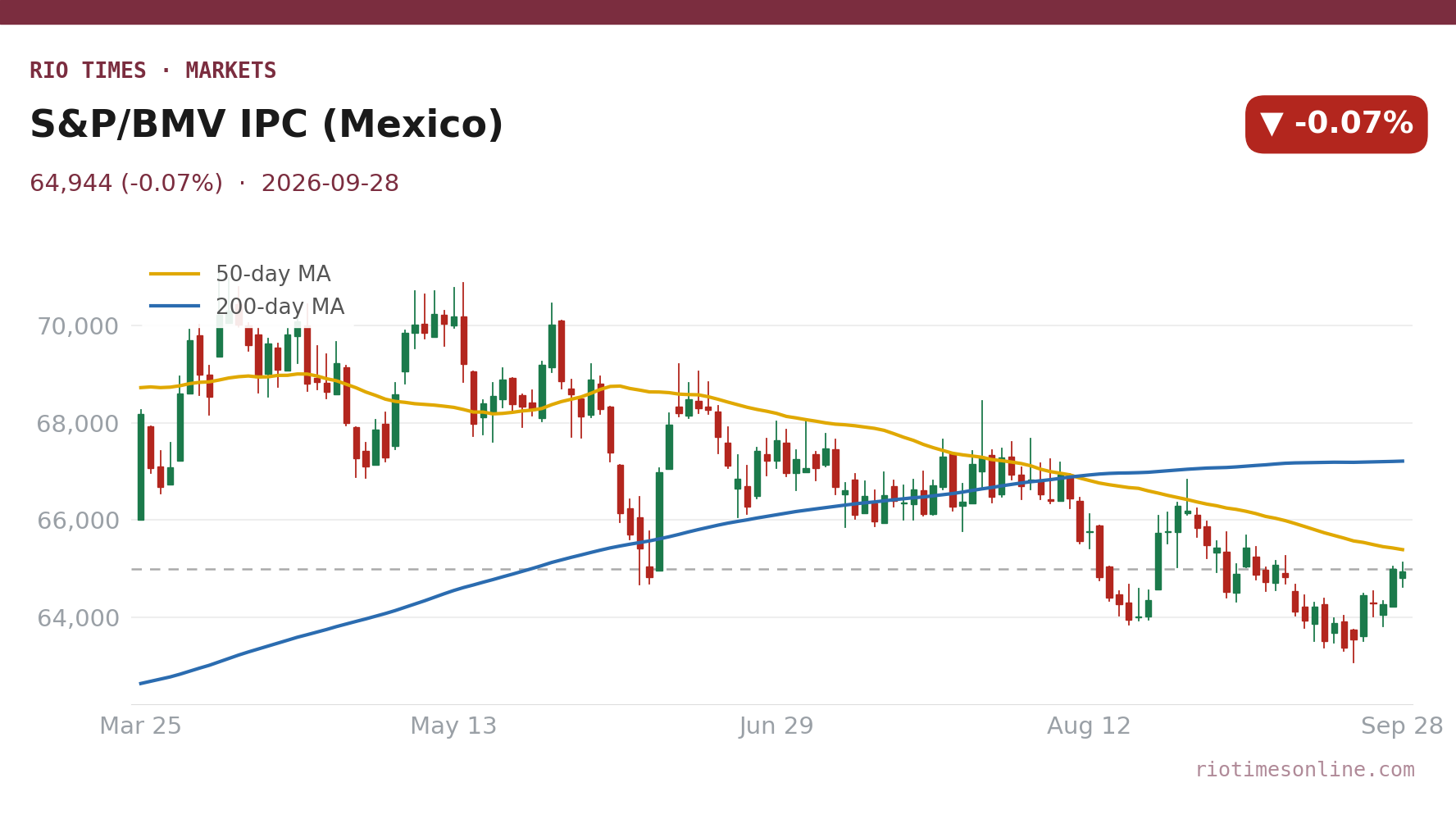
- Mexico’s benchmark index slipped 0.07% to close at 64,944 points, as losses in lenders, industrials and miners offset gains in consumer names
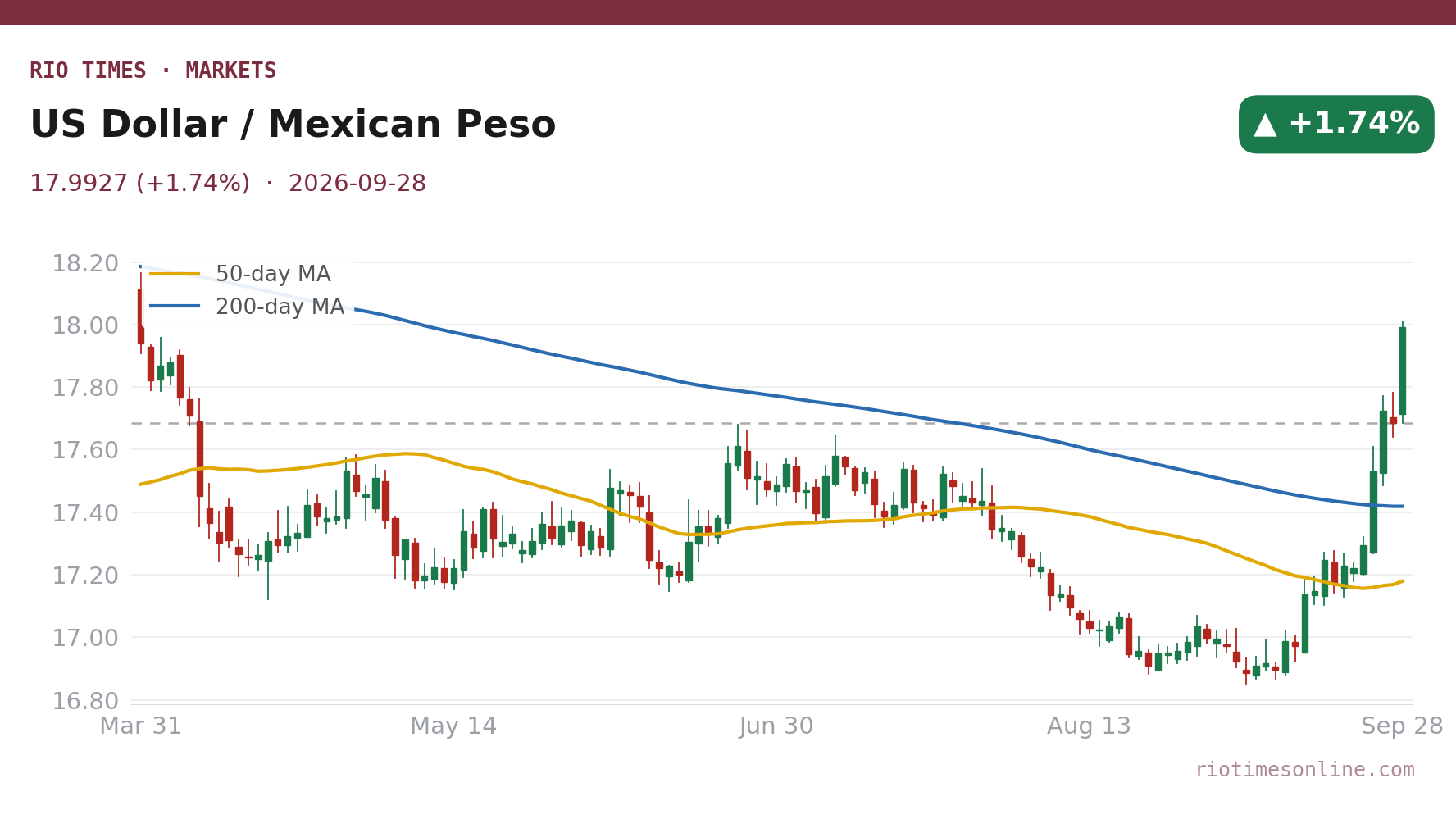
- The peso weakened 1.74% to 17.99 per US dollar, its weakest close since late March as the US currency strengthened broadly
- Banorte fell 1.0% on roughly US$37 million of turnover, one of the session’s most-traded stocks
- The move tracked a risk-off day on Wall Street where the S&P 500 dropped 0.77% and the VIX fear gauge jumped 8.07%
- Gold fell 3.71% to US$4,127 an ounce while silver tumbled 5.41%, hitting Mexico’s mining-heavy market from both sides
Today’s Focus
Mexican shares edged lower on Monday as a stronger US dollar and rising oil prices unsettled investors. The S&P/BMV IPC, the main local stock index, closed 0.07% lower at 64,944 points.
The peso fared worse, weakening 1.74% to 17.99 per US dollar. That is the currency’s weakest close since late March, pushed by a broad dollar bid as US Treasury yields climbed.
Losses were spread across lenders, industrials and miners. Banorte dropped 1.0%, while silver and gold miner Peñoles fell 1.1% as precious metals slid sharply.
The mood mirrored Wall Street, where the S&P 500 lost 0.77% after President Trump rejected an Iranian peace proposal and stalled US-Iran talks revived concerns about higher-for-longer inflation and interest rates.
What matters today. The peso’s break toward 18 per US dollar is tightening financial conditions at the same time global commodity prices are swinging hard.

01 The session in one read
Mexico’s main stock index slipped 0.07% on Monday, closing at 64,944 points, as a stronger US dollar and jittery global markets set the tone.
The peso weakened 1.74% to 17.99 per US dollar, briefly trading past 18 during the session, a psychological line that matters to importers, borrowers with dollar debt and foreign investors alike.
The day’s catalyst was geopolitical and monetary at once. Stalled US-Iran negotiations pushed oil higher and revived inflation worries, which lifted US bond yields and made the dollar more attractive.
That hit Mexico’s currency harder than its stocks. While the IPC barely moved, the peso fell to its weakest close since late March.
The 0.07% dip in the IPC was small compared with the peso’s 1.74% slide, suggesting local equity investors are not yet treating the currency move as a crisis. Defensive names like Walmex and Femsa rose, which usually signals caution rather than panic.
The variable to watch is whether the peso stabilises near 18 or keeps sliding toward its 52-week low of 18.68.
02 The day’s numbers
| Measure | Level | Change | Read |
|---|---|---|---|
| S&P/BMV IPC | 64,944 | −0.07% | Below recent highs, still above 52-week low of 60,216 |
| USD/MXN | 17.99 | +1.74% | Peso weakest since March; 52-week low 18.68 |
| 52-week high distance | −9.3% | — | IPC sits well under its 71,601 peak |
| Key technical level | 18.00 | — | Psychologically important for peso sentiment |
| US 10-year yield | 5.244% | +7.9 bp | Rising yields make the dollar more attractive |
| VIX fear index | 16.07 | +8.07% | Investors paying more for downside protection |
The IPC closed 0.07% lower at 64,944 points. That leaves the yardstick about 9.3% below its 52-week high of 71,601, reflecting a market that has been grinding lower rather than falling apart.
The peso’s move was the day’s headline. At 17.99 per US dollar, it is within sight of the 18.68 mark that represents the currency’s weakest level of the past 12 months.
Live Market IntelligenceMexico — Live Market Board
Rio Times · Live Market Intelligence
Mexico — Live Market Board
| Instrument | Last | Change | YoY | Prev. | High | Low | Volume |
|---|---|---|---|---|---|---|---|
| IPC MEX | 64,737.82 | -0.39% | +12.17% | 64,992.23 | 66,121 | 65,405 | 108,886,187 |
| USD/MXN | 17.06 | -0.24% | -8.58% | 17.10 | 17.08 | 17.01 | — |
| WALMEX | 48.07 | -0.62% | -14.38% | 48.37 | 48.65 | 48.02 | 10,781,446 |
| GMEXICO | 223.28 | +0.35% | +73.59% | 222.50 | 226.18 | 222.17 | 1,325,556 |
| FEMSA | 201.19 | -0.24% | +25.67% | 201.67 | 206.71 | 199.56 | 750,706 |
| CEMEX | 19.32 | +0.89% | +19.10% | 19.15 | 19.35 | 19.04 | 14,327,054 |
| GFNORTE | 193.98 | +1.18% | +14.36% | 191.71 | 195.79 | 191.83 | 1,579,115 |
| BIMBO | 60.98 | -0.96% | +11.89% | 61.57 | 61.46 | 60.29 | 1,048,115 |
| TELEVISA | 9.71 | +0.21% | +12.78% | 9.69 | 9.75 | 9.60 | 577,851 |
| AMX | 19.80 | -0.95% | +12.53% | 19.99 | 20.05 | 19.70 | 58,058,525 |
| GAP | 366.23 | +0.43% | -21.21% | 364.68 | 370.85 | 362.82 | 226,946 |
| ASUR | 275.04 | +1.25% | -15.28% | 271.64 | 275.08 | 271.31 | 15,451 |
| OMA | 233.50 | +0.62% | -6.48% | 232.06 | 235.00 | 230.62 | 555,693 |
| KOF | 188.04 | +0.86% | +18.94% | 186.44 | 188.56 | 185.52 | 425,273 |
| GRUMA | 252.90 | +0.11% | -21.85% | 252.61 | 254.74 | 250.36 | 90,048 |
| KIMBER | 39.74 | +0.43% | +8.85% | 39.57 | 40.09 | 39.33 | 490,551 |
| AMX ADR | 23.38 | -0.23% | +22.25% | 23.43 | 23.49 | 23.06 | 1,347,445 |
03 Why it moved — oil, the dollar and higher yields
The local session took its cue from a classic risk-off shift in global markets. President Trump rejected an Iranian peace proposal, US-Iran negotiations stalled and crude prices rose, rekindling fears that inflation could stay stubbornly high.
Higher inflation expectations pushed US Treasury yields up. The benchmark 10-year yield climbed about 8 basis points to 5.244%, a level that strengthens the dollar against emerging market currencies.
Banxico tried to soothe nerves. Governor Victoria Rodríguez Ceja told El Financiero that the peso’s depreciation did not add pressure beyond what the central bank’s inflation forecasts already assume. She described the floating exchange rate as a shock absorber for external shocks.
That message did not stop the peso from briefly trading past 18 per US dollar during the session.
04 The day’s movers
| Driver | Level / Move | Change | Note |
|---|---|---|---|
| Banorte (GFNORTEO) | Most-traded, US$37m | −1.0% | Banking bellwether slipped |
| Cemex (CEMEXCPO) | Most-traded, US$38m | −0.9% | Cement giant slipped with global growth fears |
| Grupo México (GMEXICOB) | Most-traded, US$36m | +0.3% | Mining conglomerate held steady despite metals slide |
| Industrias Peñoles (PE&OLES) | Most-traded, US$14m | −1.1% | Precious metals miner hit by gold and silver drop |
| Alsea (ALSEA) | Top IPC gainer | +3.0% | Restaurant operator defied the down day |
| Bimbo (BIMBOA) | Gainer | +1.8% | Bread maker offered defensive appeal |
| Walmex (WALMEX) | Gainer, US$16m | +0.6% | Retailer served as a defensive haven |
| Regional (RA) | Top IPC loser | −1.7% | Monterrey lender led the index decliners |
Turnover concentrated in the usual heavyweights. Cemex attracted the most trading at roughly US$38 million, followed by Banorte at US$37 million and Grupo México at US$36 million.
The gainers told a defensive story. Alsea rose 3.0% and Bimbo added 1.8%, while Walmex crept 0.6% higher — investors favouring steady consumer names as the peso fell.
05 The regional scoreboard
| Index | Country | Change |
|---|---|---|
| S&P/BMV IPC | Mexico | −0.07% |
| Ibovespa | Brazil | −0.26% |
| IPSA | Chile | −1.06% |
| Merval | Argentina | −3.28% |
| COLCAP | Colombia | −0.33% |
The down day was regional, and Mexico got off lightly. Argentina’s Merval index fell hardest, dropping 3.28%, while Chile’s IPSA lost 1.06%.
Brazil’s Ibovespa slipped 0.26% and Colombia’s COLCAP fell 0.33%, confirming that Monday’s mood was a broad Latin American retreat rather than a Mexico-specific story.
06 The technical picture
The IPC is trading roughly 9.3% below its 52-week high of 71,601, but it remains well above its 52-week low of 60,216. That puts the index in the lower-middle of its range, with no obvious break of major support or resistance on Monday.
The peso’s technical picture is more urgent. Having closed at 17.99, the currency is within striking distance of its 52-week low of 18.68.
A decisive break above 18.00 on a closing basis would likely accelerate momentum and could open a test of 18.30 next.
Conversely, if the dollar retreats and the peso recaptures the 17.80 area, traders may read this week’s slide as a one-off adjustment rather than a trend change.
07 What to watch
- US-Iran negotiations: Any progress could cool oil prices and ease the dollar bid that hit the peso
- Peso stability near 18.00: A sustained close above this level would mark a meaningful change in currency sentiment
- US Treasury yields: Further rises would keep pressure on emerging market currencies and local bonds
- Local inflation readings: Governor Rodríguez Ceja’s comments suggest the central bank will tolerate currency weakness for now
Background: Mexico’s IPC Falls 0.78% as the Peso Slips Before Banxico.
Frequently Asked Questions
What is the S&P/BMV IPC?
It is Mexico’s main stock index, tracking the country’s biggest and most liquid companies on the Mexican stock exchange
Why did the peso slide toward 18?
A stronger US dollar and higher Treasury yields made holding pesos less attractive. The peso closed at 17.99 per US dollar after briefly trading past 18
Which stocks fell hardest?
Regional fell 1.7%, the worst IPC performer, followed by cement maker GCC and bottler Arca Continental, both down about 1.1%. Among the heavyweights, Peñoles lost 1.1% and Banorte 1.0%
Was this a Mexico-only problem?
No — major Latin American markets fell together, with Argentina’s Merval down 3.28% and Chile’s IPSA losing 1.06%
IPC — Source: RT live market data, close of Monday 28 September 2026; exchange figures from BMV
This article was produced by The Rio Times’ automated newsroom system. How we use AI · Report an error
In depth
LatAm Markets: Live Signals → — real-time movers, turnover leaders and FX across Latin America.
Read More from The Rio Times