Mexico Markets: IPC & the Peso — August 29, 2026

Key Facts
- —The S&P/BMV IPC, Mexico’s main stock index, fell 0.53% to 65,484.32 points on Friday, closing near the low of its range.
- —The peso weakened to about 17.03 per US dollar, a drop of roughly 0.4% that took it back through the 17 mark.
- —Airport operators led the fall, with GAP down 3.4% and OMA down 1.0% as long-term borrowing costs rose.
- —The 10-year government bond yield rose to 9.22%, four hundredths of a percentage point higher on the day.
- —Mexico raised US$1,774 million in Japan, its largest samurai bond sale, easing next year’s funding needs.
- —Banxico has held its policy rate at 6.50% since May, and left it there again in August.
Today’s Focus
Mexico’s benchmark S&P/BMV IPC stock index slid 0.53% to finish at 65,484.32 points on Friday, closing near the low of a session that saw it trade between 65,295 and 65,964 points. The decline was led by airport operators and airlines, which sagged as investors absorbed higher long-term borrowing costs in Mexican debt markets.
The peso also lost ground against the US dollar, trading around 17.03 per greenback by late Friday — a depreciation of roughly 0.4% on the day. This marked a return to the 17-peso level for the first time in recent sessions, as local financial media linked the move to expectations of higher US interest rates.
Gainers outnumbered decliners across the broader market, 365 to 327, suggesting the selling was concentrated in a handful of heavily weighted travel and telecommunications names. America Movil, the index’s heaviest component, slipped 0.9% and added to the benchmark’s downbeat tone.
What matters today. A weak peso and higher local bond yields pressured travel-linked stocks, but broad underlying demand kept losses contained to a narrow group of names.

01 The session in one read
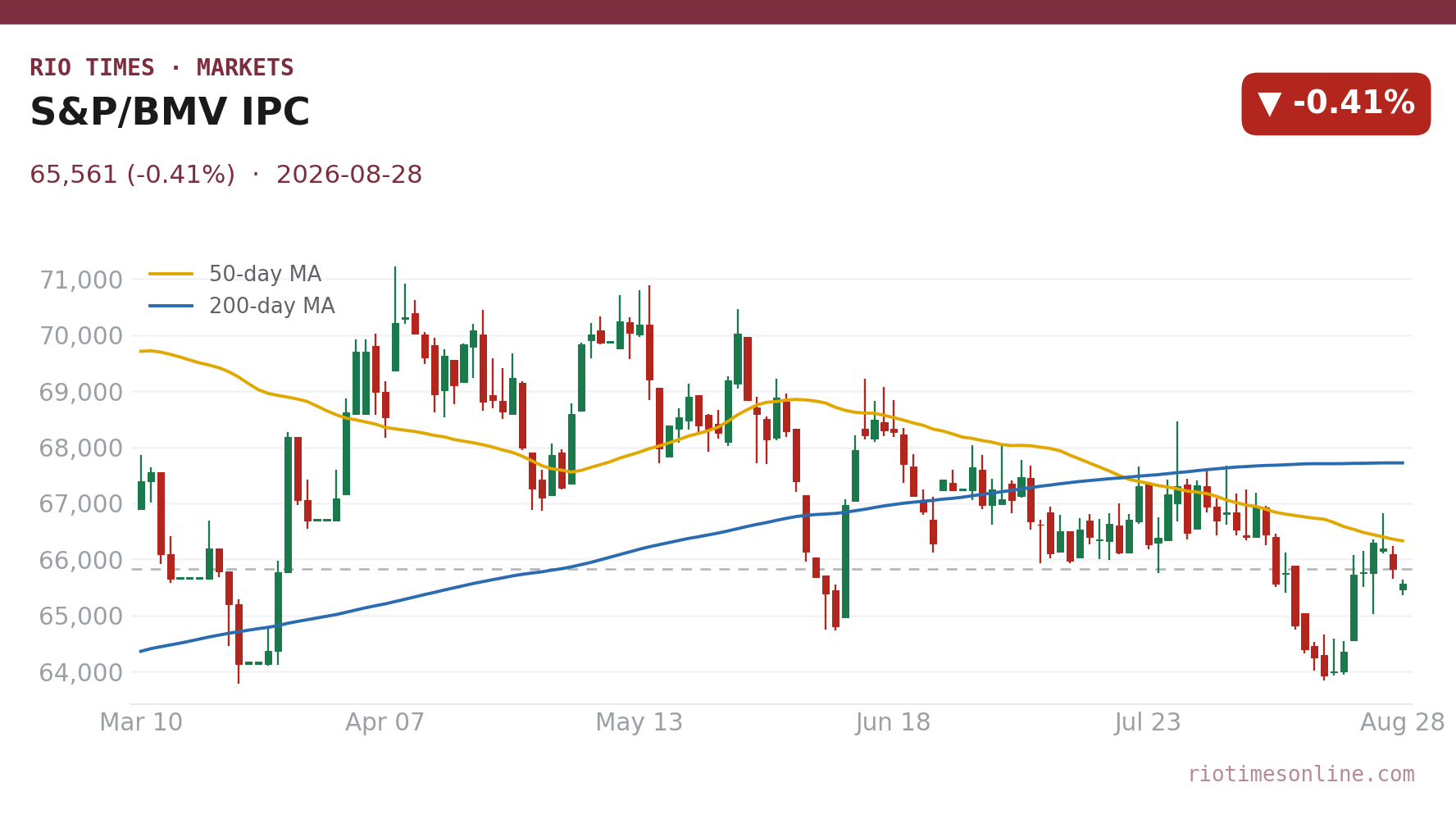
Mexico’s blue-chip share index, the S&P/BMV IPC, fell 0.53% on Friday to settle at 65,484.32 points, though it held within a relatively narrow 669-point range between 65,295 and 65,964. The decline was driven by a sharp pullback in airport and airline shares, which outweighed gains in most other constituents.
The broader market picture was less grim than the headline number suggests. Across the wider Mexican market 365 issues rose against 327 that fell, while the 35-member IPC was dragged down by a handful of heavyweights.
Walmex, for one, rose 0.6%.
The peso, Mexico’s currency, weakened past 17 per dollar to close around 17.03 in the spot market, a depreciation of roughly 0.4% on the session. Local financial media tied the move to comments from US Federal Reserve chair Kevin Warsh, which signalled US borrowing costs may stay higher for longer, a dynamic that typically pressures emerging-market currencies.
Long-term Mexican government bond yields also climbed, with the 10-year benchmark rising 0.04 percentage points to 9.22% and , according to local reports. Stocks sensitive to financing costs, such as transport and telecom operators, bore the brunt of the session’s losses.
The day’s losses were driven by a small number of large, interest-sensitive and travel-exposed names rather than a market-wide retreat. With gainers outnumbering decliners market-wide, the negative close reflects index concentration, not weak sentiment across the board.
The peso’s slide past 17 and the rise in 10-year yields to 9.22% are the keys to watch next week — if yields keep climbing, transport and telecom shares could face continued pressure.
02 The day’s numbers
| Measure | Level | Change | Read |
|---|---|---|---|
| S&P/BMV IPC (Mexico’s main stock index) | 65,484.32 | −0.53% | 9.2% below its 52-week high |
| USD/MXN (peso per US dollar) | 17.03 | +0.42% | 9.7% below its 52-week high |
| Session range (IPC) | 65,295 – 65,964 | — | Relatively tight trading band |
| 52-week range (IPC) | 58,399 – 72,111 | — | About 12% above its low |
| 52-week range (USD/MXN) | 16.89 – 18.87 | — | Peso stays close to its strongest yearly level |
The IPC remains a solid 9.2% below its 52-week high of 72,111 points, but still sits roughly 12% above its yearly low of 58,399. The same pattern holds for the peso — at 17.03 per dollar it is 9.7% off its weakest yearly point of 18.87, leaving the currency near the upper end of its yearly range.
The IPC’s slip of 0.53% was modest by recent standards. The index is still about 12% higher than a year ago, a reminder that this was a day of selective selling, not a broad retreat from Mexican risk. Rio Times · Live Market Intelligence
Live Market IntelligenceMexico — Live Market Board
Mexico — Live Market Board
Instrument Last Change YoY Prev. High Low Volume
IPC MEX
66,746.78
+1.06%
+12.17%
66,048.57
66,121
65,405
108,886,187
USD/MXN
17.06
-0.24%
-8.58%
17.10
17.08
17.01
—
WALMEX
48.07
-0.62%
-14.38%
48.37
48.65
48.02
10,781,446
GMEXICO
223.28
+0.35%
+73.59%
222.50
226.18
222.17
1,325,556
FEMSA
201.19
-0.24%
+25.67%
201.67
206.71
199.56
750,706
CEMEX
19.32
+0.89%
+19.10%
19.15
19.35
19.04
14,327,054
GFNORTE
193.98
+1.18%
+14.36%
191.71
195.79
191.83
1,579,115
BIMBO
60.98
-0.96%
+11.89%
61.57
61.46
60.29
1,048,115
TELEVISA
9.71
+0.21%
+12.78%
9.69
9.75
9.60
577,851
AMX
19.80
-0.95%
+12.53%
19.99
20.05
19.70
58,058,525
GAP
366.23
+0.43%
-21.21%
364.68
370.85
362.82
226,946
ASUR
275.04
+1.25%
-15.28%
271.64
275.08
271.31
15,451
OMA
233.50
+0.62%
-6.48%
232.06
235.00
230.62
555,693
KOF
188.04
+0.86%
+18.94%
186.44
188.56
185.52
425,273
GRUMA
252.90
+0.11%
-21.85%
252.61
254.74
250.36
90,048
KIMBER
39.74
+0.43%
+8.85%
39.57
40.09
39.33
490,551
AMX ADR
23.38
-0.23%
+22.25%
23.43
23.49
23.06
1,347,445
03 Why it moved — yield pressure and a hawkish Federal Reserve
The dominant catalyst came from outside Mexico, as local press reports tied the peso’s softness and the cautious stock-market tone to Federal Reserve chair Kevin Warsh’s remarks at the Jackson Hole economic symposium in the US. Warsh’s comments reinforced bets that the Fed may hold interest rates high to contain inflation, which usually strengthens the dollar against higher-yielding currencies like the peso.
Higher US rates also make Mexican fixed-income instruments less attractive on a relative basis, while raising the discount rate investors apply to long-dated transport and telecom cash flows. That translated directly into selling in Mexico’s most interest-sensitive pockets — airports and airlines.
On the domestic side, Mexico’s finance ministry completed a Samurai bond placement of US$1,774 million, underscoring continued demand for Mexican public debt even amid currency softness. Local newspapers also noted the country’s strong export growth in the second quarter, a cushion that may explain the broad underlying buying despite a down day for the index.
04 The day’s movers
| Driver | Level / Move | Change | Note |
|---|---|---|---|
| GAP (Grupo Aeroportuario del Pacífico — airport operator) | 3.4% lower | −3.4% | Leading the index lower on travel concerns |
| PE&OLES (Peñoles — precious metals miner) | 2.4% lower | −2.4% | Extended a weekly slide of about 3% |
| Walmex (Walmart de México — retailer) | 21 million dollars traded | +0.6% | One of the few advancers among big caps |
| America Movil (telecom heavyweight) | 17 million dollars traded | −0.8% | Added to the index’s downward pull |
| Cemex (cement maker) | 16 million dollars traded | +0.1% | Flat despite a weak construction outlook |
| GENTERA (consumer lender) | 11 million dollars traded | +1.6% | Strongest gainer among actively traded names |
Airport operator GAP’s 3.4% slide made it by far the weakest name in the most-traded group, . OMA, the other major listed airport operator, fell 1.0%, while supermarket chain Chedraui dropped 1.92%.
On the positive side, consumer lender GENTERA rose 1.6% and big-box retailer Walmex added 0.6%, evidence that domestic demand names attracted at least some bargain-hunting as the index slipped. Precious metals miner Peñoles dropped 2.4%, extending a weekly loss of about 3%, while America Movil’s 0.9% loss weighed heavily given its large index weight.
05 The regional scoreboard
| Index | Country | Change |
|---|---|---|
| S&P/BMV IPC | Mexico | −0.53% |
| Ibovespa | Brazil | +0.30% |
| MSCI Colcap / COLCAP | Colombia | −1.28% |
| S&P/BVL Peru General | Peru | −1.40% |
| IPSA | Chile | −0.22% |
The regional picture was mixed, with Brazil’s Ibovespa — the main stock index for Latin America’s largest economy — posting a 0.30% gain, while Colombia’s COLCAP and Peru’s General index dropped 1.28% and 1.40% respectively. Chile’s IPSA slipped a smaller 0.22%.
Mexico’s 0.53% fall placed it near the regional average, below Brazil’s resilience but well ahead of the sharper losses in the Andean markets. The live market board above carries the latest closes for all regional indices.
06 The technical picture
The IPC’s Friday close at 65,484.32 left it just above the midpoint of its 52-week range, which spans from 58,399 to 72,111 points. The 65,295 session low roughly coincides with an area of minor support that has held through recent sessions of selling pressure.
For the peso, the close near 17.03 per dollar means it is testing the psychological 17 level for the first time in recent weeks, with the next technical marker at the peso’s strongest level of the year, 16.89 per dollar. A sustained break above 17 would likely open the door to 17.50 and beyond, while a reversal back below would keep the currency near its strongest territory of the year.
07 What to watch
- USD/MXN at 17: Whether the peso’s slide past 17 holds or turns into a buying opportunity for exporters
- Airport sector: If GAP can recover after Friday’s 3.4% drop, and whether OMA follows or if travel fears persist
- US Federal Reserve policy: Any further Hawkish signals from Kevin Warsh that push US yields higher
- Mexican government bond yields: Whether the 10-year yield above 9.2% continues to pressure rate-sensitive stocks
Background: Mexico Stocks Dip as Central Bank Raises Growth Outlook.
Background: Mexican Stocks Post Their Best Day Since June.
More: Mexico news in English, every day from The Rio Times.
Frequently Asked Questions
Why did the S&P/BMV IPC fall on Friday?
The index fell 0.53% to 65,484.32 points, dragged lower by airport and airline stocks, alongside a weak peso and higher long-term bond yields.
How did the peso perform on Friday?
The peso weakened past 17 per dollar to close around 17.03, a depreciation of roughly 0.4% on the day, as US Federal Reserve signals pressured emerging-market currencies.
Which Mexican stocks fell the most on Friday?
Airport operator GAP led losses, down 3.4%, followed by Peñoles down 2.4% and OMA down 1.0%. Precious metals miner Peñoles fell 2.4%.
Is the Mexican stock market still up over the past year?
Yes. The S&P/BMV IPC is still about 12% higher than a year ago, despite Friday’s 0.53% dip and sitting 9.2% below its 52-week high.
Market data: RT; exchange figures from BMV
This article was produced by The Rio Times’ automated newsroom system. How we use AI · Report an error · Editorial responsibility: Matthias Camenzind, Editor-in-Chief
In depth
LatAm Markets: Live Signals → — real-time movers, turnover leaders and FX across Latin America.