Mexico Markets: IPC & the Peso — September 1, 2026
Key Facts
- Mexico’s benchmark S&P/BMV IPC index closed at 65,048 points, down 436 points or 0.67% on the session, after trading between 64,913.80 and 65,570.92.
- The Mexican peso held firm against the US dollar, ending little changed near 17.03 per greenback.
- Global risk appetite was soft after Wall Street fell on renewed US-Iran tensions, with the S&P 500 down 0.33% and oil prices firming.
- The IPC remains 9.2% below its 52-week high of 71,601 points, though the index has still gained over 11% in the past twelve months.
- Heavily-traded names moved modestly with Walmex down 1.9% and Grupo México up 1.9%, while airport operator GAP slipped 1.0%.
Today’s Focus
Mexico’s main stock index, the S&P/BMV IPC, fell 0.67% to 65,048 points on Monday, a loss of 436 points. The session was narrow — the index traded between 64,913.80 and 65,570.92 — as investors weighed a softer Wall Street session against a steady peso.
The peso ended little changed against the dollar, near 17.03 per greenback. That is roughly 9% stronger than its 52-week weakest level of 18.68, a sign the currency remains well bid even as stocks lost ground.
The tone was set overseas: US stocks fell after President Trump’s attack on Iran, which pushed oil prices higher and sent the VIX volatility gauge up more than 5%. Mexico’s equity market tracked that cautious mood, though the move was modest compared with Chile’s 1.14% drop and Colombia’s 1.34% decline.
What matters today. A soft global session nudged Mexican shares lower, but a firm peso and limited domestic catalysts kept the damage contained.

01 The session in one read
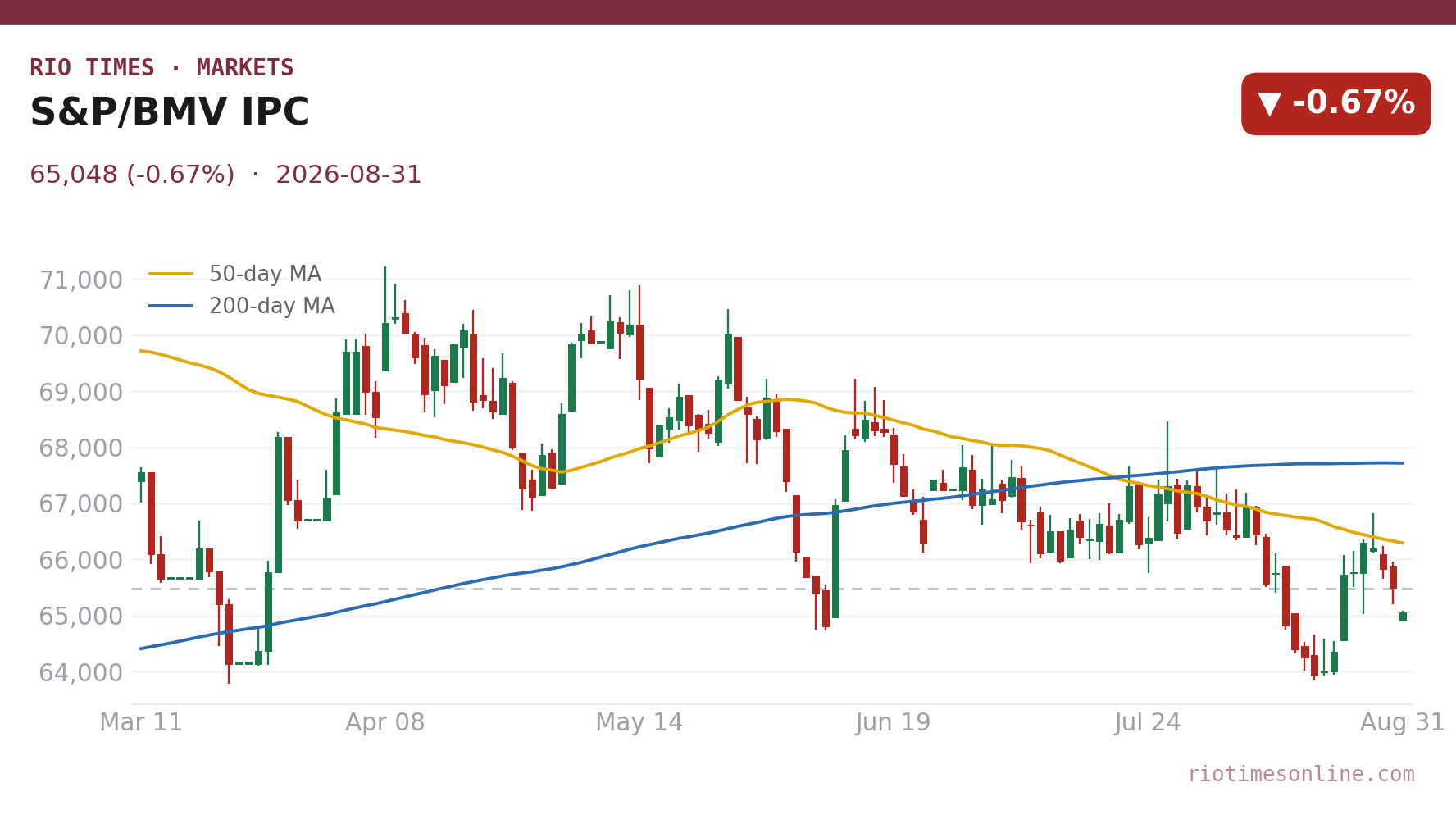
Mexico’s S&P/BMV IPC — the main stock index tracking the country’s largest listed companies — closed at 65,048 points on Monday, down 436 points or 0.67%. The move was small but pointed lower all day, with the index trading between a low of 64,913.80 and a high of 65,570.92.
The Mexican peso did the opposite, ending little changed near 17.03 per US dollar. A stronger peso makes a country’s assets more attractive to foreign investors, but it can also squeeze exporters by making their goods pricier abroad.
The backdrop was cautious. US stocks fell after President Trump’s attack on Iran, which pushed up oil prices and sent investors into safer assets. Mexico’s equity market tracked that mood, though the damage was limited compared with the falls seen in Chile and Colombia.
Monday’s decline was small and orderly: the IPC lost 0.67%, less than the 1%-plus drops in Chile and Colombia, and the peso actually strengthened. That suggests local investors were not panicking over the Iran headline, though they were unwilling to chase stocks higher either.
The index’s close of 65,048 sits closer to the day’s low than its high, implying late-session selling pressure. The variable to watch is whether oil prices keep climbing on Middle East tension, which could hit Mexican airlines and consumer names but support energy-linked shares.
02 The day’s numbers
| Measure | Level | Change | Read |
|---|---|---|---|
| S&P/BMV IPC (Mexico stocks) | 65,048 | -0.67% | Narrow session, late drift lower |
| Session range | 64,913.80 – 65,570.92 | — | Closed near the session low |
| 52-week position | 9.2% below 71,601 high | — | Still up 11.2% over 12 months |
| USD/MXN (peso) | 16.99 | −0.24% | Holds just above 17 per dollar |
| 52-week peso range | 16.91 – 18.68 | — | About 9% stronger than worst |
The IPC’s 0.67% decline was contained, but the session’s shape matters: the index closed at 65,048, not far above the day’s low of 64,913.80. That suggests buyers stepped away in afternoon trade rather than defending the morning levels.
The peso finished near 17.03 per dollar, essentially flat on the day. It remains comfortably within the 16.91–18.68 range of the past year, a sign of relative stability even as global stocks wobbled. Rio Times · Live Market Intelligence
Live Market IntelligenceMexico — Live Market Board
Mexico — Live Market Board
Instrument Last Change YoY Prev. High Low Volume
IPC MEX
68,929.72
+1.87%
+12.17%
67,663.29
66,121
65,405
108,886,187
USD/MXN
17.06
-0.24%
-8.58%
17.10
17.08
17.01
—
WALMEX
48.07
-0.62%
-14.38%
48.37
48.65
48.02
10,781,446
GMEXICO
223.28
+0.35%
+73.59%
222.50
226.18
222.17
1,325,556
FEMSA
201.19
-0.24%
+25.67%
201.67
206.71
199.56
750,706
CEMEX
19.32
+0.89%
+19.10%
19.15
19.35
19.04
14,327,054
GFNORTE
193.98
+1.18%
+14.36%
191.71
195.79
191.83
1,579,115
BIMBO
60.98
-0.96%
+11.89%
61.57
61.46
60.29
1,048,115
TELEVISA
9.71
+0.21%
+12.78%
9.69
9.75
9.60
577,851
AMX
19.80
-0.95%
+12.53%
19.99
20.05
19.70
58,058,525
GAP
366.23
+0.43%
-21.21%
364.68
370.85
362.82
226,946
ASUR
275.04
+1.25%
-15.28%
271.64
275.08
271.31
15,451
OMA
233.50
+0.62%
-6.48%
232.06
235.00
230.62
555,693
KOF
188.04
+0.86%
+18.94%
186.44
188.56
185.52
425,273
GRUMA
252.90
+0.11%
-21.85%
252.61
254.74
250.36
90,048
KIMBER
39.74
+0.43%
+8.85%
39.57
40.09
39.33
490,551
AMX ADR
23.38
-0.23%
+22.25%
23.43
23.49
23.06
1,347,445
03 Why it moved — Iran tensions, oil and a steady peso
The session’s dominant external driver was geopolitical. Reports that the US attacked Iran sent Wall Street lower, with the S&P 500 down 0.33%, the Dow Jones off 0.70% and the Nasdaq easing 0.12%.
Oil prices slumped about 3% on the risk of wider disruption in the Middle East. For Mexico, that cuts both ways: higher crude helps state finances and oil-linked shares, but it can also feed inflation expectations and hurt transport and consumer names.
Locally, investors had little new macroeconomic news to trade. Mexico’s S&P Global manufacturing PMI reading was due after the close, leaving the equity market to take its cue from global markets.
The peso’s small gain suggests the currency market was not worried about a regional escalation. A stable peso often reflects confidence in Mexico’s relatively high interest rates and the country’s role as a US export hub.
04 The day’s movers
| Driver | Level / Move | Change | Note |
|---|---|---|---|
| Walmex (WALMEX) | Most-traded, $255m | -1.9% | Consumer staple lagged the board |
| GMexico (GMEXICOB) | $135m turnover | +1.9% | Mining strength on firm commodities |
| Banorte (GFNORTEO) | $92m turnover | +1.0% | Banking name firmed with peso |
| Femsa (FEMSAUBD) | $82m turnover | +0.1% | Bottler and retailer held up |
| GAP airports (GAPB) | $70m turnover | -1.0% | Travel-linked, hit by oil spike |
| ASUR airports (ASURB) | $43m turnover | -0.4% | Milder airport-operator decline |
| Gentera (GENTERA) | $36m turnover | -3.6% | Worst of the liquid names |
| América Móvil (AMXB) | $35m turnover | -1.0% | Telecom giant eased with the IPC |
Walmart de México, known as Walmex, was the most-traded stock on the day with around $255 million changing hands, and it fell 1.9%. That made it a visible drag on the index even though other big names, like Grupo México and Banorte, posted gains.
Grupo México, the mining and transport conglomerate, rose 1.9% on the session, likely helped by firm commodity prices. Airport operators GAP and ASUR fell 1.0% and 0.4% respectively, consistent with the upward pressure in fuel costs linked to oil.
05 The regional scoreboard
| Index | Country | Change |
|---|---|---|
| S&P/BMV IPC | Mexico | -0.67% |
| Ibovespa | Brazil | +1.00% |
| IPSA | Chile | -1.14% |
| COLCAP | Colombia | −1.33% |
| Merval | Argentina | +1.83% |
Mexico’s loss of 0.67% was the smallest negative move among the Latin American indices that declined. Chile’s IPSA fell 1.14% and Colombia’s COLCAP dropped 1.34%, both far sharper than the Mexican benchmark.
Brazil’s Ibovespa actually rallied 1.00%, and Argentina’s Merval jumped 1.00%, giving the region a mixed tone. The divergence underscores that Monday’s dip was global but not uniform, with commodity-linked markets holding up best.
06 The technical picture
The IPC closed at 65,048, slightly below the middle of its 52-week range of 60,216 to 71,601 points. It is now 9.2% under the high, which marks a meaningful setback from the earlier part of the year.
Looking closer, the session high of 65,570.92 sits just above the close, and recent trading suggests resistance between 65,570 and 65,600. A break above that band — roughly 0.8% higher — could signal a renewed push toward the upper edge of the range.
The day’s low of 64,913.80 is the immediate support to watch. A drop through there would be the first real test of the 65,000-point level, which has psychological importance for local and foreign investors alike.
07 What to watch
- Oil prices and Iran: A sustained jump in crude could hit consumer and travel names but support mining and energy-linked shares.
- US manufacturing PMI: Mexico’s factory PMI, released after the close, will signal whether exports are still expanding.
- Fiscal balance data: Mexico’s fiscal balance, due late on Monday, may shape expectations for public debt and local yields.
- Global risk tone: Mexico often trades in step with the S&P 500, so any sharp move on Wall Street will ripple through the IPC.
Background: Mexico Stocks Dip as Central Bank Raises Growth Outlook.
Background: Mexican Stocks Post Their Best Day Since June.
More: Mexico news in English, every day from The Rio Times.
Frequently Asked Questions
What is the S&P/BMV IPC?
It is Mexico’s main stock index, measuring the performance of the country’s largest publicly traded companies in Mexican pesos.
Why did the peso strengthen?
The peso ended little changed near 17.03 per dollar, holding firm as the dollar index slipped and on steady demand for Mexico’s relatively high-yielding assets.
Which stocks moved most?
Walmex fell 1.9% on the heaviest turnover, while Gentera dropped 3.6%. Grupo México rose 1.9%, buoyed by firmer commodity prices.
How is Mexico’s index positioned?
The IPC is 9.2% below its 52-week high of 71,601 points but still more than 11% higher than a year ago.
Market data: RT; exchange figures from BMV
This article was produced by The Rio Times’ automated newsroom system. How we use AI · Report an error · Editorial responsibility: Matthias Camenzind, Editor-in-Chief
In depth
LatAm Markets: Live Signals → — real-time movers, turnover leaders and FX across Latin America.