Mexico Fines 55 Officials and a Company US$5.6 Million

POLITICS · MEXICO
Key Facts
- —The country Mexico, the largest US trading partner, is led by President Claudia Sheinbaum. Her government created an Anticorruption and Good Government Ministry, headed by Raquel Buenrostro.
- —Why it matters The cases reach the state oil company Pemex, the power utility CFE, the IMSS social security system and the state food agency, bodies that sign large supply contracts.
- —Why now The ministry publishes sanctions in batches. The previous one, on 20 September 2026, covered 47 officials and one company.
- —What happened On 4 October 2026 the ministry announced sanctions on 55 officials and one company. Fines total 102 million pesos (about US$5.6 million), with bans of up to 10 years.
- —The numbers About 90 million pesos (about US$4.9 million) falls on three former food agency officials, over meat and tuna paid for in 2019 and 2020 without proof of delivery.
- —What it means for you US firms that sell to Mexican state bodies should expect old contracts to be audited. These are administrative penalties, not criminal convictions.
- —Still open Everyone sanctioned may appeal. The ministry has not said how much of the money it expects to recover.
Mexico corruption fines of 102 million pesos (about US$5.6 million) were announced on Sunday 4 October against 55 officials and a company. For US suppliers to Pemex, the power utility and the health system, the cases show old procurement files being reopened.
The Anticorruption and Good Government Ministry is the federal body that audits and disciplines public servants. It said the Federal Administrative Justice Tribunal, the federal court for administrative cases, imposed the heavier penalties. Thirteen people received 10-year bans from public service, according to a Rio Times count of the official list.
What the Ministry Announced
Communiqué 116, dated 4 October 2026, lists serious offences at 14 federal bodies and minor ones at seven. Under Mexican law, the tribunal rules on serious offences, while the ministry itself sanctions minor ones.
Penalties range from a private reprimand to dismissal and a 10-year ban. Most of the money sits in a handful of cases, as the chart below shows.
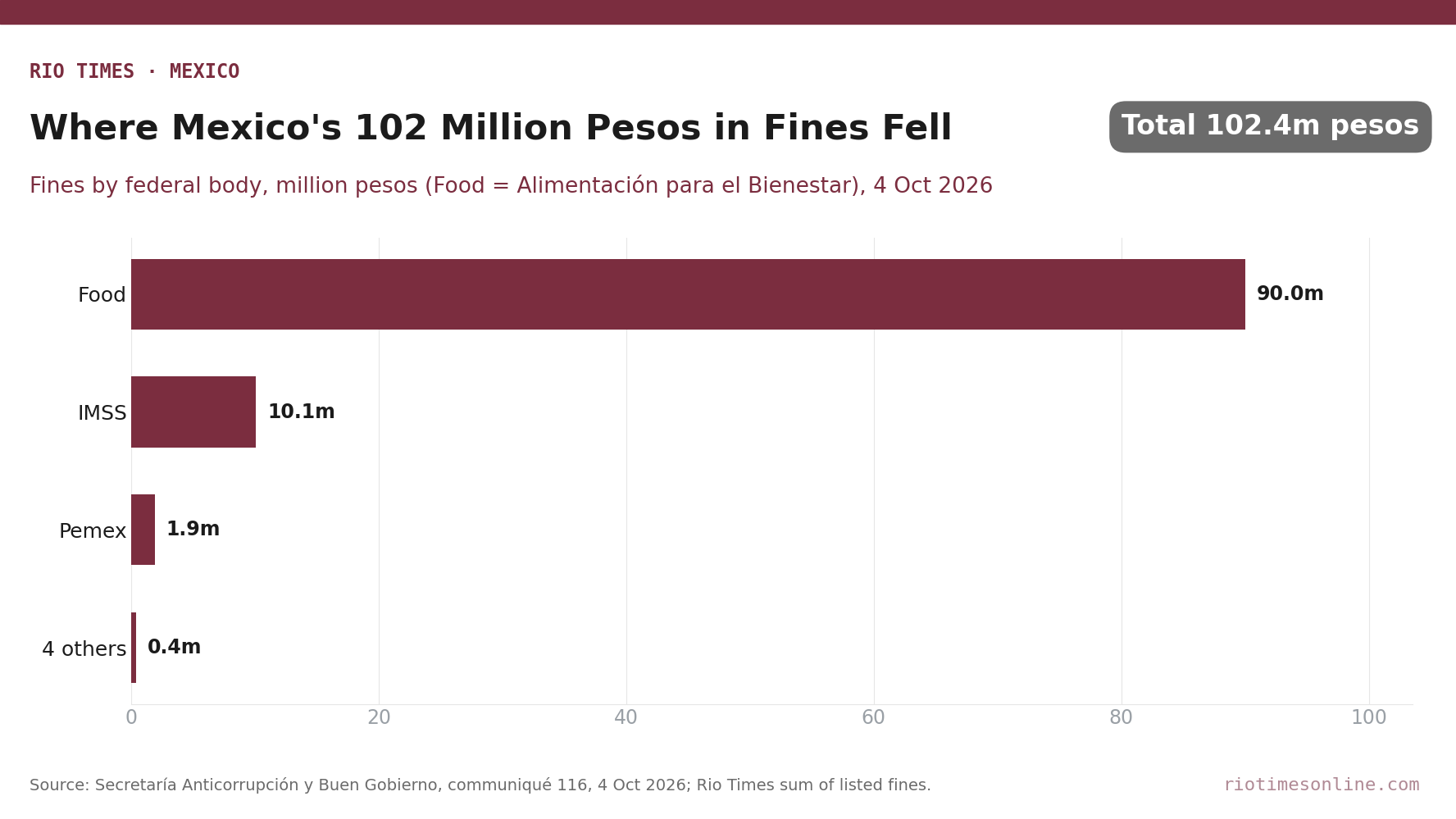
The Rio Times added up every fine in the official list and reached about 102.4 million pesos (about US$5.6 million). El Universal, La Jornada and Proceso all reported the rounded figure of 102 million.
The government frames these batches as part of a wider effort. On 22 September it claimed prevention work had saved 83.8 billion pesos (about US$4.6 billion at Friday’s rate) in two years. We covered that in Mexico Says Its Anti-Corruption Drive Saved US$4.9 Billion. That savings figure comes from the government itself. It has not been confirmed by an independent auditor.
The Food Agency Cases Carry Most of the Money
The largest single penalty, 73.4 million pesos (about US$4.0 million), falls jointly on three officials at the former head office of DICONSA. The rural store network paid for meat in 2020 without proof that it arrived.
The same three officials, listed at the head office of Segalmex, the former state food-security agency, also received 10-year bans over a 2019 tuna purchase. A company identified only as “G.” was barred for one year and shares a fine of 16.6 million pesos (about US$910,000).
Both bodies now sit inside Alimentación para el Bienestar, the federal food agency. Segalmex was already the subject of earlier rulings, covered in our report Segalmex: Mexico Fines Ex-Officials $40m Over Its Biggest Corruption Scandal.
Pemex, the IMSS and the National Guard
At the IMSS in Morelos, two officials received 10-year bans and a shared fine of 10.1 million pesos (about US$555,000). The ministry says they altered market prices for toner in 2021 to steer a contract to one company.
Three Pemex employees were banned for 10 years and fined between 600,000 and 677,000 pesos each (about US$33,000 to US$37,000). Two had claimed fuel allowances they were not owed, and one profited from arranging three hires.
The list also covers smaller abuses. A CFE meter reader in Sonora took 500 pesos (about US$27) from users on 18 occasions to overlook illegal power use.
In the National Guard, Mexico’s federal security force, 10 members were dismissed for submitting invalid school certificates. Those documents formed part of their applications for firearms licences, according to the communiqué.
Several cases involve sexual harassment, including at the customs agency and at an IMSS hospital in Querétaro. Those officials received bans of between one and five years.
What It Means for You
Mexico sells more to the United States than any other country does, and US companies bid for Pemex, CFE and IMSS contracts. A system that punishes rigged pricing lowers one risk for honest bidders.
These Mexico corruption fines are modest beside the size of the federal budget, so they are not a market event. For investors in Pemex debt, explained in What Is Pemex? Mexico’s State Oil Giant, Its US$77.5 Billion Debt and Why It Matters, it is a governance signal rather than a credit one.
These are administrative penalties, not criminal convictions. For travellers and residents in Mexico, the rulings change nothing in daily life.
What Is Not Known
Everyone hit by the Mexico corruption fines may challenge the rulings. The ministry says it will defend each one in court.
It is not known how many will appeal or how long that will take.
The ministry has not said how much of the 102 million pesos (about US$5.6 million) it has collected so far. Nor has it said whether any case has been referred to federal prosecutors for criminal charges.
Officials are named only by first name and initial in the communiqué. The company fined over the tuna purchase is also unnamed.
How much did Mexico fine the 55 officials?
The fines total 102 million pesos, about US$5.6 million, according to the Anticorruption and Good Government Ministry on 4 October 2026. Most of it relates to food agency purchases.
Who imposed the sanctions?
The Federal Administrative Justice Tribunal imposed the penalties for serious offences. The Anticorruption and Good Government Ministry imposed those for minor offences.
Can the officials appeal?
Yes. Everyone sanctioned may challenge the ruling, and the ministry says it will defend each decision in court.
Sources: Secretaría Anticorrupción y Buen Gobierno, communiqué 116; La Jornada; El Universal; Proceso; El Economista; Buen Gobierno, 22 September 2026.
This article was produced by The Rio Times’ automated newsroom system. How we use AI · Report an error · Editorial responsibility: Matthias Camenzind, Editor-in-Chief