
ENERGY · MAURITANIA
Key Facts
- —The country Mauritania, a desert state of about five million people on Africa’s Atlantic coast, exports iron ore, gold and fish and now offshore gas.
- —Why it matters Two fires in August left parts of the capital, Nouakchott, without reliable power for three to five days. The inquiry now names who failed.
- —Why now The independent commission signed its summary on Tuesday 6 October. The state news agency AMI put it online on Thursday 8 October.
- —What happened The report ties both fires to three new 33 kV cable links and urges a payment freeze, a contract review and a referral to prosecutors.
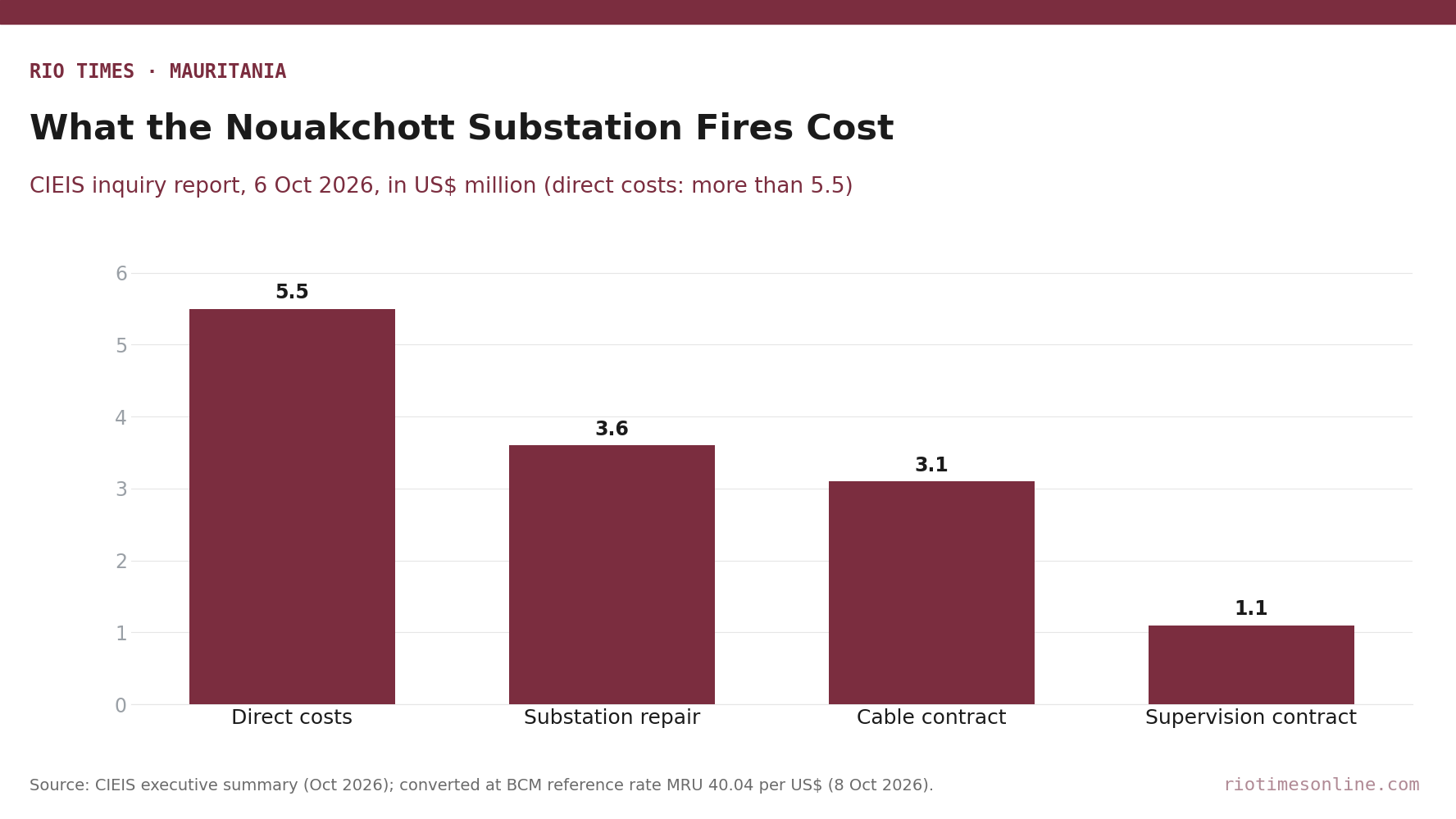
- —The numbers More than MRU 220 million (about US$5.5 million) in direct costs, plus MRU 143.9 million (about US$3.6 million) to repair two substations.
- —What it means for US readers Power reliability is a basic test for foreign investors in Mauritania’s gas, gold and iron ore, including New York listed Kinross Gold.
- —Still open The exact technical fault, any sanctions on named officials, and whether prosecutors open a case all remain undecided.
Mauritania has published the SOMELEC fire report on the two blazes that knocked out power across parts of Nouakchott in August. It links both fires to new cable links installed weeks earlier and finds failings at the state utility, the energy ministry and the private contractor. For foreign investors in the country’s gas, gold and iron ore, it is a frank official account of how fragile the capital’s grid has been.
The fires hit two substations of the Société Mauritanienne d’Électricité (SOMELEC), the state power company, on Friday 21 and Saturday 22 August. One stands in Toujounine, in Nouakchott-Nord, and the other in Tevragh-Zeina, in Nouakchott-Ouest.
According to the report’s executive summary, outages lasted between three and five days depending on the district. Households, shops and businesses were all affected.
What the Inquiry Found
Prime Minister El Moctar Ould Djay set up the commission by order (arrêté n°1228/PM) on Tuesday 25 August, a day after President Mohamed Ould Cheikh El Ghazouani visited both sites. It was chaired by Ousmane Mamoudou Kane, a former minister, and included the Inspector General of State and the head of the national public procurement control body.
The commission found a direct link between the fires and three new 33 kV links. They were switched on on Saturday 15 August at the eastern substation and on Thursday 20 August at the northern one. In both cases the fire started in the 33 kV cells those links fed.
It could not pin down the exact fault. The cable, its ends and its joint boxes all showed anomalies. The most likely scenario, the commission says, is overheating where the cable’s metal screen meets its earthing braid.
It found no evidence of sabotage or of an operating error. It did list what made the fires worse: no SOMELEC staff on site to use the extinguishers, no fire walls between the 33 kV cell blocks, weak detection, and slow alerts to the civil protection service.
Contracts, Money and Who Is Named
The links were part of an emergency programme for Nouakchott’s grid. In November 2024 the government set aside MRU 1.77 billion (about US$44 million) for it. Amounts here are converted at the Central Bank of Mauritania reference rate of MRU 40.04 per US dollar for Thursday 8 October.
The cable work went to a local firm, CTM Bâtiments, under a contract worth MRU 124 million (about US$3.1 million). The engineering firm IRAF (Ingénierie & Réalisations Africaines) won a supervision contract of MRU 45 million (about US$1.1 million).
The report says CTM Bâtiments was not qualified for the contract. It says the firm submitted a certificate of good performance that the national iron ore company, SNIM, which is cited as its issuer, has formally disputed. It also says the cable manufacturer and specifications were changed without proof that the new cable was equivalent. These are findings of an administrative inquiry, not court rulings.
Its recommendations are blunt. SOMELEC should suspend all payments to CTM Bâtiments and move towards ending the contract, after formal notice, while making sure the links are finished. The procurement regulator ARMP should review how the contract was awarded. SOMELEC should pass the disputed certificate to judicial authorities.
The summary also lists shortcomings by the energy ministry and the energy minister, the ministry’s secretary general and its director general of electricity, a former and the current SOMELEC director general, the utility’s distribution chief and its tender committee. It names their roles, not the people.
Ould Djay chaired the interministerial crisis committee on Thursday 8 October, after the commission chairman handed the report to President Ghazouani. He said officials found responsible would face administrative measures and breaches of the law would be prosecuted, the local outlet Saharamedias reported. According to AMI, he said the president had ordered the recommendations applied in full and with rigour.
Late on Thursday, AMI reported that the Ministry of Energy and Petroleum, led by Minister Mohamed Ould Khaled, had started drafting an action plan to carry out the recommendations.
What It Means for US Readers
Mauritania is small, but it sits on assets US investors follow. The Tasiast gold mine is run by Kinross Gold, which is listed in New York. Its local company lent experts to the inquiry, alongside Swiss and German engineering firms.
Offshore, the Greater Tortue Ahmeyim gas project, shared with Senegal, has turned the country into a gas exporter. An earlier analysis, Mauritania Gas Is Flowing. Uranium and Hydrogen Are Queued, sets out what is in the pipeline.
A grid that fails for days in the capital raises costs for every business that depends on it. The stabiliser is that the government published the findings in full and accepted them. The report itself says SOMELEC’s organisation has not kept pace with new generation capacity.
Its wider advice is to bring in technical help from a reference public utility, hire managers through open competition, clean up the state’s financial dealings with SOMELEC, including its debt and cut the utility’s commercial losses. For background on the economy, see Mauritania Explained: Iron Ore, Offshore Gas, Migration and the 2029 Question.
What Is Not Known
The precise technical cause of the fires remains unproven, by the SOMELEC fire report’s own account. Fire damage limited how far it could reconstruct events.
No charges have been announced. A referral to prosecutors is a recommendation, and anyone named keeps the presumption of innocence. Neither CTM Bâtiments’ nor IRAF’s response is part of the published summary.
It is also unclear when the two substations will be fully rebuilt, and who will finish the cable links if the contract is ended.
Frequently Asked Questions
What did the SOMELEC fire report find?
It linked the August fires at two Nouakchott substations to three new 33 kV cable links and found failings in contracting, supervision and fire safety. It could not establish the exact technical fault.
How long were the power cuts in Nouakchott?
Between three and five days depending on the district, according to the commission’s executive summary.
How much did the fires cost?
More than MRU 220 million (about US$5.5 million) in direct costs, plus MRU 143.9 million (about US$3.6 million) to repair the two substations. Wider losses were put at about 0.07% of third-quarter GDP.
Has anyone been charged?
No. The commission recommended that SOMELEC pass a disputed contractor certificate to judicial authorities, and the prime minister said breaches of the law would be prosecuted. No case has been announced.
Does this affect foreign investors?
Indirectly. Reliable power matters for every business in the capital, and the report calls for an overhaul of how the state utility is managed.
Sources: Commission indépendante d’enquête sur les incendies des postes de transformation de la SOMELEC (CIEIS), executive summary, 6 October 2026, published by AMI: ami.mr; AMI, prime minister’s committee meeting, 8 October 2026: ami.mr; AMI, energy ministry action plan, 8 October 2026: ami.mr; Saharamedias, prime minister’s statement, 8 October 2026: fr.saharamedias.net; Cridem / Shems Maarif, 9 October 2026: cridem.org; Central Bank of Mauritania reference rate, 8 October 2026: bcm.mr.
Editorial responsibility: Matthias Camenzind, Editor-in-Chief · Editorial standards · Report an error
Part of our ongoing coverage
Africa: The New Scramble — the great-power contest over the continent.