Soybeans Rebound Before USDA Grain Stocks Report as Corn Edges Lower
Key Facts
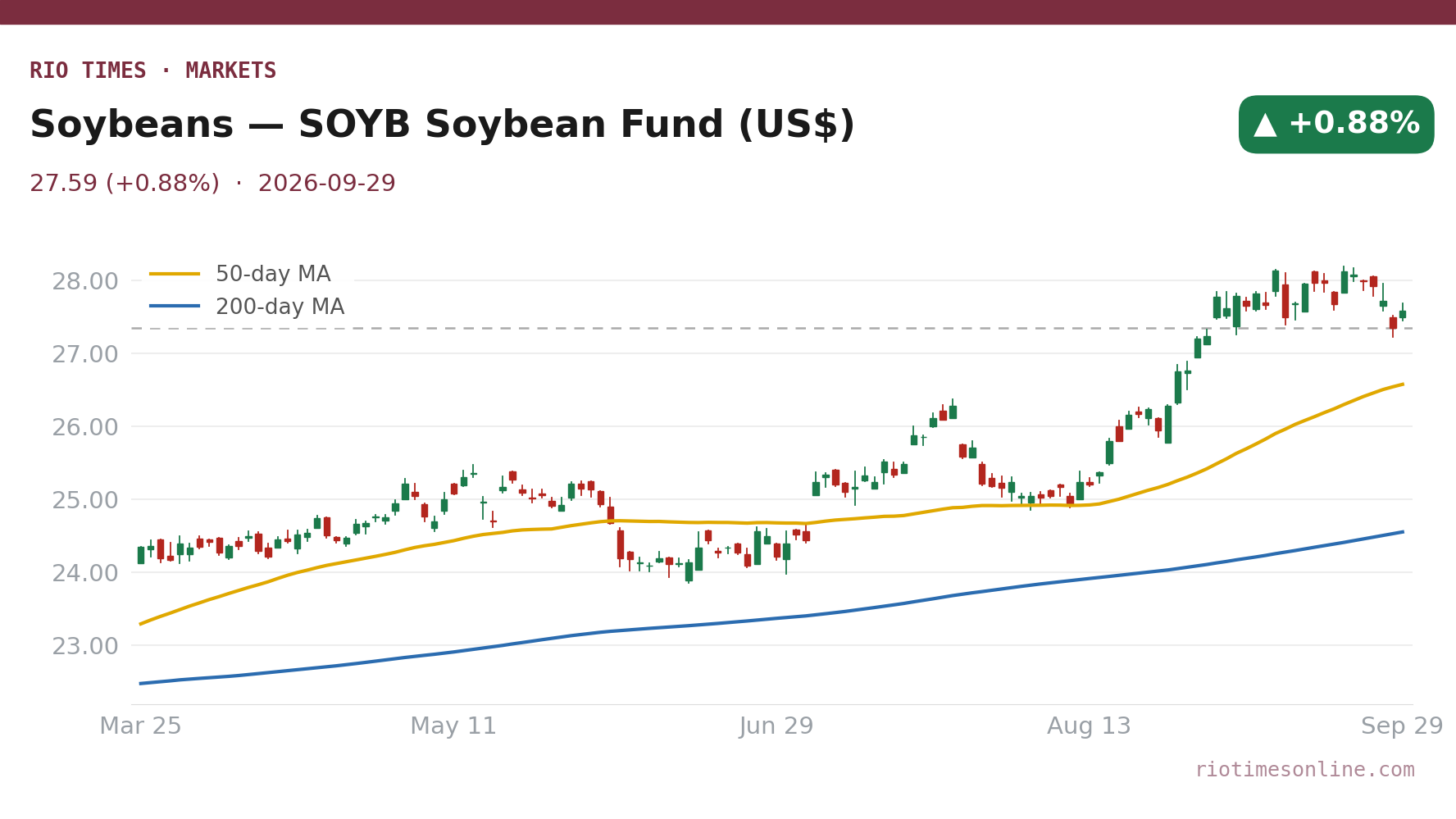
- Soybeans rebounded: the SOYB fund rose 0.88% to US$27.59 after a 1.33% fall on Monday, and November soybean futures in Chicago gained 9½ cents to US$12.97¾ a bushel.
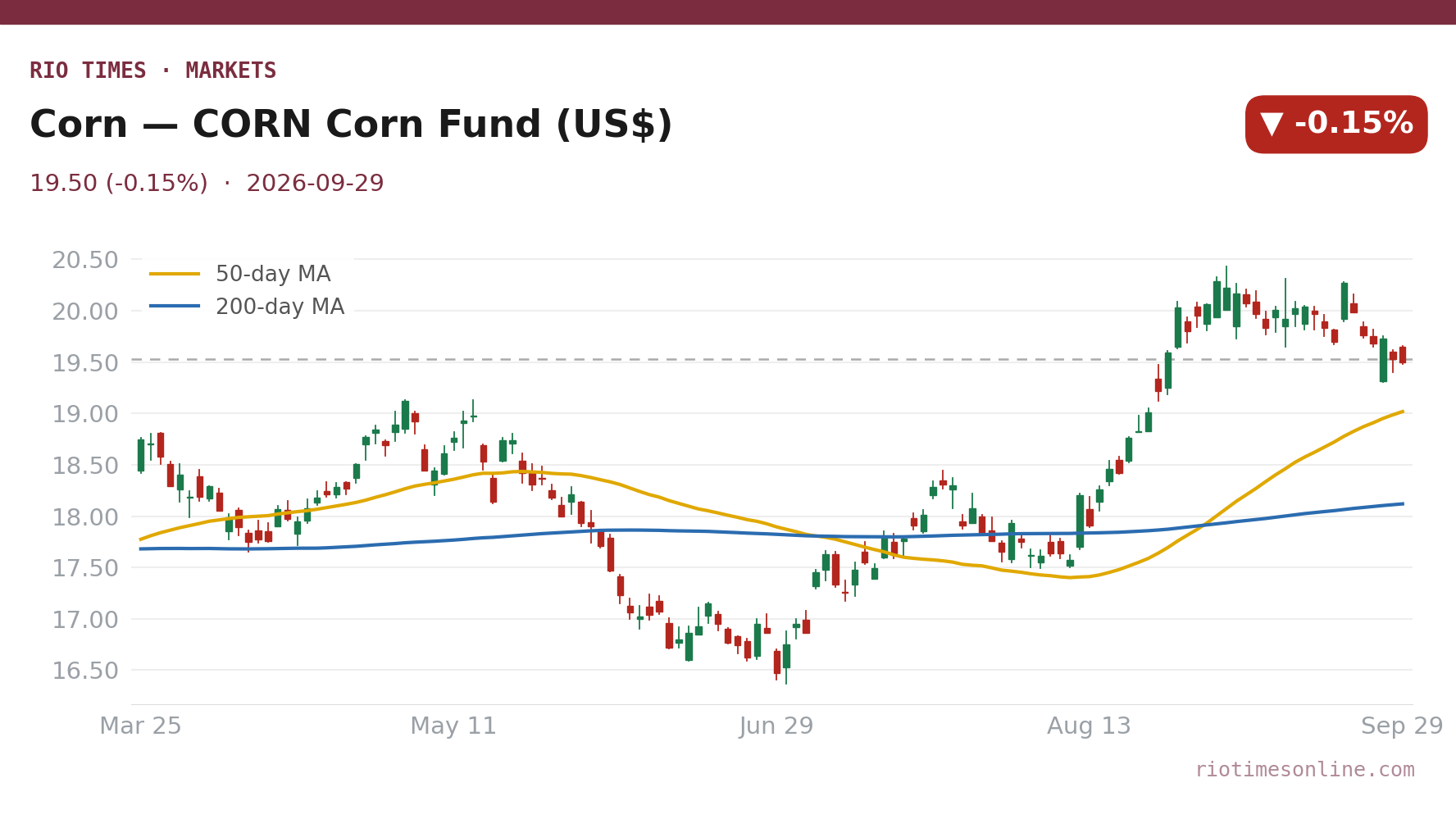
- Corn edged lower: the CORN fund slipped 0.15% to US$19.50, and December corn futures eased ¾ cent to US$5.22¼ a bushel.
- Wheat ticked up: the WEAT fund gained 0.32% to US$25.05.
- The USDA’s quarterly Grain Stocks report is due today at noon Eastern time (16.00 UTC); analysts expect 1.924 billion bushels of corn and 323 million bushels of soybeans on 1 September.
- China left soybeans out of the tariff cuts it announced on 28 September, so US beans still carry an extra 10% duty while corn and wheat get relief.
- Brazil’s soybean planting reached 3.4% of the expected area by 24 September, slightly ahead of 3.2% a year earlier, consultancy AgRural said.
Today’s Focus
Soybeans recovered on Tuesday, 29 September 2026, after Monday’s slide on China’s decision to keep its extra tariff on US beans. Traders pointed to steady demand and positioned ahead of a quarterly US government stocks report.
The SOYB fund rose 0.88% to US$27.59, while the CORN fund eased 0.15% to US$19.50. Corn traded sideways before the report, which could reset estimates of old-crop supplies.
China’s exclusion of soybeans from its tariff relief keeps Brazil’s price edge in the world’s largest soybean market. Brazil’s planting has started slightly ahead of last year, while drought is slowing fieldwork in Argentina’s core farm region.
The US dollar index edged up 0.17% to 101.37, a small headwind for dollar-priced grain.
What matters today. Today’s USDA Grain Stocks report is the next catalyst; a large corn number would hit the CORN fund hardest just as the US harvest gathers pace.
01 The session in one read
Grain trackers split on Tuesday, 29 September. The soybean fund bounced, the corn tracker slipped and wheat edged up, as the market waited for Wednesday’s quarterly US stocks report.
November soybeans gained 9½ cents to US$12.97¾ a bushel, recovering part of Monday’s loss. December corn eased ¾ cent to US$5.22¼. Soybean oil settled at 68.36 US cents a pound, higher on the day.
Soybeans look best supported into the report. China’s state buyers Sinograin and COFCO have bought more than 12 million tonnes of US soybeans, nearly half the 25 million tonnes a year that the White House says Beijing committed to through 2028, although China has not confirmed that target. Corn faces the most near-term risk from harvest pressure. The variable to watch is today’s USDA Grain Stocks report: a larger-than-expected corn inventory would hit the CORN fund hardest, while a small soybean number would extend SOYB’s bounce.
02 The board
SOYB, the soybean tracker, rose 0.88% to US$27.59. WEAT, the wheat tracker, gained 0.32% to US$25.05.
CORN, the corn tracker, eased 0.15% to US$19.50, the weakest of the three. All three funds hold Chicago futures, not physical grain. Brazil’s farmland group SLC Agrícola fell 0.65% in São Paulo to R$16.75 (about US$3.22).
| Asset | Level | Change |
|---|---|---|
| Soybeans (SOYB) | US$27.59 | +0.88% |
| Corn (CORN) | US$19.50 | -0.15% |
| Wheat (WEAT) | US$25.05 | +0.32% |
Source: RT close, 2026-09-29. Where a commodity has no spot feed, an exchange-traded tracker or leading producer is shown as a labelled proxy.
Live Market IntelligenceThe live market board
Rio Times · Live Market Intelligence
Latin America — Cross-Market Board
| Instrument | Last | Change | YoY | Prev. | High | Low | Volume |
|---|---|---|---|---|---|---|---|
| IBOV | 183,827.59 | +0.46% | +21.85% | 182,991.13 | 168,310 | 167,142 | — |
| IPSA | 11,055.91 | -0.73% | — | 11,137.23 | 11,210 | 10,984 | 1,513,213,483 |
| IPC MEX | 65,071.30 | +0.20% | +12.17% | 64,944.41 | 66,121 | 65,405 | 108,886,187 |
| MERVAL | 2,782,561 | -0.59% | +30.51% | 3,022,485 | 3,042,365 | 2,991,150 | — |
| COLCAP | 2,558.92 | -0.79% | — | 9.04 | 9.05 | 9.02 | 4,133 |
| BVL PERÚ | 60,220.45 | +0.32% | — | — | — | — | — |
| USD/BRL | 5.16 | +0.01% | -5.13% | 5.16 | 5.18 | 5.14 | — |
| EUR/BRL | 5.95 | +1.01% | -5.83% | 5.89 | 5.98 | 5.94 | — |
| USD/MXN | 17.06 | -0.24% | -8.58% | 17.10 | 17.08 | 17.01 | — |
| USD/CLP | 913.98 | +0.04% | -5.67% | 913.65 | 915.11 | 906.68 | — |
| USD/COP | 3,140 | +0.03% | -22.04% | 3,139 | 3,141 | 3,105 | — |
| USD/PEN | 3.36 | -0.66% | -4.82% | 3.38 | 3.38 | 3.35 | — |
| USD/ARS | 1,493 | +0.10% | +12.96% | 1,491 | 1,494 | 1,480 | — |
| USD/UYU | 40.27 | +1.24% | +1.80% | 39.77 | 40.27 | 40.23 | — |
| USD/PYG | 5,939 | +1.68% | -19.54% | 5,841 | 5,939 | 5,925 | — |
| USD/BOB | 11.64 | -0.76% | +72.04% | 11.73 | 11.72 | 11.64 | — |
| USD/DOP | 58.34 | +1.25% | -3.44% | 57.62 | 58.34 | 58.04 | — |
| USD/CRC | 445.92 | +0.89% | -9.71% | 441.97 | 448.50 | 445.92 | — |
03 What moved it
Soybeans bounced after Monday’s sell-off. China’s tariff relief, announced on 28 September, covered US corn, wheat, sorghum, meat, dairy, soybean oil and soybean meal, but not whole soybeans. That kept an extra 10% duty on US beans and hit prices on Monday. On Tuesday, buyers focused on demand again.
Corn traded sideways. Traders rarely take large positions before the quarterly stocks report, which shows how much grain was left in US bins on 1 September.
The dollar index rose 0.17% to 101.37. A firmer dollar makes US grain dearer for importers paying in other currencies.
04 Tuesday’s data, one by one
Monday’s edition set five grain markers and flagged this week’s calendar. Here is where they stand.
USDA Quarterly Grain Stocks: due Wednesday. The report comes out at noon Eastern time (16.00 UTC, 1 pm BRT) on 30 September, not on Tuesday. A Dow Jones survey of analysts expects 1.924 billion bushels of corn, 323 million bushels of soybeans and 1.849 billion bushels of wheat in store on 1 September.
US soybean export sales: due Thursday. The USDA’s weekly export sales report comes on Thursday; it will show whether China is booking new US cargoes despite the 10% duty.
South American planting weather: mixed. Brazil’s soybean planting reached 3.4% by 24 September, up from 1.2% a week earlier and ahead of 3.2% a year ago, AgRural said; irregular rain is slowing work in Mato Grosso. In Argentina, 70% of the core region faces water shortage or drought, the Rosario Board of Trade said in its 24 September report. Corn planting there reached 55% of the intended area, against 60% a year earlier.
US harvest (Monday’s USDA crop progress). Corn was 18% harvested and soybeans 17% by 27 September, both level with the five-year average. The USDA rated 57% of corn and 58% of soybeans good to excellent.
Dollar strength: slight. The dollar index rose 0.17%. The Brazilian real firmed 0.45% to 5.2019 per US dollar.
US consumers: weaker. The Conference Board’s consumer confidence index fell to 81.9 in September, against an 89.2 forecast. Grain markets did not react.
China’s September PMIs: back above 50. The official manufacturing PMI, released at 1.30 am UTC on Wednesday, rose to 50.1 from 49.8, in line with forecasts, after Tuesday’s close.
Brazil’s Tuesday data: no grain reaction. The IGP-M price index, weighted towards wholesale prices, rose 1.57% in September, just below the 1.60% forecast, the Getulio Vargas Foundation said. Unemployment held at 5.3% in the three months to August (IBGE), and the Caged registry showed 165,827 formal jobs created in August.
Black Sea wheat shipping. No new data on Tuesday.
05 The Latin American read
Brazil’s early planting keeps its new crop on track for the export window that Chinese buyers watch closely. The pace depends on rain in Mato Grosso, the largest soybean state.
Argentina is behind. Dry soils are cutting wheat prospects and slowing corn planting in the core region, and soybean planting there usually starts in mid-October.
China’s extra 10% duty on US soybeans keeps Brazil’s price advantage in its biggest export market.
06 The names to watch
Sinograin and COFCO, China’s state grain buyers, have bought more than 12 million tonnes of US soybeans. The White House says Beijing committed to 25 million tonnes a year through 2028; China has not confirmed that figure.
In the United States, harvest progress sets the supply pace. Corn and soybean harvests match their five-year averages, but crop ratings trail last year, with corn at 57% good to excellent against 66% a year ago.
07 The outlook
Today’s stocks report will set the tone for the rest of the week. A corn surprise would hit the CORN fund hardest because harvest supplies are already building.
Soybeans look better supported, but any sign that China’s state buyers are slowing purchases would quickly undo Tuesday’s rebound.
08 What to watch
- USDA Quarterly Grain Stocks, 16.00 UTC (1 pm BRT): corn, soybean and wheat stocks on 1 September; survey averages 1.924 billion, 323 million and 1.849 billion bushels.
- US government energy inventories, 14.30 UTC: weekly EIA data, including ethanol output, a read on corn demand.
- US data, 12.15–13.45 UTC: ADP private payrolls (forecast 70,000), August PCE inflation and the Chicago PMI, all dollar drivers.
- Brazil fiscal data, 11.30 UTC: the central bank’s August public-sector budget and debt figures, which move the real and farmers’ selling prices in reais.
Frequently Asked Questions
Why did soybeans rise on Tuesday?
They recovered after Monday’s fall on China’s decision to keep an extra 10% duty on US beans, as traders focused on demand before the USDA stocks report. November futures gained 9½ cents to US$12.97¾ a bushel.
Did China’s tariff cuts help US grains?
They covered US corn and wheat, as well as sorghum, meat, dairy, soybean oil and soybean meal, but excluded whole soybeans, which still carry an extra 10% duty.
How is Brazil’s soybean crop progressing?
Planting reached 3.4% of the expected area by 24 September, slightly ahead of 3.2% a year earlier, AgRural said. Argentina’s core region is dry.
When is the USDA Grain Stocks report?
It is due on Wednesday 30 September at noon Eastern time (16.00 UTC). Analysts expect 1.924 billion bushels of corn and 323 million bushels of soybeans.
Source: RT live market data, close of Tuesday 29 September 2026.
This article was produced by The Rio Times’ automated newsroom system. How we use AI · Report an error
LatAm Markets: Live Signals → — real-time movers, turnover leaders and FX across Latin America.
Read More from The Rio Times