Dominican Republic Expands Controversial Border Wall with Haiti
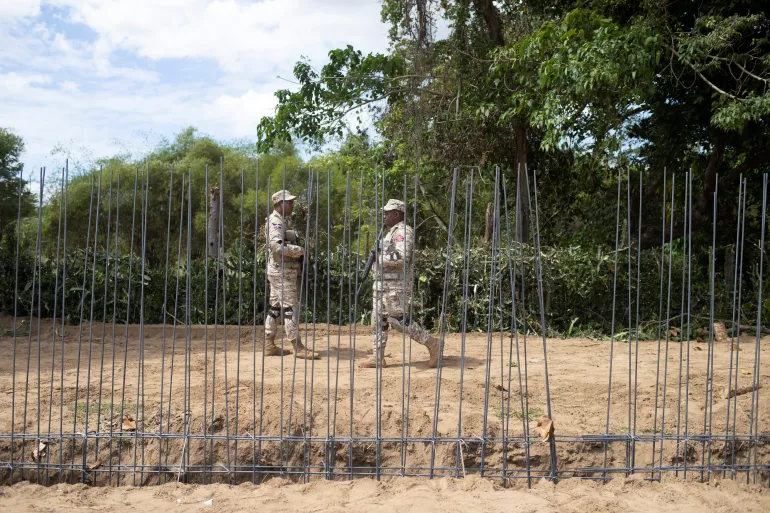
The Dominican Republic has announced plans to extend its border wall with Haiti by 10 to 12 kilometers, increasing its total length to approximately 176 kilometers.
President Luis Abinader revealed this decision on February 17, 2025, citing demands from cattle ranchers in the northern border region of Dajabón. Ranchers credit the existing 34-kilometer section of the wall with reducing livestock and vehicle thefts by 80%.
The government will fund the extension through a multi-year budget, with completion targeted for 2026. Construction of the wall began in 2021 as part of a broader strategy to curb irregular immigration, smuggling, and organized crime along the shared border.
The barrier will eventually span more than half of the 392-kilometer boundary between the two nations on the island of Hispaniola. The structure features a concrete base topped with barbed wire and advanced security systems, including fiber optics, motion sensors, cameras, and drones.
The first phase is already 80% complete, with progress varying across provinces. This initiative reflects growing concerns over Haiti’s ongoing political and economic instability. The situation has led to increased migration into the Dominican Republic.
Since October 2024, Dominican authorities have deported over 142,000 undocumented Haitian migrants, bringing last year’s total expulsions to more than 276,000.
These measures have drawn criticism from human rights organizations. They accuse the Dominican government of discriminatory practices and harsh treatment of Haitians.
Border Wall Sparks Trade and Security Debate
The wall’s construction has also sparked controversy for its potential impact on cross-border trade and relations. Haiti relies heavily on imports from the Dominican Republic, with bilateral trade reaching $1 billion annually.
Informal trade along the border contributes significantly to local economies on both sides. Critics argue that the wall could disrupt these economic ties while failing to address root causes like poverty and instability in Haiti.
President Abinader has defended the project as essential for national security and territorial integrity. He emphasized that it would help combat human trafficking, drug smuggling, and other illicit activities.
However, opposition voices warn that physical barriers alone cannot resolve complex issues rooted in historical inequalities between the two nations. The expansion underscores deepening divisions on an island where shared geography contrasts starkly with social and economic realities.
More: Latin America news in English, every day from The Rio Times.
This article was produced by The Rio Times’ automated newsroom system. How we use AI · Report an error · Editorial responsibility: Matthias Camenzind, Editor-in-Chief