Bitcoin Slips Past $63K & Stablecoins Anchor LatAm
Key Facts
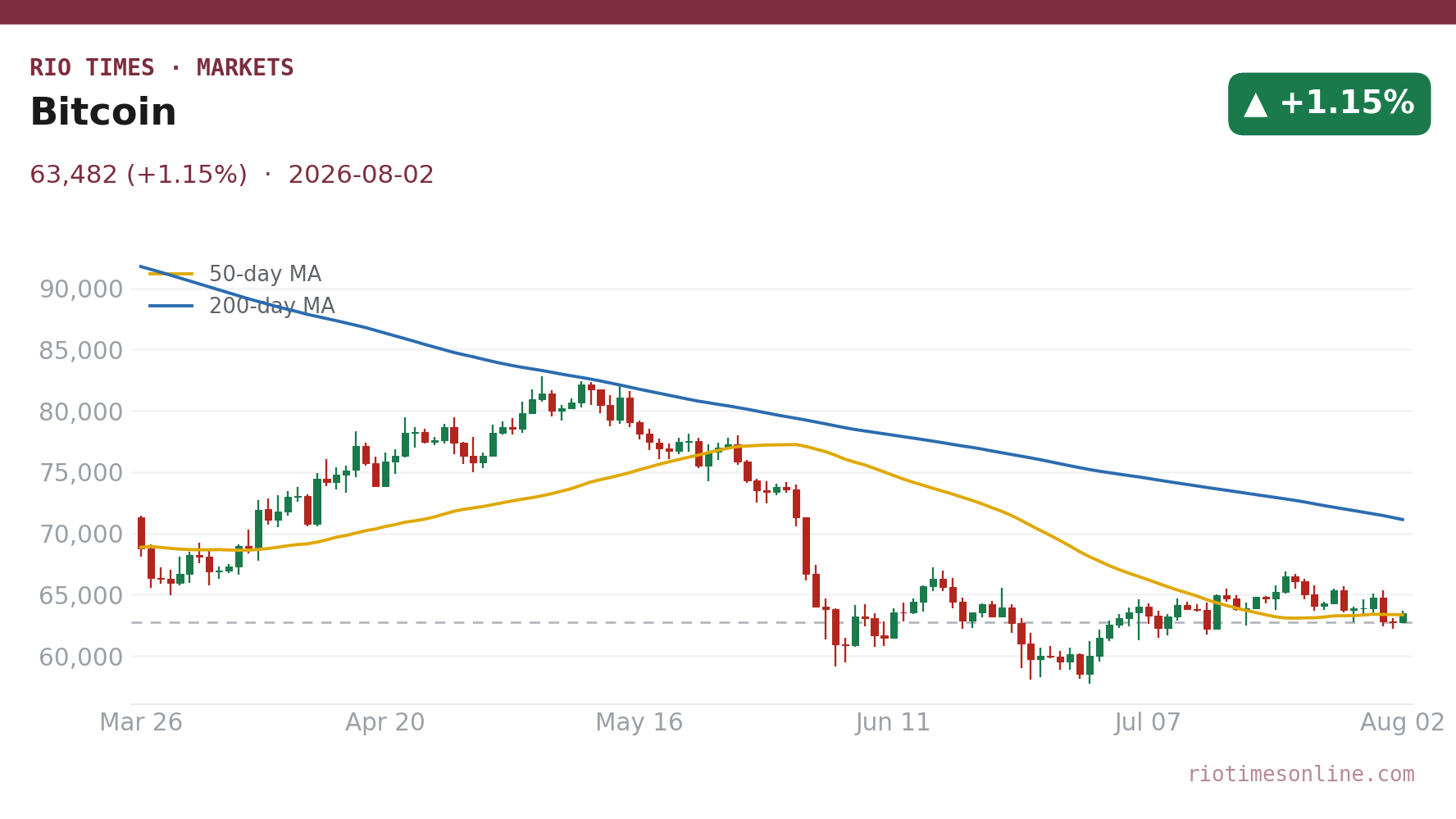
- Bitcoin slid to US$63,482, pulling back 1.15% as traders cut risk before new SEC broker-dealer guidance.
- Ether settled higher at US$1,883, rising 2.12% on the strength of Latin American stablecoin circulation on Ethereum.
- Solana closed near US$73.45, moving only 2.20% higher, with recent network outages capping institutional momentum.
- Dollar‑pegged stablecoins USDT and USDC are now Brazil’s informal payment rails, moving money past bank wires for freelancers.
- Argentines convert wages to stablecoins in seconds using Solana or Polygon, bypassing a 30% loss on official dollar channels.
- El Salvador’s Chivo wallet processes remittances using Bitcoin rails so families receive funds on a phone without money‑transfer fees.
Today’s Focus
Bitcoin lost its footing on Monday, dipping to US$63,482 as traders in New York locked in profits ahead of tighter US broker rules. Ether bucked the trend, climbing 2.12% to US$1,883 on the back of booming stablecoin activity across Brazil and Argentina. Solana and XRP moved sideways, with Solana’s network fragility and the open Ripple case limiting price discovery.
The real action is beneath the price chart: dollar‑pegged tokens USDT and USDC are no longer pure trading vehicles. In Brazil, fintechs Nubank and Mercado Pago pipe stablecoin rails into ordinary payment apps, letting users move reais to dollars with a tap. Argentina’s chronic inflation has turned USDT into a quasi‑savings account, insulating freelance income from a peso that loses value by the week.
El Salvador demonstrates the human use‑case. A portion of remittances from the US now arrives in Bitcoin wallets via the state‑run Chivo app, cutting fees for families who once paid Western Union a tenth of every transfer. The government’s reserves keep accumulating Bitcoin, keeping the project alive even as daily point‑of‑sale adoption remains modest.
For foreign investors, these networks are now infrastructure. BlackRock’s spot Bitcoin ETF may anchor the price, but the long bet is that Latin America turns stablecoins into a permanent settlement layer.
What matters today. Price dips hide a structural shift: Latin America is using stablecoins and Bitcoin as the payment plumbing for a region desperate to escape currency controls.
01 The session in one read
Bitcoin drifted lower by 1.15% to US$63,482, pausing after a multi‑week run supported by heavy BlackRock and Fidelity spot ETF inflows. Open interest on CME Bitcoin futures eased, suggesting professional traders reduced leveraged bets in the hours before new SEC crypto broker guidance.
Ether posted a clean 2.12% gain to US$1,883, while Solana managed a modest 2.20% advance to US$73.45. XRP added 2.35% to settle at US$1.0846 as the market parsed the latest filing in the SEC’s long‑running case against Ripple.
The mild pullback in Bitcoin masks a profound transformation in how Latin America moves money. Ether’s gain of more than 2% and the steady global usage of USDT and USDC signal that value is flowing into the settlement infrastructure, not just the headline token. Investors should watch whether Brazil’s central bank folds stablecoins into its digital‑real pilot, as a successful regulatory wrap would turn tokens from grassroots tools into state‑endorsed financial rails.
02 The board
The proxy board reflects how crypto is trading alongside macro risk‑on assets, not against them. Bitcoin futures open interest dipped on the CME, signaling that the 1.15% drop was driven by position‑trimming rather than a fundamental flight.
Ethereum‑based liquid‑staking platforms such as Lido saw a volume bump, confirming that Ether’s premium over Bitcoin came from yield‑seeking traders parking Ether for protocol rewards rather than purely directional bets.
| Asset | Level | Change |
|---|---|---|
| Bitcoin | US$63,482 | +1.15% |
| Ethereum | US$1,883 | +2.12% |
| Solana | US$73.45 | +2.20% |
| XRP | US$1.0846 | +2.35% |
Source: RT close, 2026-08-02. Where a commodity has no spot feed, an exchange-traded tracker or leading producer is shown as a labelled proxy.
Live Market IntelligenceThe live market board
Rio Times · Live Market Intelligence
Latin America — Cross-Market Board
| Instrument | Last | Change | YoY | Prev. | High | Low | Volume |
|---|---|---|---|---|---|---|---|
| IBOV | 183,476.86 | -0.27% | +21.85% | 183,965.91 | 168,310 | 167,142 | — |
| IPSA | 11,255.90 | -0.39% | — | 11,299.82 | 11,210 | 10,984 | 1,513,213,483 |
| IPC MEX | 64,651.92 | +0.60% | +12.17% | 64,264.16 | 66,121 | 65,405 | 108,886,187 |
| MERVAL | 2,893,751 | -1.57% | +30.51% | 3,022,485 | 3,042,365 | 2,991,150 | — |
| COLCAP | 2,584.72 | -0.95% | — | 9.04 | 9.05 | 9.02 | 4,133 |
| BVL PERÚ | 59,934.37 | +1.27% | — | — | — | — | — |
| USD/BRL | 5.16 | +0.01% | -5.13% | 5.16 | 5.18 | 5.14 | — |
| EUR/BRL | 5.95 | +1.01% | -5.83% | 5.89 | 5.98 | 5.94 | — |
| USD/MXN | 17.06 | -0.24% | -8.58% | 17.10 | 17.08 | 17.01 | — |
| USD/CLP | 913.98 | +0.04% | -5.67% | 913.65 | 915.11 | 906.68 | — |
| USD/COP | 3,140 | +0.03% | -22.04% | 3,139 | 3,141 | 3,105 | — |
| USD/PEN | 3.36 | -0.66% | -4.82% | 3.38 | 3.38 | 3.35 | — |
| USD/ARS | 1,493 | +0.10% | +12.96% | 1,491 | 1,494 | 1,480 | — |
| USD/UYU | 40.27 | +1.24% | +1.80% | 39.77 | 40.27 | 40.23 | — |
| USD/PYG | 5,939 | +1.68% | -19.54% | 5,841 | 5,939 | 5,925 | — |
| USD/BOB | 11.64 | -0.76% | +72.04% | 11.73 | 11.72 | 11.64 | — |
| USD/DOP | 58.34 | +1.25% | -3.44% | 57.62 | 58.34 | 58.04 | — |
| USD/CRC | 445.92 | +0.89% | -9.71% | 441.97 | 448.50 | 445.92 | — |
03 What moved it
US regulators are preparing to tighten custody and dealer rules after enforcement sweeps against Binance and Coinbase. That threat of a compliance shock made Monday the moment to trim Bitcoin exposure, even as BlackRock’s iShares Bitcoin Trust and Fidelity’s Wise Origin Bitcoin Fund still hold recent net inflows.
Global manufacturing surveys weakened, pulling copper proxies lower. Bitcoin increasingly tracks copper as a global‑growth signal, so the soft macro reading reinforced what the regulatory jitters started.
04 The Latin American read
Brazil’s regulated exchange structure lets apps from Nubank and Mercado Pago offer direct crypto access, holding Ether and Bitcoin in licensed custody. Dollar‑pegged stablecoins USDT and USDC now sit inside those apps, letting a São Paulo freelancer bill a US client and convert dollars to reais without a SWIFT wire.
In Argentina, capital controls create a permanent floor for stablecoin demand. Local exchanges report that families save in USDT as a surrogate dollar, while tech exporters invoice in stablecoins and convert only the pesos they need through peer‑to‑peer markets.
El Salvador keeps buying Bitcoin for its national reserves, and a chunk of US‑to‑El‑Salvador remittances flows through the government’s Chivo wallet. The settlement happens on Bitcoin rails, but the cost saving for a family receiving US$150 is immediate compared with a traditional money‑transfer operator’s cut.
05 The names to watch
BlackRock’s IBIT and Fidelity’s FBTC spot Bitcoin ETFs will indicate whether US institutions buy this dip or wait for regulatory clarity. Lido’s staking flows on Ethereum will confirm if Ether’s yield premium persists.
In Latin America, Nubank and Mercado Pago signal how deeply stablecoins have entered retail finance, while Argentina’s peer‑to‑peer USDT volumes on local exchanges measure desperation‑driven adoption.
06 The outlook
The SEC’s broker‑dealer update and any copper‑price bounce will dictate the next Bitcoin leg. For Latin America, the critical variable is whether Brazil’s central bank merges stablecoin payments into the digital‑real pilot this quarter, a step that would formalise what millions of freelancers already do on USDT rails.
07 What to watch
- SEC broker‑dealer guidance: A stricter custody rule could force Coinbase to change its business model, repricing the whole sector.
- Brazil digital‑real pilot: If Banco Central do Brasil formally integrates USDT and USDC, stablecoins become a licensed payments layer.
- Argentina’s parallel dollar rate: A widening gap between the official and blue‑chip swap rate drives new savers into stablecoin dollar substitutes.
- El Salvador’s reserve buys: New government Bitcoin purchases signal continued sovereign commitment despite moderate domestic retail use.
Frequently Asked Questions
Why did Bitcoin fall when Ether rose?
Bitcoin faced regulatory profit‑taking ahead of new SEC rules, while Ether gained from heavy stablecoin circulation on Ethereum’s network in Latin America.
How do Argentina’s capital controls push people into crypto?
Argentines have restricted access to official dollars; they buy USDT as a dollar proxy, then convert to pesos only when needed via peer‑to‑peer markets.
What is the Chivo wallet in El Salvador?
Chivo is the government‑issued digital wallet that lets Salvadorans send and receive Bitcoin or US dollars, cutting fees on remittances sent from abroad.
Do stablecoins work inside a normal Brazilian bank app?
Yes. Nubank and Mercado Pago let customers buy USDT or USDC and hold them in regulated custody, moving between reais and dollar‑pegged tokens without leaving the app.
This article was produced by The Rio Times’ automated newsroom system. How we use AI · Report an error
LatAm Markets: Live Signals → — real-time movers, turnover leaders and FX across Latin America.
Read More from The Rio Times