Latin America Oil: Petrobras, YPF Rise as Ecopetrol Drops
Key Facts
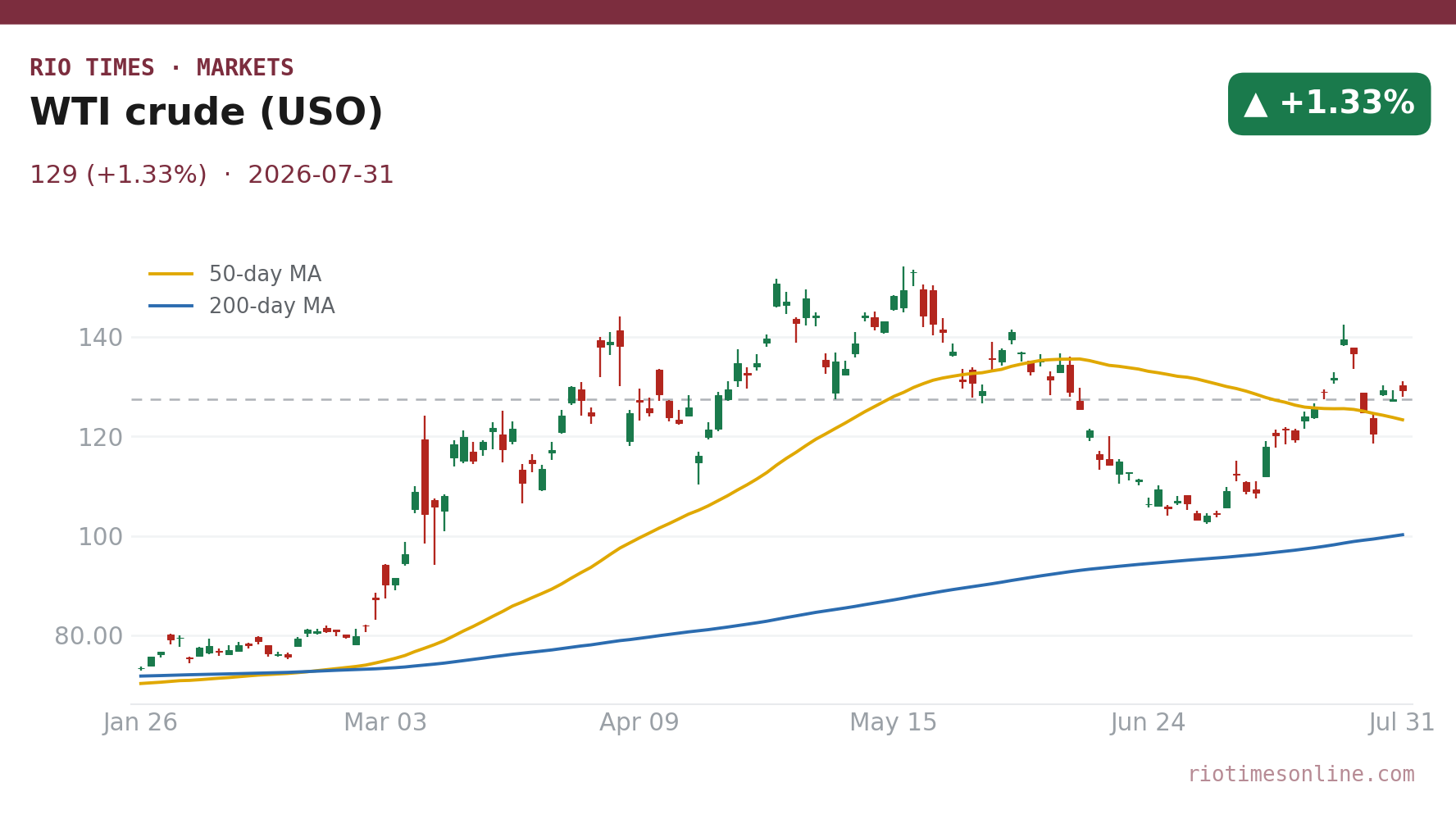
- The WTI-tracking USO fund settled at US$129.17, a gain of 1.33% on the day as supply tightness fears returned to the crude market.
- Petrobras shares rose 1.46% to US$19.40, outpacing the broader crude move as Brazil’s pre-salt output narrative sustained investor interest.
- YPF ended 0.75% higher at US$52.54, a modest gain reflecting steady unconventional production from Argentina’s Vaca Muerta shale play.
- Colombia’s Ecopetrol fell 1.58% to US$16.77, bucking the regional trend as company-specific pressures weighed on the Bogotá-listed name.
- Guyana’s Stabroek Block operator ExxonMobil remained a focal point, as the consortium’s light sweet crude continues to reshape Atlantic Basin trade flows for foreign investors.
- OPEC+ supply management remains the umbrella driver, with coalition production levels dictating the futures curve that USO and Latin American producers ultimately track.
Today’s Focus
USO, the exchange-traded fund that tracks West Texas Intermediate crude futures, settled at US$129.17 on Friday, a 1.33% daily gain. Petrobras rose +1.46% to US$19.40, extending its strength on Brazil’s pre-salt story. Argentina’s YPF added +0.75% to US$52.54, while Colombia’s Ecopetrol bucked the board with a -1.58% drop to US$16.77.
The session’s move came as the global market focused on OPEC+ production discipline and the macroeconomic signals shaping demand forecasts. Guyana’s offshore boom remained a bright spot for non-OPEC supply, with ExxonMobil-led operations in the Stabroek Block reliably feeding light sweet crude into the Atlantic market.
For foreigners watching Latin America, the board shows a region where national oil companies and private operators are on divergent paths: Brazil and Guyana are expanding, Argentina is slowly unlocking shale, and Mexico and Venezuela face structural constraints that cap the upside for their respective investment stories.
What matters today. Brazil’s pre-salt strength and Guyana’s reliable light sweet output are the two regional stories most directly lifting producer shares today.

01 The session in one read
Oil proxies moved mostly higher on Friday, with the United States Oil Fund rising 1.33% to US$129.17 as WTI futures strengthened. The fund, which rolls near-month NYMEX contracts, gave foreign investors a clean read on a market that is once again pricing supply tightness into the front of the curve.
Latin American producer shares largely followed the commodity higher, though by differing margins that highlight the region’s fractured energy-investment landscape. Petrobras gained +1.46% to US$19.40, as Brazil’s deepwater pre-salt fields remained a magnet for the commodity-cycle capital that global funds have been allocating to Latin America.
The session reinforced a pattern where Petrobras and the Guyanese operators command a scarcity premium among Latin American oil equities, while Pemex’s heavy debt load and PDVSA’s sanctions-choked exports render them largely uninvestable for global funds that are instead channelling capital into Brazil’s deepwater and Argentina’s shale. The variable to watch is whether OPEC+ signals any revision to its production baseline at its next technical committee meeting, which would instantly reset the futures curve that USO proxies.
02 The board
Petrobras’s +1.46% advance made it the standout mover on a board where crude strength was not a uniform tide. YPF, Argentina’s partially state-owned shale champion, rose +0.75% to US$52.54, a measured gain that reflects Vaca Muerta’s slow but steady production growth.
Colombia’s Ecopetrol fell -1.58% to US$16.77, the only decliner on the regional board and a reminder that not every Latin American integrated oil name captures the full upside of a crude rally. The divergence underscores that equity markets still differentiate fiercely among national oil companies based on their operational momentum and fiscal environments.
| Asset | Level | Change |
|---|---|---|
| WTI crude (USO) | US$129.17 | +1.33% |
| Petrobras | US$19.40 | +1.46% |
| Ecopetrol | US$16.77 | -1.58% |
| YPF | US$52.54 | +0.75% |
Source: RT close, 2026-07-31. Where a commodity has no spot feed, an exchange-traded tracker or leading producer is shown as a labelled proxy.
Live Market IntelligenceThe live market board
Rio Times · Live Market Intelligence
Latin America — Cross-Market Board
| Instrument | Last | Change | YoY | Prev. | High | Low | Volume |
|---|---|---|---|---|---|---|---|
| IBOV | 186,505.13 | +0.52% | +21.85% | 185,547.66 | 168,310 | 167,142 | — |
| IPSA | 11,381.18 | +1.30% | — | 11,235.54 | 11,210 | 10,984 | 1,513,213,483 |
| IPC MEX | 63,507.11 | -1.11% | +12.17% | 64,216.98 | 66,121 | 65,405 | 108,886,187 |
| MERVAL | 3,046,139 | +0.57% | +30.51% | 3,022,485 | 3,042,365 | 2,991,150 | — |
| COLCAP | 2,510.93 | -0.03% | — | 9.04 | 9.05 | 9.02 | 4,133 |
| BVL PERÚ | 58,965.05 | +0.64% | — | — | — | — | — |
| USD/BRL | 5.16 | +0.01% | -5.13% | 5.16 | 5.18 | 5.14 | — |
| EUR/BRL | 5.95 | +1.01% | -5.83% | 5.89 | 5.98 | 5.94 | — |
| USD/MXN | 17.06 | -0.24% | -8.58% | 17.10 | 17.08 | 17.01 | — |
| USD/CLP | 913.98 | +0.04% | -5.67% | 913.65 | 915.11 | 906.68 | — |
| USD/COP | 3,140 | +0.03% | -22.04% | 3,139 | 3,141 | 3,105 | — |
| USD/PEN | 3.36 | -0.66% | -4.82% | 3.38 | 3.38 | 3.35 | — |
| USD/ARS | 1,493 | +0.10% | +12.96% | 1,491 | 1,494 | 1,480 | — |
| USD/UYU | 40.27 | +1.24% | +1.80% | 39.77 | 40.27 | 40.23 | — |
| USD/PYG | 5,939 | +1.68% | -19.54% | 5,841 | 5,939 | 5,925 | — |
| USD/BOB | 11.64 | -0.76% | +72.04% | 11.73 | 11.72 | 11.64 | — |
| USD/DOP | 58.34 | +1.25% | -3.44% | 57.62 | 58.34 | 58.04 | — |
| USD/CRC | 445.92 | +0.89% | -9.71% | 441.97 | 448.50 | 445.92 | — |
03 What moved it
The broad crude move was underpinned by OPEC+ supply management, the coalition of OPEC members and allies such as Russia that continues to calibrate production levels to defend a price floor. Global demand indicators, particularly Chinese industrial output and US transport activity, provided the demand-side narrative that traders used to justify bidding up futures.
A stronger US dollar against some emerging-market currencies acted as a partial brake on the rally, making dollar-denominated crude marginally more expensive for importers. Still, the prevailing mood in the futures market was one of tightening physical balances, which fed directly into the near-month contracts that USO holds.
04 The Latin American read
Brazil’s pre-salt story continues to set Petrobras apart. The Santos Basin fields—including the giant Búzios and Mero projects—produce medium to light crude that commands favourable differentials against heavier grades, giving the company a quality edge that appeals to refiners from Rotterdam to Singapore. Argentina’s YPF is tapping a different geology at Vaca Muerta, the vast shale formation in the Neuquén Basin, where unconventional drilling technology is steadily lowering well costs and improving productivity, drawing incremental interest from foreign partners.
Guyana’s transformation into a petro-state remains the region’s most dramatic supply-side story. ExxonMobil’s Stabroek Block operations, backed by Chevron and CNOOC, are pumping light sweet crude into Atlantic Basin trade routes, generating revenues that flow into the Guyanese government’s Natural Resource Fund and reshaping the country’s external accounts.
Mexico’s Pemex and Venezuela’s PDVSA present contrasting pictures of state-company stress. Pemex carries a heavy debt load while struggling to arrest output declines at mature fields, making its Maya heavy crude exports vulnerable to any downturn in US Gulf Coast refining demand. PDVSA operates under a web of US sanctions that, despite limited waivers, continues to choke export volumes from the extra-heavy Orinoco Belt reserves.
05 The names to watch
Petrobras remains the bellwether for investors wanting exposure to Brazil’s pre-salt growth without taking on the operational and partner risk of individual deepwater projects. The company’s New York-listed American Depositary Receipts are the most liquid single-stock proxy for Latin American crude for foreign investors.
YPF is the purest public-equity play on Argentina’s Vaca Muerta shale, although its partially state-owned structure means local political and currency dynamics often inject volatility that is unrelated to the underlying geology. For Guyana exposure, ExxonMobil and Chevron are the listed entry points, although both are globally diversified and do not offer a standalone Guyanese pure play.
06 The outlook
The immediate outlook for Latin American oil equities depends on whether OPEC+ signals any adjustment to its production baseline at the next technical committee meeting, which would reset the futures curve that USO tracks. A surprise increase in the coalition’s quotas could test the supply-tightness thesis that underpinned Friday’s move, while any extension of current curbs would reinforce the price floor that supports producer shares.
For Petrobras and YPF specifically, the second half of the year will test whether pre-salt and shale output growth can outpace any softening in global crude demand. Foreign capital flows into Latin American commodity equities remain sensitive to dollar strength and US interest rate expectations, two macro variables that sit entirely outside the control of Rio de Janeiro, Buenos Aires or Georgetown.
07 What to watch
- OPEC+ technical committee meeting: Any hint of a baseline revision would instantly move the futures curve that USO and Latin American producer shares track.
- Petrobras pre-salt output data: Quarterly production figures for Búzios and Mero fields will either confirm or challenge the growth narrative that has supported a valuation premium.
- US dollar index: A sustained dollar rally would make emerging-market crude imports more expensive, potentially capping demand growth that underpins current prices.
- Venezuela sanctions renewal: The expiry or extension of US Treasury general licenses will determine whether limited PDVSA exports continue, altering the supply of heavy sour crude in the Americas.
Background: Braskem Bond Tender Rejected Amid $9.4B Debt Crisis.
Frequently Asked Questions
What is USO and why do you quote it?
The United States Oil Fund is an exchange-traded fund that tracks West Texas Intermediate crude oil futures by holding and rolling near-month NYMEX contracts. We cite its price as a liquid equity-market proxy for WTI rather than a raw commodity spot price.
Why did Petrobras outperform Ecopetrol today?
Petrobras gained on the strength of Brazil’s pre-salt output story, with its light crude commanding premium differentials. Ecopetrol faced company-specific headwinds that decoupled its shares from the broader crude move.
Is Guyana investable through a single stock?
No pure-play Guyanese producer is publicly listed. Investors access the Stabroek block story through ExxonMobil and Hess, which operate the offshore fields alongside CNOOC.
How do OPEC+ decisions reach Latin American shares?
OPEC+ production targets shape the global supply balance that sets WTI futures prices. Those futures are the reference for the USO fund and influence revenue expectations for all Latin American oil producers, from Petrobras to YPF.
This article was produced by The Rio Times’ automated newsroom system. How we use AI · Report an error
LatAm Markets: Live Signals → — real-time movers, turnover leaders and FX across Latin America.
Read More from The Rio Times