Brazil Grain Exports Surge, Dragging Crop Funds Down
Key Facts
- SOYB eased to US$25.16 as the soybean-tracking fund slipped 0.08% with Brazil’s massive crop offering stiff competition even into a hesitant China.
- CORN dropped -0.62% to US$17.65 weighed by benign US Midwest weather and Brazil’s aggressive corn export campaign out of ports like Santos.
- WEAT slid 3.29% to US$23.81 its steepest decline of the three, pressured by plentiful Black Sea cargoes and solid Argentine harvest prospects.
- China’s cautious buying tempered demand as tighter crushing margins for soybeans encouraged some processors to delay cargo purchases from Brazil and Argentina.
- A broadly steady US dollar offered grain trackers little support making dollar-denominated funds like CORN and WEAT pricier for buyers using other currencies and capping rallies.
- A firmer Brazilian real trimmed the incentive for farm sales improving local-currency revenue for Mato Grosso growers and adding to the export wave that weighs on global grain benchmarks.
Today’s Focus
The three main grain-tracking funds fell across the board Friday, reflecting a market awash in South American supply and a hesitant Chinese buyer. The soybean fund SOYB eased 0.08% to US$25.16 while the corn tracker CORN slipped -0.62% to US$17.65 as ample Brazilian shipments and benign US crop weather removed supply fears.
Wheat was the sharpest laggard, with the WEAT fund sinking 3.29% to US$23.81, punished by strong export flows from the Black Sea and a promising Argentine crop. Investors are reading the synchronized decline as a signal that global feed-grain availability is comfortable for now, removing the urgency for buyers to chase prices higher.
For foreign readers watching Latin America’s export engine, the session illustrates a classic double squeeze: Brazilian farmers are selling aggressively into a weak real, while China, the world’s top soybean importer, is buying cautiously as its economy finds only limited support from government measures. The resulting price softness keeps a lid on grain-tracker funds despite robust physical shipments from Santos and the Paraná River corridor.
What matters today. Ample South American harvests and a cautious China, magnified by a strong dollar, are jointly capping grain-tracker prices despite brisk export loadings.
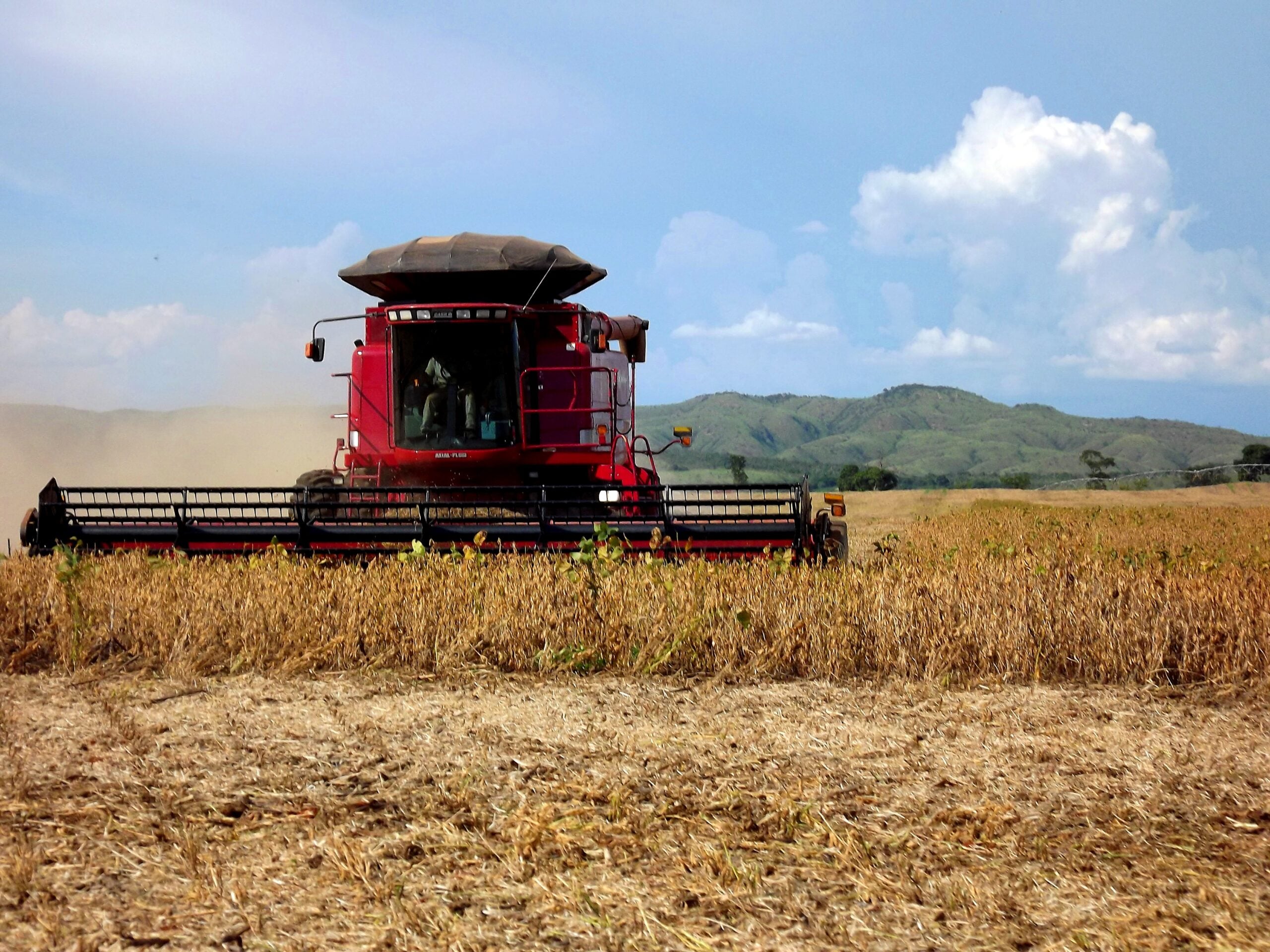
01 The session in one read
Grain prices fell in unison on Friday in a session dominated by the weight of freshly harvested South American supplies and a guarded outlook from the world’s biggest commodity buyer. Tracking funds for soybeans, corn and wheat each marked a loss, with the wheat fund WEAT bearing the heaviest hit, tumbling 3.29% to US$23.81, while the soybean tracker SOYB and corn tracker CORN saw more measured but clear declines.
Investors took the view that, with Brazilian ports moving record volumes and no immediate weather threat in Argentina, the forward supply curve is comfortably covered. This sense of abundance, combined with a firm US dollar and cautious Chinese economic signalling, was enough to push all three grain funds into the red.
Grains are trading on the arrival of physical supply rather than on disruption risk, with Brazilian and Argentine cargoes meeting a Chinese market that is in rationing mode because of slim crush margins. The persistent fund outflows from WEAT, relative to milder moves in SOYB and CORN, reflect the added drag of competitive Black Sea wheat. For the near term, the critical variable to watch is whether China accelerates soybean purchases to rebuild crushing inventories or continues to buy hand-to-mouth, which would keep a lid on the SOYB tracker.
02 The board
Friday’s board showed a clean sweep of red across grain-tracking funds. The US-listed soybean ETF SOYB fell 0.08% to settle at US$25.16, as the fund’s underlying Chicago futures contracts reacted to the twin pressures of a massive Brazilian harvest and Chinese buyers scaling back their forward coverage. The corn-tracking fund CORN dipped -0.62% to US$17.65, with traders pointing to a competitively priced Brazilian corn crop that is eroding the premium typically held by US Gulf shipments.
The demand-sensitive wheat fund WEAT sustained the deepest wound of the day, sliding 3.29% to US$23.81. This sharp move reflected not just Argentine crop improvements but a glut of competitively priced Black Sea wheat that is winning tenders from price-sensitive importers in the Middle East and North Africa. Unlike soy and corn, where the decline was gradual, wheat’s slide was amplified by the sheer volume of cargoes jostling for a home in the export market.
| Asset | Level | Change |
|---|---|---|
| Soybeans (SOYB) | US$25.16 | -0.08% |
| Corn (CORN) | US$17.65 | -0.62% |
| Wheat (WEAT) | US$23.81 | -3.29% |
Source: RT close, 2026-07-31. Where a commodity has no spot feed, an exchange-traded tracker or leading producer is shown as a labelled proxy.
Live Market IntelligenceThe live market board
Rio Times · Live Market Intelligence
Latin America — Cross-Market Board
| Instrument | Last | Change | YoY | Prev. | High | Low | Volume |
|---|---|---|---|---|---|---|---|
| IBOV | 185,547.66 | -0.51% | +21.85% | 186,502.64 | 168,310 | 167,142 | — |
| IPSA | 11,235.54 | -0.77% | — | 11,322.60 | 11,210 | 10,984 | 1,513,213,483 |
| IPC MEX | 63,507.11 | -1.11% | +12.17% | 64,216.98 | 66,121 | 65,405 | 108,886,187 |
| MERVAL | 3,028,871 | +0.00% | +30.51% | 3,022,485 | 3,042,365 | 2,991,150 | — |
| COLCAP | 2,511.76 | -2.16% | — | 9.04 | 9.05 | 9.02 | 4,133 |
| BVL PERÚ | 58,496.57 | +0.80% | — | — | — | — | — |
| USD/BRL | 5.16 | +0.01% | -5.13% | 5.16 | 5.18 | 5.14 | — |
| EUR/BRL | 5.95 | +1.01% | -5.83% | 5.89 | 5.98 | 5.94 | — |
| USD/MXN | 17.06 | -0.24% | -8.58% | 17.10 | 17.08 | 17.01 | — |
| USD/CLP | 913.98 | +0.04% | -5.67% | 913.65 | 915.11 | 906.68 | — |
| USD/COP | 3,140 | +0.03% | -22.04% | 3,139 | 3,141 | 3,105 | — |
| USD/PEN | 3.36 | -0.66% | -4.82% | 3.38 | 3.38 | 3.35 | — |
| USD/ARS | 1,493 | +0.10% | +12.96% | 1,491 | 1,494 | 1,480 | — |
| USD/UYU | 40.27 | +1.24% | +1.80% | 39.77 | 40.27 | 40.23 | — |
| USD/PYG | 5,939 | +1.68% | -19.54% | 5,841 | 5,939 | 5,925 | — |
| USD/BOB | 11.64 | -0.76% | +72.04% | 11.73 | 11.72 | 11.64 | — |
| USD/DOP | 58.34 | +1.25% | -3.44% | 57.62 | 58.34 | 58.04 | — |
| USD/CRC | 445.92 | +0.89% | -9.71% | 441.97 | 448.50 | 445.92 | — |
03 What moved it
The central force behind Friday’s softness was Brazil’s ability to price grains aggressively amid a weakening domestic currency. The Brazilian real has firmed against the US dollar in recent weeks, a move that directly inflates the local-currency earnings of farmers in Mato Grosso and Paraná when they sell dollar-denominated soy and corn abroad. This currency tailwind has turned Brazil’s already large 2025/26 harvest into a relentless export flow, with vessels lining up at Santos and Paranaguá to load cargoes destined for Asia.
On the demand side, China’s soybean crushers are pulling back. Processing margins have tightened enough that some plants are deferring or reducing purchases, choosing to run down existing inventories rather than lock in new arrivals at current price levels. Chinese government commentary emphasises targeted economic support rather than a broad stimulus package, a message that investors interpret as a soft cap on near-term grain demand growth. With China acting as the world’s anchor buyer for soybeans, even a modest slowdown in its pace of purchasing can tilt the entire complex lower.
04 The Latin American read
For Brazil and Argentina, the grain complex’s decline is a story told in two different currencies with the same result. A weaker Brazilian real is encouraging farmers to sell even as dollar-denominated futures soften, because their revenue in reais remains attractive; every cent that futures lose is partially offset by a more favourable exchange rate. In Argentina, an overvalued official peso and distorted domestic grain markets mean producers watch global price moves even more closely, using the export parity price as a guide for when to commit their corn and wheat to the Rosario loading docks.
The broader Latin American macro backdrop reinforces the supply story. Higher US interest rates have supported the dollar against most emerging-market currencies, a dynamic that historically weighs on dollar-priced commodities. For foreign investors watching the region’s farm economy, the current configuration—ample crops, a broadly steady greenback and cautious Chinese demand—creates headwinds for the SOYB, CORN and WEAT trackers, even as Brazilian and Argentine ports operate at a frantic pace.
05 The names to watch
Investors seeking direct exposure to the Latin American grain story beyond the futures-tracking ETFs have a tight universe of listed names. Brazil’s SLC Agrícola, a large-scale producer of soy, corn and cotton with operations centred in Mato Grosso, is a primary domestic proxy for on-farm profitability in the current high-volume, weak-currency environment. On the logistics side, the port operator Santos Brasil reflects activity levels at Latin America’s largest container and bulk terminal complex, offering a read on export volumes.
Argentina’s trading and agribusiness names, such as Molinos Agro and the locally listed arm of Adecoagro, shift with the export parity arithmetic and government policy. While the ETFs SOYB, CORN and WEAT capture the global price, these producer and logistics equities add a layer of company-specific risk, from sowing decisions to tax and export registration changes. Friday’s session suggests that, for now, the sheer volume of crop moving onto the global market is the headline that overrides all others.
06 The outlook
The immediate path for grain trackers is pinned to China’s next moves. If crushers begin rebuilding inventories, SOYB would likely stabilise and drag CORN and WEAT with it through the feed-cost channel. The alternative scenario, in which China continues buying hand-to-mouth, would extend the slow drift lower across the complex. Traders are also monitoring Argentine weather maps for any sign of stress that could lift corn and wheat from their current heavy-supply narrative. Until then, the weight of South American crop and a disciplined Chinese buyer suggests the path of least resistance for grain trackers remains to the downside.
07 What to watch
- China soybean crush margins: A rebound in processor profitability would signal renewed buying and could lift SOYB
- Brazilian real versus US dollar: Further BRL weakness would keep the export spigot wide open, pressuring CORN and SOYB
- Argentine weather and crop ratings: Any deterioration in the Pampas would tighten corn and wheat supply, reversing part of WEAT’s slide
- Black Sea wheat shipment pace: Sustained high volumes from Russia and Ukraine would continue to weigh on WEAT
Frequently Asked Questions
Why did grain prices fall on Friday?
Ample Brazilian soybean and corn harvests, a cautious stance from Chinese buyers, steady Black Sea wheat flows and a firmer US dollar combined to push the SOYB, CORN and WEAT trackers lower.
How does a weaker Brazilian real affect grain prices?
A weaker real boosts local-currency revenue for Brazilian farmers selling grain in dollars, encouraging aggressive export sales that add to global supply and can pressure international grain-tracker prices lower.
What role does China play in the grain markets?
China is the world’s largest soybean importer and a major corn buyer; when its crushers slow purchases because of tight margins or economic caution, it can soften the entire grain complex, particularly SOYB.
Why is WEAT falling harder than SOYB or CORN?
Wheat is facing added pressure from competitive Black Sea exports on top of Argentine crop improvements, meaning a larger supply pool is chasing the same buyers, which amplifies the price decline in the WEAT tracker.
This article was produced by The Rio Times’ automated newsroom system. How we use AI · Report an error
LatAm Markets: Live Signals → — real-time movers, turnover leaders and FX across Latin America.
Read More from The Rio Times