Congo’s Fastest-Ever Ebola Outbreak, and the World Looking Away
Health · DR Congo
—The record. The outbreak declared in Congo on 15 May is the fastest-growing Ebola event on record and the largest ever documented in the country.
—The count. By late August it had passed 5,700 confirmed cases and 2,700 deaths, spread across sixty health zones in six provinces.
—The strain. The Bundibugyo virus has no approved vaccine or treatment; the existing Ebola medicines were certified for a different species.
—The spillover. Uganda recorded twenty cases and two deaths before declaring its own outbreak over; single cases were treated in France and Germany.
—The front line. More than 150 health workers have been infected, and more than forty of them have died.
—The gap. The World Health Organization believes the true number of infections could be two to four times the confirmed count.
In a hundred days, an outbreak in Congo’s north-east has outrun every Ebola response ever mounted. It is caused by a strain the medicine cabinet does not cover, in a war zone the world has stopped reading about.
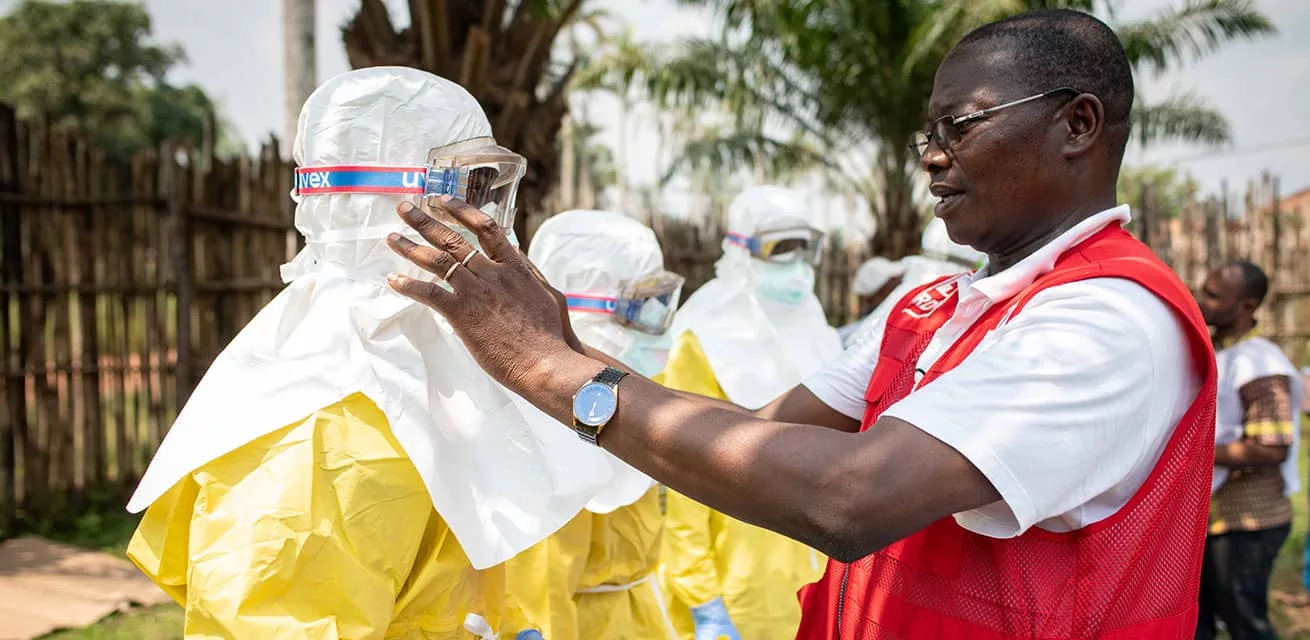
A hundred days of exponential growth
The outbreak was declared on 15 May in Mongbwalu, a gold-mining town in Ituri province. It is Congo’s seventeenth Ebola outbreak, but none of the previous sixteen moved like this.
The milestones tell the story. Confirmed cases passed one thousand on 20 June, two thousand on 13 July, three thousand on 24 July, four thousand on 7 August and five thousand on 17 August.
The Africa CDC put the comparison bluntly. This outbreak reported about 1,600 cases in its first six weeks — against roughly 1,000 in the same stretch of the 2014 West Africa epidemic and fewer than 400 in the 2018 Kivu outbreak.
By late August it had already killed more people than the entire 2018–2020 Kivu outbreak, which ran for two years. That event was once the benchmark of Ebola horror; this one passed it in three months.
Why Bundibugyo is harder
Ebola is not one virus but a family. Nearly all the tools the world stockpiled after 2014 — the ERVEBO vaccine, the antibody treatments — were built for the Zaire species.
This outbreak is Bundibugyo, a rarer species seen only twice before, in Uganda in 2007 and in Congo in 2012. There is no approved vaccine and no proven treatment for it.
The case fatality rate is running near 47%, toward the top of Bundibugyo’s known range. Health workers have paid heavily: more than 150 infected, over forty dead.
A vaccination campaign using the Zaire-strain vaccine began for frontline workers in Kisangani in late August, on animal-study evidence of partial protection. It is a measure of desperation that doctors are reaching for a vaccine designed for a different virus.
The terrain fights back
Ituri is not a normal epidemiological battlefield. Some 1.9 million people there already need humanitarian aid, and armed conflict has made whole districts unreachable for months at a time.
The virus has travelled along the region’s commerce: miners, traders and refugees move constantly between Ituri, North Kivu and the Ugandan border. Cases appeared in Goma, a city effectively under M23 control, where no response team can freely work.
The most alarming number came from the WHO’s emergencies chief in July. Four of five new patients in Ituri were not on any contact list, which means the chains of transmission are largely invisible.
Modelling cited by the WHO suggests the real caseload could be two to four times the confirmed one. Even the count of the dead — 2,786 by 26 August — is an estimate of the floor, not the ceiling.
The geography widened steadily: from Ituri into North Kivu and South Kivu, then Haut-Uélé, Tshopo and, by mid-August, Bas-Uélé. Sixty of the country’s 151 health zones have now reported cases.
The world that is elsewhere
Uganda, which caught twenty cases through a funeral party that crossed the border, managed what Congo could not: it traced, isolated and declared its outbreak over on 26 August.
Europe’s encounter with the virus amounted to two patients treated in Germany and one case in France, all contained. The global system’s defences worked — at the border.
Inside the outbreak zone, the response is still short of money, staff and access. Médecins Sans Frontières opened a new treatment centre in Beni only in late August, a hundred days in.
The pledging gap is not new. The Kivu outbreak of 2018–2020 also ran for months before serious funding arrived, and it ended only after a vaccine existed — a luxury this strain does not offer.
Ebola has a grim pattern: the world pays attention when the virus boards a plane, and looks away when it stays in the forest. This outbreak is the largest test yet of whether that pattern can be broken.
More: DR Congo news in English, every day from The Rio Times.
Frequently Asked Questions
How bad is Congo’s 2026 Ebola outbreak?
It is the largest Ebola outbreak ever recorded in Congo and the fastest-growing anywhere on record. By late August, confirmed cases had passed 5,700 with more than 2,700 deaths, across sixty health zones in six provinces.
Why is there no vaccine for this Ebola strain?
The outbreak is caused by the Bundibugyo species of Ebola virus, while the stockpiled vaccine and antibody treatments were developed for the Zaire species. No Bundibugyo vaccine has been approved, and a Zaire-strain vaccine is being used for frontline workers only on evidence of partial protection.
Has the 2026 Ebola outbreak spread beyond Congo?
Uganda recorded twenty cases and two deaths early in the outbreak, then declared its own episode over on 26 August. Two patients were treated in Germany and one case was recorded in France, all imported and contained.
What would it take to stop the outbreak?
Contact tracing, isolation centres, safe burials and community trust — plus access. Much of Ituri is conflict terrain where response teams cannot freely operate, and the WHO estimates the true caseload may be two to four times the confirmed figures.
Connected Coverage
Africa Intelligence Brief — Thursday, August 27, 2026
This article was produced by The Rio Times’ automated newsroom system. How we use AI · Report an error · Editorial responsibility: Matthias Camenzind, Editor-in-Chief