Colombia Court Gives Petro 3 Days to Answer Registrar

POLITICS · COLOMBIA
Key Facts
- —The country Colombia, about 53 million people, is a leading US security partner in South America. Its elections are run by the National Civil Registry, headed by Registrar Hernán Penagos.
- —Why it matters Former President Gustavo Petro has said for months that the 2026 presidential vote was rigged. The registrar now asks a court to make him correct those claims.
- —Why now The Council of State admitted the registrar’s tutela, a fast constitutional rights claim. The order is dated 30 September and became public on Monday, 5 October.
- —What happened The claim targets 14 posts on X between 2 June and 5 August 2026 and a televised cabinet meeting on 14 July, according to the court order.
- —The numbers Abelardo de la Espriella won the 21 June runoff with 49.66% to 48.70% for Iván Cepeda, a 250,830-vote margin, Registry figures show.
- —What it means for you The US Treasury sanctioned Petro on 24 October 2025 under counter-narcotics rules. A court test of his fraud claims shapes how Washington reads Colombian politics before the 2027 local elections.
- —Still open Petro has three days from notification to answer. A tutela is normally decided within ten days, and the court has not ruled on the merits.
Petro fraud claims about Colombia’s 2026 presidential election are now before the Council of State, the country’s top administrative court in Bogotá. For Washington, which sanctioned Petro in October 2025, the case tests whether Colombia’s institutions can settle a disputed result calmly.
The court admitted a tutela by Registrar Hernán Penagos, head of the National Civil Registry that runs elections, against Gustavo Petro, El Tiempo and Caracol Radio reported on Monday. Petro governed as Colombia’s left-wing president from 2022 until 7 August 2026. Penagos asks for his good name, his honour and the Registry’s reputation to be protected, and for Petro to correct his statements.
What the Court Agreed to Hear
Magistrate Nicolás Yepes Corrales of the court’s Section Three, Subsection C, signed the admission order on 30 September, Infobae reported. The court stressed that admitting the claim is not a decision on whether Petro’s accusations were true or false.
The claim covers 14 posts on Petro’s X account from 2 June to 5 August and a cabinet meeting broadcast on 14 July. Penagos says those messages accused him and the Registry of committing electoral fraud.
The alleged fraud, as listed in the filing, included changes to the voter roll and to polling stations. It also cited the security of E-14 tally sheets, server IP addresses and a refused audit of source code.
Penagos says he asked Petro for a correction and received no reply within 15 working days. El Espectador quoted the filing as saying there was “a reckless disregard for the truth.”
Why a Former President Still Answers for It
Petro left office on 7 August, so the court first had to decide whether it could hear the case at all. It said yes, because the statements were made while he was head of state.
“That he is now a private citizen does not alter the subject of the debate,” the order said, in El Tiempo’s report. The court also called the case one of national legal importance.
The Petro fraud claims raise a question of where free expression ends and a president’s duty to communicate begins, the court said. It has asked the presidency, the National Electoral Council, which oversees parties and campaigns, prosecutors and the ombudsman to comment.
What the Count and the Audit Showed
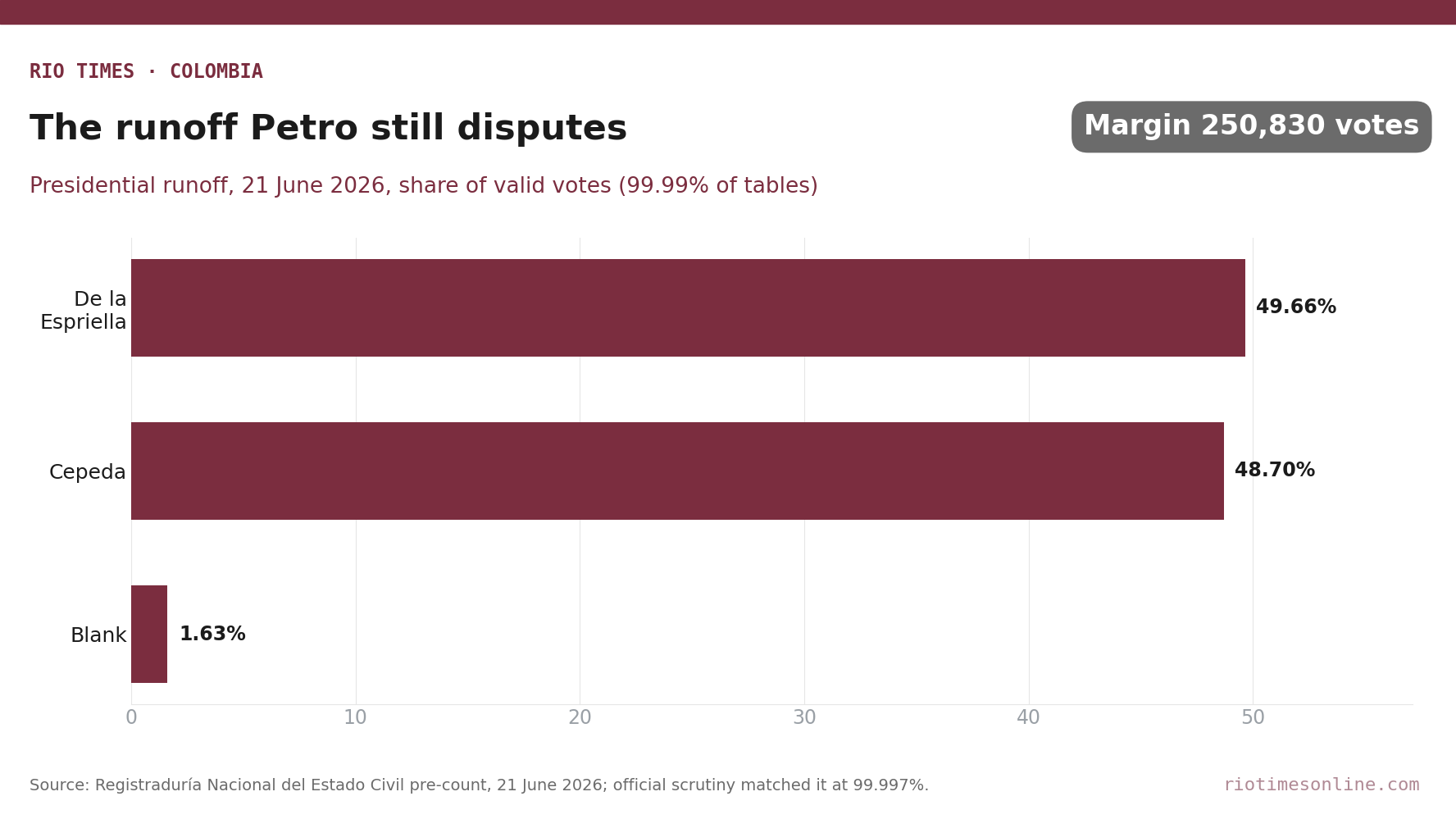
The 21 June runoff was the closest in Colombia’s recent history. Abelardo de la Espriella, a conservative lawyer who took office on 7 August, won 12,959,542 votes, or 49.66%, Registry figures show. Iván Cepeda, a left-wing senator running for Petro’s Historic Pact, won 12,708,712.
The official scrutiny by judges and notaries matched the election-night pre-count at 99.997%, the Registry said on 23 June. Cepeda’s camp had challenged about 33,000 of 122,020 voting tables, El País reported.
An international audit by CAPEL, part of the Inter-American Institute of Human Rights, reported on 4 August. It found no evidence of systematic data manipulation, as set out in 49.7% Win Passes Audit as Colombia Swears in New President.
Petro Answers on X
Petro replied on Monday that the matter is “in the hands of the justice system,” Infobae and Semana reported. He said the Registry’s lack of transparency had violated his own right to vote.
He repeated that 97% of the E-14 files published online by Thomas Greg & Sons, the private firm contracted for the Registry’s election logistics, lacked a hash code. That is a digital fingerprint that shows whether a file was altered.
He also cited what he called mathematical patterns across consecutive voting tables, citing a statistical review he attributed to a group called Testigos Digitales (Digital Witnesses). He asked whether the 2027 local elections would run without hash codes.
Petro closed by citing a remark he attributed to US President Donald Trump, that De la Espriella won thanks to him. That remark has not been independently confirmed.
For context on the wider campaign season, see It’s Official: Colombia Certifies De la Espriella as President-Elect. Parties are already regrouping for 2027, as in Ex-Senator Cabal Joins Colombia’s Republican Party.
What It Means for You
For US investors, the case is a test of institutional calm, not a market shock. Holders of Colombian assets gain when a disputed vote is settled by courts rather than in the street.
The US Treasury sanctioned Petro on 24 October 2025, which bars US persons from most dealings with him. That designation is separate from this Colombian case, which concerns only his public statements.
For visitors, this is a legal dispute in Bogotá and does not change entry rules or daily travel. The larger signal is for the 2027 local elections and trust in how votes are counted.
What Is Not Known
It is not known whether Petro will file a formal reply within the three-day window, or what evidence he will submit. Petro fraud claims have so far rested on his own posts and a statistical review by the group Testigos Digitales.
It is also unclear whether the Registry will answer the hash-code question in court. Penagos has not said publicly how the E-14 files were secured.
What is a tutela in Colombia?
A tutela is a fast constitutional claim that any person can file to protect a fundamental right. Judges normally must decide it within ten days.
Did Colombia’s 2026 runoff show signs of fraud?
The official scrutiny matched the pre-count at 99.997%, the Registry said on 23 June. An international CAPEL audit reported in August found no evidence of systematic manipulation.
What happens if Petro loses the case?
The Council of State could order him to correct his statements publicly. It cannot jail him through a tutela; any criminal matter would be a separate process.
Sources: Council of State admission order, 30 September 2026, as reported by El Tiempo, Caracol Radio and Infobae; El Espectador; Petro’s reply as reported by Semana and Infobae; Registraduría Nacional del Estado Civil runoff figures, 21 and 23 June 2026, via RCN Radio and El País; US Treasury, Treasury Sanctions Colombian President Gustavo Petro and His Support Network, 24 October 2025.
This article was produced by The Rio Times’ automated newsroom system. How we use AI · Report an error · Editorial responsibility: Matthias Camenzind, Editor-in-Chief
In depth