
GUIDES · CHILE
Key Facts
- —The country A high-income economy in World Bank terms and a top copper exporter. Conservative President José Antonio Kast has governed since 11 March 2026.
- —United States US direct investment in Chile stood at US$33.6 billion at the end of 2024, per US Commerce Department data. A free trade agreement has been in force since 1 January 2004.
- —China Chile’s biggest trading partner, with goods trade of US$65.3 billion in 2025, or 32.7% of the total. Trade with the US was US$33.9 billion (Subrei).
- —Investment flows Foreign direct investment reached US$14.2 billion in 2025, up 13%. It totalled US$10.1 billion from January to July 2026 (central bank).
- —Lenders The IMF approved a precautionary US$11.8 billion Flexible Credit Line on 26 August 2026. Chile’s central bank has never drawn on such a line.
- —Trade friction A 12.5% US tariff has applied since July 2026 to about 40.3% of Chile’s shipments to the US; copper is exempt. Talks were still open on 7 October 2026.
Chile foreign ties run on two tracks: American capital and security cooperation on one side, Chinese demand for copper and lithium on the other. This guide sets out who invests, lends, trades and keeps a presence in Chile, with figures and dates. For US investors, exporters and travellers, it explains why Santiago’s balancing act matters.
The United States: Top Project Investor and Trade Partner
The United States is a leading foreign investor in Chile. The US direct investment position reached US$33.6 billion at the end of 2024, up from US$31.2 billion a year earlier. Those figures come from the US Bureau of Economic Analysis, as published by SelectUSA, the Commerce Department’s investment programme.
American firms also lead the pipeline of new projects. InvestChile, the government’s investment promotion agency, tracked a portfolio of US$65.7 billion in foreign projects at the end of 2025. Projects from the United States accounted for US$19.1 billion of that, ahead of Denmark and the United Kingdom.
The commercial base is the US-Chile Free Trade Agreement, in force since 1 January 2004, the US Trade Representative’s office says. In 2025, goods trade with the United States was worth US$33.9 billion, 17% of Chile’s total, says Subrei, the trade undersecretariat.
One flagship American investor is Albemarle, the US lithium producer. It owns 100% of its Salar de Atacama brine operation and a conversion plant at La Negra near Antofagasta. Its quota under a contract with Corfo, the state development agency, expires on 1 January 2044, per a report filed with US regulators.
Money also flows the other way. Chilean companies held US$6.3 billion of direct investment in the United States at the end of 2024, measured by ultimate owner. Software and IT services led their announced US projects, SelectUSA data show.
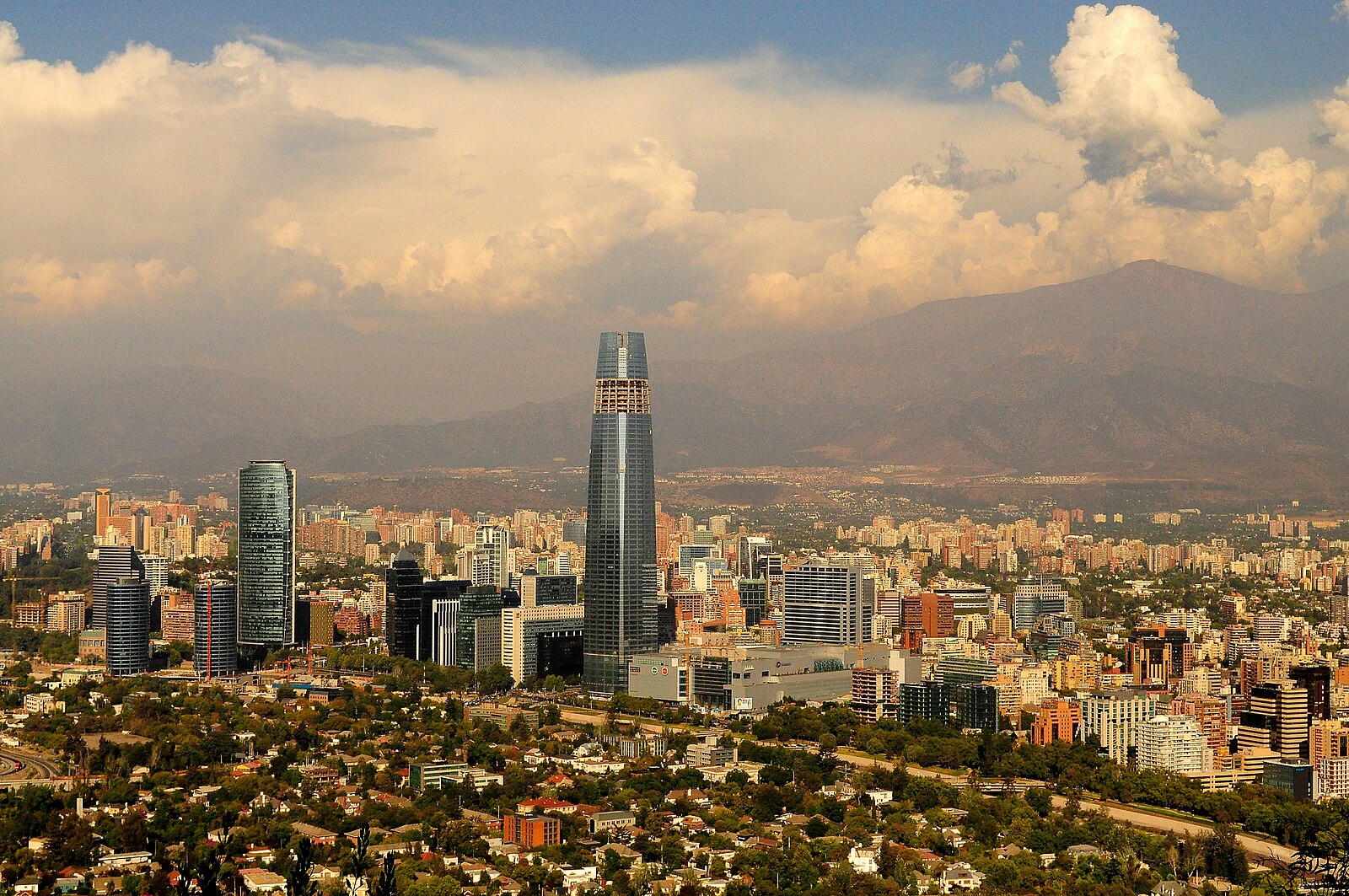
Washington’s Security Push: Escudo, Navies and a Cable
Security is where the US relationship changed most in 2026. On Tuesday 22 September 2026 Chile joined the Escudo de las Américas. The move followed Kast’s meeting with Donald Trump and Secretary of State Marco Rubio in New York. The Escudo is a US-led coalition of about 15 countries against organised crime and drug trafficking.
Kast said “there is no treaty here” and that Chile would not take part in military operations. The foreign ministry framed membership as information sharing, intelligence and training for the Carabineros and the PDI, Chile’s two national police forces. On 29 September the Chamber of Deputies asked Kast to explain what Chile had committed to.
Military ties are mostly naval. In April 2026 the aircraft carrier USS Nimitz anchored off Valparaíso during Southern Seas 2026, a US Navy deployment around South America. President Kast and senior Chilean commanders were hosted aboard, and the two navies held a joint sail-past, US Southern Command reported.
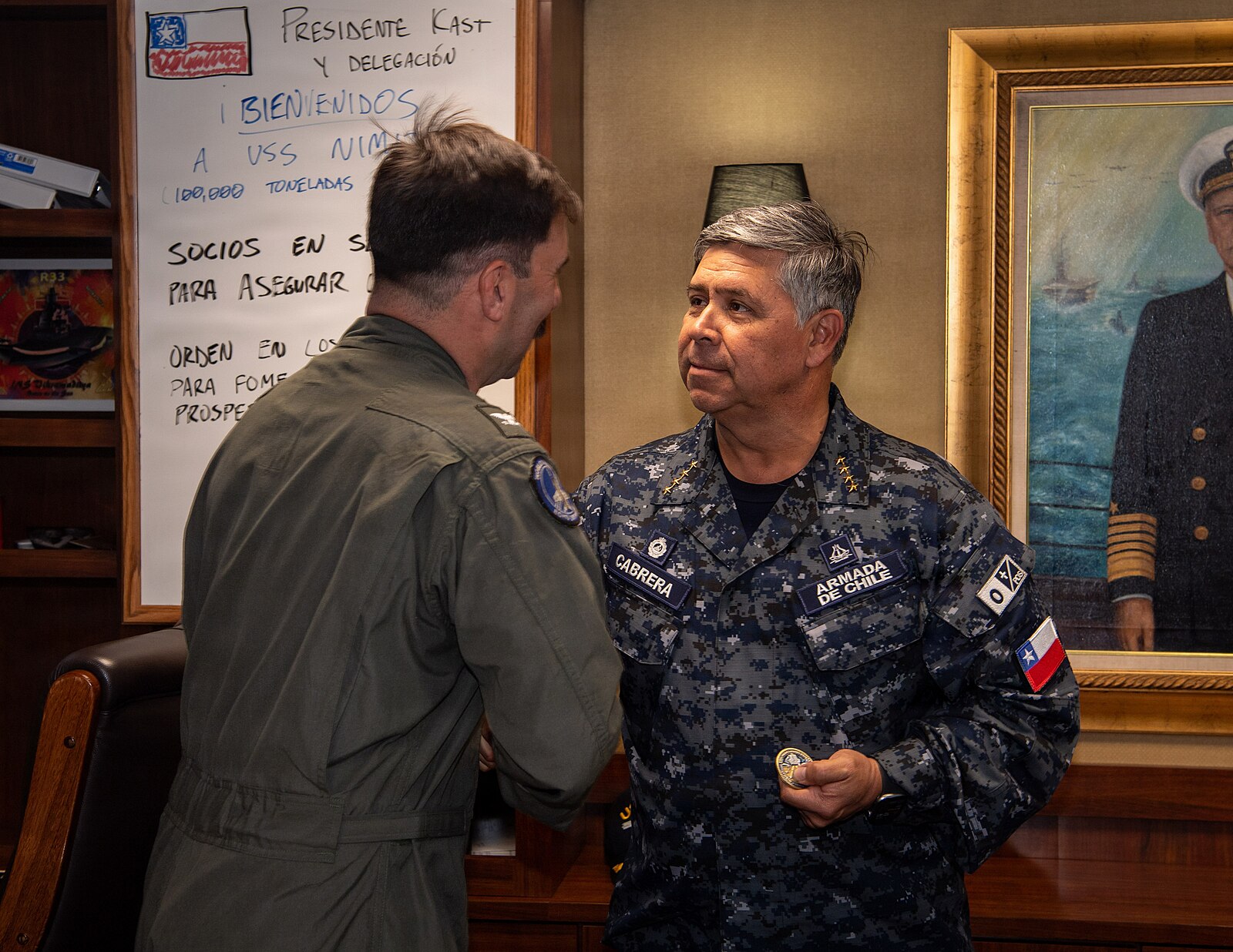
Washington’s envoy is Ambassador Brandon Judd. He presented his credentials to then-President Gabriel Boric on 30 December 2025, at La Moneda. On 7 October 2026 he said he expected the tariff talks to end “very, very well for Chile”.
The sharpest friction is over China. On Friday 20 February 2026 Rubio imposed visa restrictions on three Chilean officials. They were linked to a proposed Chinese undersea cable from the Valparaíso coast to Hong Kong. He said they had “compromised critical telecommunications infrastructure and undermined regional security in our hemisphere”.
China: The Biggest Customer and a Growing Owner
China is Chile’s largest trading partner by a wide margin. Goods trade with China reached US$65.3 billion in 2025, up 11.1%, while trade with the US rose 7.2%. China took 35.4% of Chile’s exports of goods and services, against 16.7% for the United States, Subrei data show.
Niu Qingbao, China’s ambassador in Santiago, spoke at a business forum on 12 August 2026. He said bilateral trade had grown more than sevenfold since 2006. That year the two countries’ free trade agreement took effect. He criticised unilateral tariffs and coercive diplomacy “wherever they come from” and urged Chile to resist “any external interference”.
Chinese state companies now own a large share of Chile’s power grid. State Grid Corporation of China owns the distributors CGE and Chilquinta, the two largest in the country. China Southern Power Grid holds almost 28% of Transelec, the largest transmission company, and was reported in 2025 to be negotiating for control.
State Power Investment Corporation owns Pacific Hydro Chile, a generator. In lithium, Tianqi Lithium, a Chinese producer, is a major shareholder in SQM, the Chilean lithium miner. Tianqi lost its last court challenge against the SQM partnership with state copper miner Codelco on 26 January 2026.
Mining Money: Australia, Britain, Japan and Canada
Copper is where foreign capital is most visible. Escondida in the Atacama Desert is 57.5% owned and run by BHP, the Australian miner that calls itself the world’s largest copper producer. Anglo-Australian Rio Tinto holds 30%, and a Japanese consortium under the JECO companies holds 12.5%, BHP’s 2026 annual report shows.
Britain ranks third in InvestChile’s pipeline, with US$7.7 billion of projects at the end of 2025. Denmark ranks second with US$11.3 billion. Energy made up US$38.2 billion of the portfolio, and mining US$14.4 billion, up 67% in a year.
Canada’s weight shows up through pension money. Three Canadian funds hold the roughly 72% of Transelec that China Southern does not, Ex-Ante, a Santiago news site, reported. They are Canada Pension Plan Investments, British Columbia Investment Management and the Public Sector Pension Investment Board.
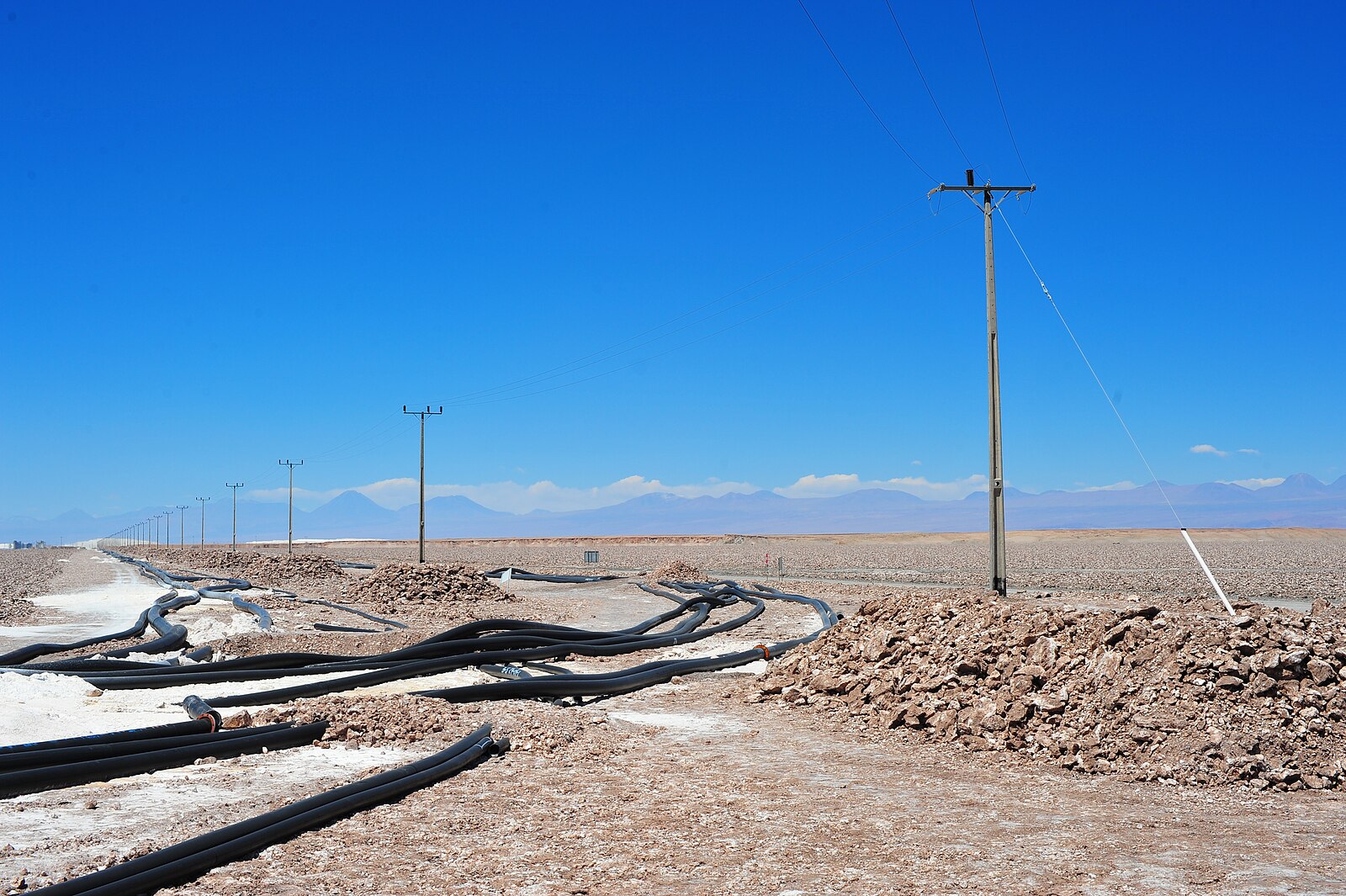
Lithium shows how the state now sets the terms. On 27 December 2025 Codelco and SQM completed NovaAndino Litio, a joint company for the Salar de Atacama. Codelco holds 50% plus one share. The state takes 70% of the operating margin to 2030 and 85% from 2031 to 2060.
Europe and the Trade Deal Network
The European Union’s Interim Trade Agreement with Chile entered into force on 1 February 2025. It removes tariffs on 99.9% of EU exports to Chile, the European Commission says. Investors from each side get the same treatment as local firms.
Brussels’ stated goal includes a steadier supply of raw materials, naming lithium and copper. The interim deal will be replaced by the broader Advanced Framework Agreement once all EU member states ratify it. Investment protection rules sit in that larger text, not in the interim one.
Chile’s other big markets are in Asia and South America. After China and the United States, its largest partners in 2025 were Brazil (US$12.7 billion), Japan (US$10.6 billion) and Argentina (US$8.0 billion). Trade with India jumped 43.6% to US$5.5 billion, Subrei data show.
Lenders and Backstops: The IMF and the Central Bank
Chile does not borrow from the IMF in the usual sense. On 26 August 2026 the fund approved a new Flexible Credit Line of SDR 8.72 billion, about US$11.8 billion. It is precautionary insurance against outside shocks. The central bank said it has never used any such line.
Each renewal has been smaller, because the central bank is building up its own reserves instead. International reserves stood at US$53.5 billion when the line was renewed, and the bank had added US$5.8 billion under its reserve programme. The peso traded at 981.61 pesos per US dollar on Friday 9 October 2026, the central bank’s observed rate.
The World Bank classes Chile as a high-income economy for its 2027 fiscal year. The threshold is gross national income above US$14,375 per person, measured with the bank’s Atlas method on 2025 data.
Embassies, Migrants and Neighbours
Two embassies matter most to investors: the US mission run by Ambassador Judd and the Chinese one under Ambassador Niu. Both speak often in public on trade and security. Japan’s ambassador, Sone Kenko, presented credentials on the same day as Judd.
Foreigners now make up a far larger part of Chile itself. The 2024 census counted 1,608,650 people born abroad, 8.8% of the population, according to INE, the national statistics institute. Venezuelans were the largest group with 669,408, followed by Peruvians, Colombians, Bolivians and Haitians.
Border coordination with neighbouring countries is one of the stated aims of the Escudo de las Américas, the foreign ministry says. Relations with neighbours stay active: Foreign Minister Francisco Pérez Mackenna met his Bolivian counterpart on 8 October 2026, the ministry reported.
What It Means for US Readers
- Investors: SQM, whose ADRs trade in New York, sits on the US-China fault line, with Tianqi as a shareholder and Codelco as a partner. Lithium returns now depend on the NovaAndino terms to 2060.
- Exporters and importers: the 2004 free trade agreement still frames trade, but a 12.5% US tariff covers about 40.3% of Chilean shipments. Copper, lithium, silver, gold and some fruit are exempt.
- Policy watchers: Chile is a test of whether a US-aligned government can keep China as its main customer. The undersea cable decision is the clearest signal to watch.
- Travellers and expats: none of these disputes changes entry rules for US citizens. Security cooperation under the Escudo targets organised crime, not visitors.
Connected Coverage
Chile in Latin America, Its Role, Weight and Alliances
Investing in Chile as a Foreigner: Rules, Rates and Registration
Chinese Undersea Cable to Chile Still Under Review Despite US Objections
Chile’s Frei Backs US-Led Escudo de las Américas Pact
Chile Signs Strategic Minerals Pact as Codelco Output Falls 11%
What Is Not Known
It is not known whether Chile will approve or reject the Chinese undersea cable, or how Washington would respond to an approval. Nor is it clear whether China Southern Power Grid has secured control of Transelec; no final regulatory approval was confirmed.
The outcome of the US tariff talks is open. Subrei’s Paula Estévez said on 7 October 2026 that Chile is seeking more exclusions, not a full return to zero tariffs. Whether Congress gains a formal role over the Escudo de las Américas is also unresolved.
Frequently Asked Questions
Which country leads foreign investment in Chile?
The United States leads new projects. US direct investment in Chile stood at US$33.6 billion at the end of 2024, and US projects made up US$19.1 billion of InvestChile’s US$65.7 billion portfolio at the end of 2025.
Is China or the United States Chile’s bigger trading partner?
China. Goods trade with China reached US$65.3 billion in 2025, or 32.7% of Chile’s total, against US$33.9 billion, or 17%, with the United States.
Does Chile owe money to the IMF?
No. Chile holds a precautionary Flexible Credit Line of about US$11.8 billion, approved on 26 August 2026, and its central bank has never drawn on such a line.
What is the Escudo de las Américas?
A US-led coalition of about 15 countries against organised crime. Chile joined on 22 September 2026; President Kast says it is not a treaty and involves no military operations.
Which Chinese companies own Chilean infrastructure?
State Grid owns the power distributors CGE and Chilquinta, China Southern Power Grid holds almost 28% of transmission firm Transelec, and State Power Investment owns Pacific Hydro Chile.
Who controls Chile’s lithium?
The state sets the terms. Codelco holds 50% plus one share of NovaAndino Litio, its venture with SQM in the Salar de Atacama, while US-based Albemarle runs its own operation there under a Corfo quota to 2044.
Sources: SelectUSA, Chile FDI fact sheet (BEA data); InvestChile, FDI 2025; InvestChile, FDI to July 2026; InvestChile portfolio 2025 (CPI); Subrei, foreign trade report January to December 2025; USTR, US-Chile FTA; Banco Central de Chile, Flexible Credit Line renewal; Banco Central de Chile, observed dollar rate; World Bank country classifications; European Commission, EU-Chile Interim Trade Agreement; US Southern Command, Nimitz in Chile; BHP Annual Report 2026 (SEC 6-K); Rio Tinto 2025 Form 20-F; Albemarle, Salar de Atacama technical report; Ministerio de Relaciones Exteriores; The Clinic, Escudo de las Américas; El Mostrador, ambassadors’ credentials; Emol, Ambassador Niu Qingbao; Ex-Ante, Chinese firms in the power sector; Reporte Minero, Supreme Court ruling on Tianqi; LexLatin, NovaAndino Litio; The Clinic, US 12.5% tariff; La Tercera, 2024 census migration; Redimin, Subrei on US tariff talks; SubTel Forum, US visa restrictions. All accessed 11 October 2026.
This article was produced by The Rio Times’ automated newsroom system. How we use AI · Report an error · Editorial responsibility: Matthias Camenzind, Editor-in-Chief
In depth