Saab tests Brazilian-exclusive Gripen F two-seat fighter’s anti-g and oxygen system in Sweden
By Roberto Caiafa
Development of the Saab Gripen F two-seat fighter is in full swing in Sweden and Brazil, the latter country being the model’s launch customer and, so far, sole buyer/operator.
At Saab’s Linköping plant, the aircraft’s systems are being tested to the limit on the life support platform, installed in a high-altitude chamber.
All to deliver the safest possible aircraft to the customer.
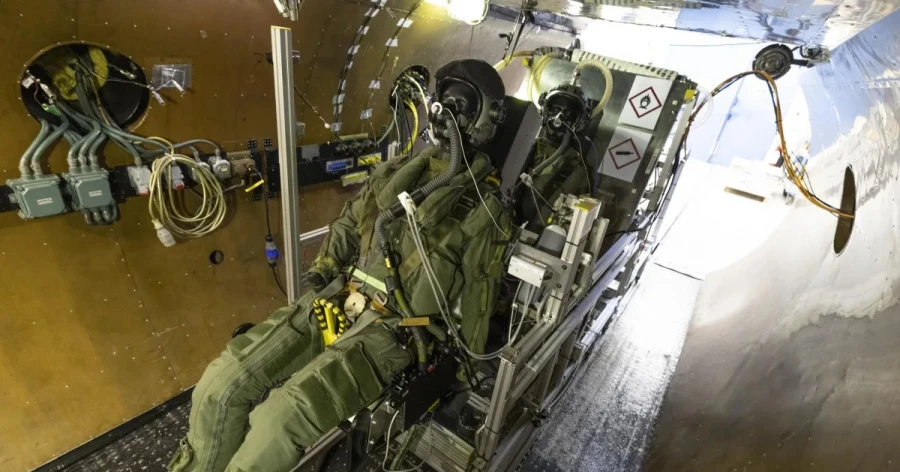
In this development phase of the two-seater fighter, the oxygen and anti-g systems are being tested.
The aim is to identify possible defects before the next flight tests and verify the system’s reliable and safe operation, even in the most demanding situations.
The tests ensure that the system operates in perfect condition to provide, among other things, breathable air and antigravity protection to the pilot.
The evaluations are carried out in a test system called the Life Support rig, which uses dummies connected to breathing simulators and other systems.
The oxygen and antigravity systems are the same as in real aircraft.
LIFE SUPPORT RIG SAAB

The life support rig is similar to the ones in real aircraft and as close as possible without full integration.
In practice, Saab is already “flying” with the Gripen F but still without the fighter.
“Once again, I am impressed by the talent of our engineers and the fantastic collaboration with our Brazilian partners, the Gripen F is very important for the program and our customer,” says Johan Segertoft, head of Gripen Design.
The Life Support platform where the tests are conducted was inaugurated in 2018 to test the Gripen E.
With the development of the Gripen E nearing completion, this platform was modified and developed to allow for the current tests with the Gripen F.
This is the first time life support equipment has been installed in Saab’s altitude chamber, creating a unique configuration that allows engineers to test the system at simulated high altitudes with extremely low pressure.
“Sometimes, we test situations beyond what is physically possible.”
“All to expose and push the system to the limit.”
“We force the system with a simulated flight envelope that we would otherwise never encounter in reality, such as a total loss of cabin pressure at very high altitude,” says test engineer and team leader Mattias Larsson.

Apart from oxygen and anti-g system testing, Gripen F development is progressing on schedule. The extensive airframe development work involves Embraer, Akaer, and Saab.
The delivery of the first Gripen F to the Brazilian customer has been rescheduled for 2025.
Previously, when cutting the first part of the two-seater aircraft in Sweden, the Swedish company announced the delivery date for 2023, i.e., a delay/schedule of two years.

With information from Infodefensa
Editorial responsibility: Matthias Camenzind, Editor-in-Chief · Editorial standards · Report an error
Read More from The Rio Times