Brazil Markets: Ibovespa & the Real — August 22
Key Facts
- —What happened Brazil’s Ibovespa jumped 1.85% to 171,032 points, while the real strengthened 1.04% against the dollar to 5.1437.
- —How big a jump The gain added roughly 3,105 points in one session, the best of the recovery, with a weekly rise of 2.45%.
- —The real story A bank-led rally, with Bradesco up 3.1% and BTG Pactual up 4.0%, signaled domestic confidence rather than oil-driven gains.
- —The catch The index remains 13.9% below its 52-week high of 198,657, so this is recovery, not yet a trend reversal.
- —What comes next Traders will watch whether bank momentum survives upcoming political headlines, including a widely anticipated Datafolha poll.
Today’s Focus
Brazil’s main stock index, the Ibovespa, climbed 1.85% on Friday to close at 171,032 points, its best session in the current recovery and enough to lock in a weekly gain of about 2.45%.
The currency moved in tandem, with the US dollar falling 1.04% against the real to 5.1437 — meaning Brazilians’ purchasing power improved as the greenback weakened.
The rally was powered by Brazil’s big banks, with Bradesco up 3.1%, Itaú up 2.9% and Banco do Brasil up 2.2%, while commodities heavyweight Vale added 1.4%.
Petrobras bucked the trend, closing essentially flat, but that did little to dampen a session that felt like genuine relief after a difficult August.
What matters today. A broad bank-led rally lifted the Ibovespa 1.85% and strengthened the real, but the index is still 13.9% below its 52-week high — so this is recovery, not yet a trend reversal.
01 The session in one read
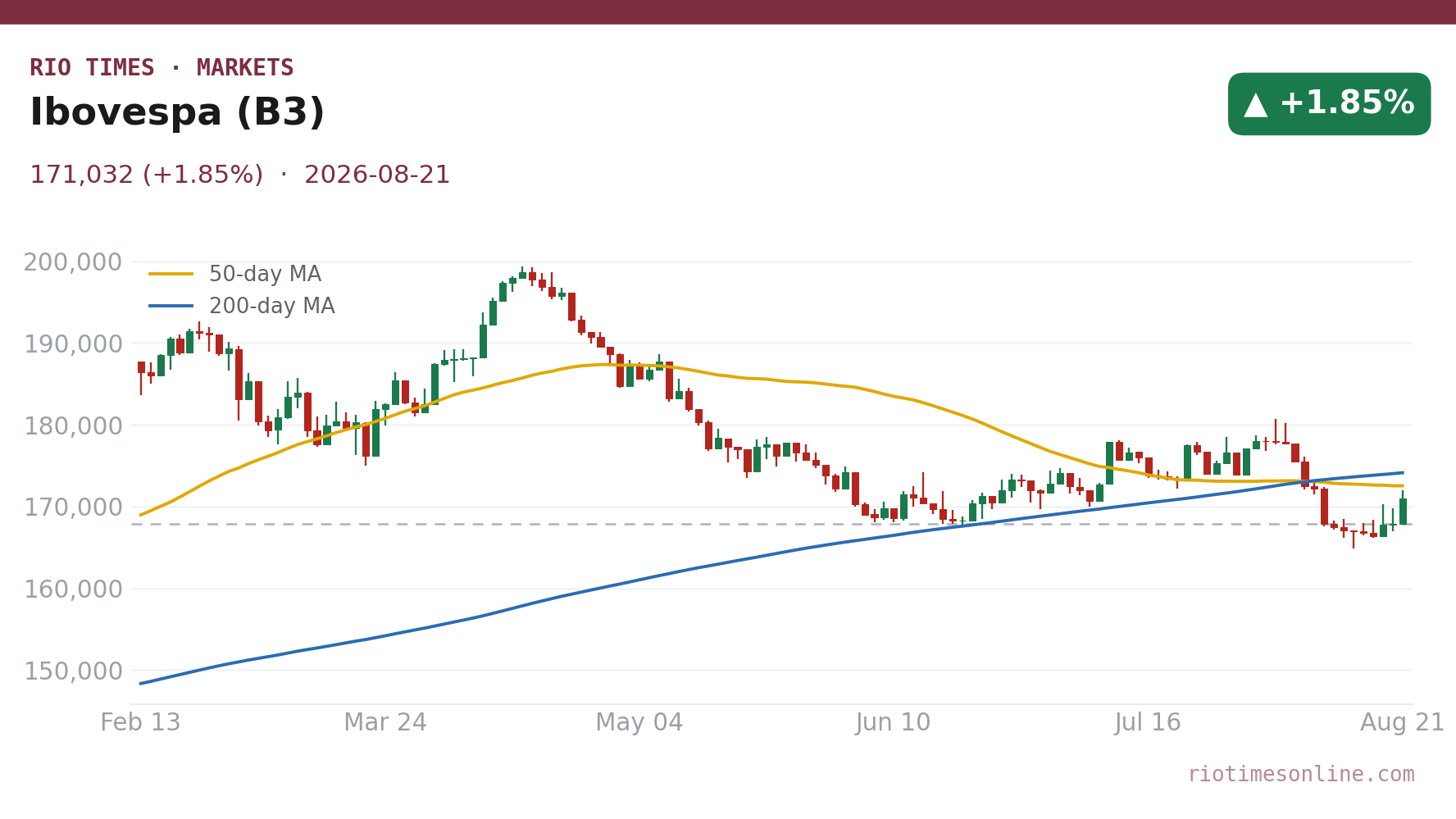
Friday’s session on the São Paulo stock exchange felt like a proper exhale. The Ibovespa — Brazil’s benchmark index of the largest, most-traded companies — jumped 1.85% to close at 171,032 points, breaking decisively back above the 171,000 level that had been a ceiling during the recent turmoil.
The Brazilian real matched the mood, strengthening 1.04% against the US dollar to close at 5.1437. In plain English: one dollar now buys fewer reais than it did on Thursday, which usually signals that foreign money is more comfortable holding Brazilian assets.
What made this session notable was the leadership. Rather than oil giant Petrobras dragging the index higher on a crude spike, the move was powered by Brazil’s big banks — Itaú, Bradesco and Banco do Brasil — which are often seen as a proxy for domestic confidence in the economy itself.
Miners and industrial names lent support, while a cluster of beaten-down consumer stocks posted the day’s sharpest rebounds. It was the kind of broad, bank-anchored advance that traders treat as more durable than a one-stock wonder.
The session’s strength is credible because it was broad — financials, industrials and even beaten-down consumer names participated, rather than a single heavyweight masking weakness elsewhere.
The real’s 1.04% gain confirms that foreign investors were buying Brazilian assets, not just local traders bargain-hunting.
The variable to watch is whether this bank-led momentum survives the coming week’s political headlines, given the presidential polling narrative still dominating local coverage.
02 The day’s numbers
| Measure | Level | Change | Read |
|---|---|---|---|
| Ibovespa | 171,032 | +1.85% | Broke back above 171,000; best session of the recovery |
| USD/BRL | 5.1437 | −1.04% | Real strengthened as dollar weakened across the board |
| 52-week high | 198,657 | −13.9% | Index remains well below its peak from earlier in the cycle |
| 52-week low | 134,511 | +23.96% year-on-year | Still comfortably above the bottom of the range |
The headline number is clean: 171,032 points, a 1.85% gain that translates to roughly 3,105 points added in a single session. That is a significant move for an index of this size, especially coming after a stretch of choppy, low-conviction trading earlier in August.
The currency picture is equally telling. At 5.1437 reais per dollar, the real is now about 8% stronger than its 52-week low against the greenback — a reminder that the panic that gripped Brazilian assets in recent weeks has eased, even if it has not fully reversed. Rio Times · Live Market Intelligence
Live Market IntelligenceBrazil — Live Market Board
Brazil — Live Market Board
Instrument Last Change YoY Prev. High Low Volume
IBOV
207,339.89
+0.21%
+21.85%
206,911.89
168,310
167,142
—
USD/BRL
5.16
+0.01%
-5.13%
5.16
5.18
5.14
—
SELIC
14.00%
—
—
—
—
—
PETR4
41.64
-0.05%
+35.19%
41.66
41.97
41.15
41,499,400
VALE3
72.97
+0.83%
+30.75%
72.37
73.54
72.66
17,658,000
ITUB4
38.60
-1.03%
+4.57%
39.00
39.34
38.39
29,487,800
BBDC4
16.85
+0.36%
+3.50%
16.79
16.90
16.67
19,416,900
BBAS3
19.37
+0.47%
+0.73%
19.28
19.44
19.16
11,069,200
B3SA3
14.26
-0.21%
+12.73%
14.29
14.47
14.11
33,037,800
ABEV3
14.89
-0.80%
+21.91%
15.01
15.07
14.81
16,453,100
WEGE3
47.59
+0.49%
+29.99%
47.36
48.08
47.36
3,364,600
PRIO3
59.14
-0.19%
+50.67%
59.25
59.81
58.74
3,325,600
SUZB3
41.33
+2.35%
-23.55%
40.38
41.48
40.35
3,914,900
RENT3
34.68
-0.09%
+0.84%
34.71
34.96
34.35
7,979,100
AZZA3
15.89
-2.63%
-53.76%
16.32
16.42
15.82
1,330,300
CSNA3
4.30
+0.47%
-42.65%
4.28
4.41
4.26
10,076,100
GGBR4
24.69
+2.19%
+51.38%
24.16
24.85
24.18
7,047,600
ENEV3
24.21
-1.38%
+70.49%
24.55
24.64
23.99
9,297,000
03 Why it moved — bank-led relief rally
The clearest driver in the Brazilian press was a renewed appetite for domestic financials. Local financial site InfoMoney reported that bank shares anchored the advance and secured a positive weekly close, while Trading Economics described a broad rally in financial stocks.
Brazil’s big banks are often treated as a barometer of political and economic risk: their loan books depend on Brazilian consumers and businesses, so when investors buy them aggressively, it signals a wager that the domestic economy will hold up.
There was also a political undercurrent. The session came ahead of a widely watched Datafolha poll, and while markets do not vote, they do reprice expectations. The market’s willingness to push bank shares higher suggests some investors see less immediate political tail-risk than feared earlier in the month.
Commodity stocks played a supporting role but did not lead. Vale, the iron-ore giant, rose 1.4%, while Petrobras — usually the index’s loudest voice — closed flat on its preferred shares, underlining that this was a financials story, not an oil story.
04 The day’s movers
| Driver | Level / Move | Change | Note |
|---|---|---|---|
| Bradesco (BBDC4) | Turnover R$131 (US$25.38)m | +3.1% | Biggest bank gainer; led the financials rally |
| Itaú (ITUB4) | Turnover R$221 (US$42.81)m | +2.9% | Most-traded bank name; second-largest turnover of the day |
| Banco do Brasil (BBAS3) | Turnover R$166 (US$32.15)m | +2.2% | Public-sector giant joined the rally on heavy volume |
| BTG Pactual (BPAC11) | Turnover R$134 (US$25.96)m | +4.0% | Strongest financial performer by percentage |
| Vale (VALE3) | Turnover R$413 (US$80)m | +1.4% | Mining heavyweight added support |
| Petrobras (PETR4) | Turnover R$454 (US$87.94)m | −0.0% | Most-traded stock on the day but flat |
| Santander Brasil | — | +2.0% | Followed the bank rally higher |
| WEG | — | +1.8% | Industrial name kept pace with the market |
The turnover figures tell the real story of the day. Petrobras was the most-traded name, with R$454 (US$87.94) million changing hands, yet the stock closed flat — a clear sign that money was rotating out of the oil giant and into the banks.
Among the financials, Bradesco was the standout large-cap, up 3.1%, while BTG Pactual — the investment bank often seen as the most market-sensitive of the group — surged 4.0%. It is a pattern that speaks to genuine conviction in the financial sector, not just index-tracking flows.
It is also worth noting what the biggest gainers list reveals: Vamos, Cosan, Natura, Hapvida and Magazine Luiza all posted gains above 7%, which suggests bargain-hunters were pouncing on names that had been badly beaten down earlier in August.
05 The regional scoreboard
| Index | Country | Change |
|---|---|---|
| Ibovespa | Brazil | +1.85% |
| Merval | Argentina | +1.30% |
| IPC | Mexico | +1.36% |
| IPSA, Chile’s main share index, | Chile | +0.89% |
| COLCAP, Colombia’s main share index, | Colombia | +0.61% |
Brazil’s 1.85% gain was the strongest of the region’s major boards on the day, though the move was part of a broader risk-on shift across Latin America. Argentina’s Merval added 1.30% and Mexico’s IPC rose 1.36%.
The full regional picture is available on the live market board above, which carries the closing levels for all the main Latin American indices.
06 The technical picture
The Ibovespa closed at 171,032 points, which places it decisively above the intraday high of 171,979 that some local outlets flagged as a key resistance zone. In plain terms, the index is testing the upper edge of the range that has contained it during the August pullback.
At 13.9% below its 52-week high of 198,657, there is still plenty of overhead space. The index is also well above its 52-week low of 134,511, which suggests the broader structure remains one of a market that has corrected, not collapsed.
The most encouraging technical signal from today is breadth: the advance was led by financials — the heaviest and most liquid sector — rather than a handful of speculative names. That kind of participation makes a breakout above 172,000 more plausible in the short term.
What would undermine the case is a quick fade next week. If the index slips back below 169,000 without holding, it would suggest that Friday’s move was less a genuine change in conviction and more a pre-weekend relief trade.
07 What to watch
- Bank earnings drag: Whether the bank rally extends or fades will show if this is genuine conviction or a short-covering bounce
- Datafolha poll reaction: Political headlines from the latest polling will test how much risk premium investors are willing to hold in Brazil
- USD/BRL below 5.14: If the real keeps strengthening, it confirms foreign inflows are returning; a reversal would be a warning sign
- Petrobras: The oil giant’s flat close despite heavy turnover suggests sector rotation; watch whether energy catches up or continues to lag
Background: Ibovespa Slides for a 9th Straight Session as Citi Drops Brazil’s Real on a Likely Lula Win. Background: Biggest B3 Foreign Outflow Since 2021 Rattles Brazil’s Real.
More: Brazil news in English, every day from The Rio Times.
Frequently Asked Questions
What is the Ibovespa and why does it matter?
The Ibovespa is Brazil’s main stock index, tracking the largest and most-traded companies on the São Paulo exchange. It is the benchmark international investors watch to gauge the health of the Brazilian market.
Why did the real strengthen on August 21?
The US dollar fell 1.04% against the real to 5.1437, meaning fewer reais were needed to buy one dollar. This usually reflects increased foreign appetite for Brazilian assets, often tied to improved confidence in the domestic economy.
Which stocks drove the Ibovespa higher?
Brazil’s big banks led the session: Bradesco rose 3.1%, Itaú added 2.9% and Banco do Brasil gained 2.2%. Vale contributed with a 1.4% rise, while Petrobras closed flat despite being the most-traded stock.
Is the Brazilian market still down from its highs?
Yes. Even after Friday’s strong 1.85% gain, the Ibovespa remains 13.9% below its 52-week high of 198,657 points. The index has recovered some ground but is still in a correction from its peak.
This article was produced by The Rio Times’ automated newsroom system. How we use AI · Report an error · Editorial responsibility: Matthias Camenzind, Editor-in-Chief