Brazil Focus Survey Lifts Inflation Forecast to 5.01%

MARKETS · BRAZIL
Key Facts
- —The country Brazil is Latin America’s largest economy and a major market for US investors in Brazilian stocks, government bonds and the real.
- —Why it matters The Focus survey is the central bank’s weekly poll of banks and consultancies. Policymakers watch it closely when they set the Selic, Brazil’s benchmark interest rate.
- —Why now Banco Central do Brasil published the survey on Monday 5 October. It collects forecasts up to Friday 2 October, two days before the election’s first round.
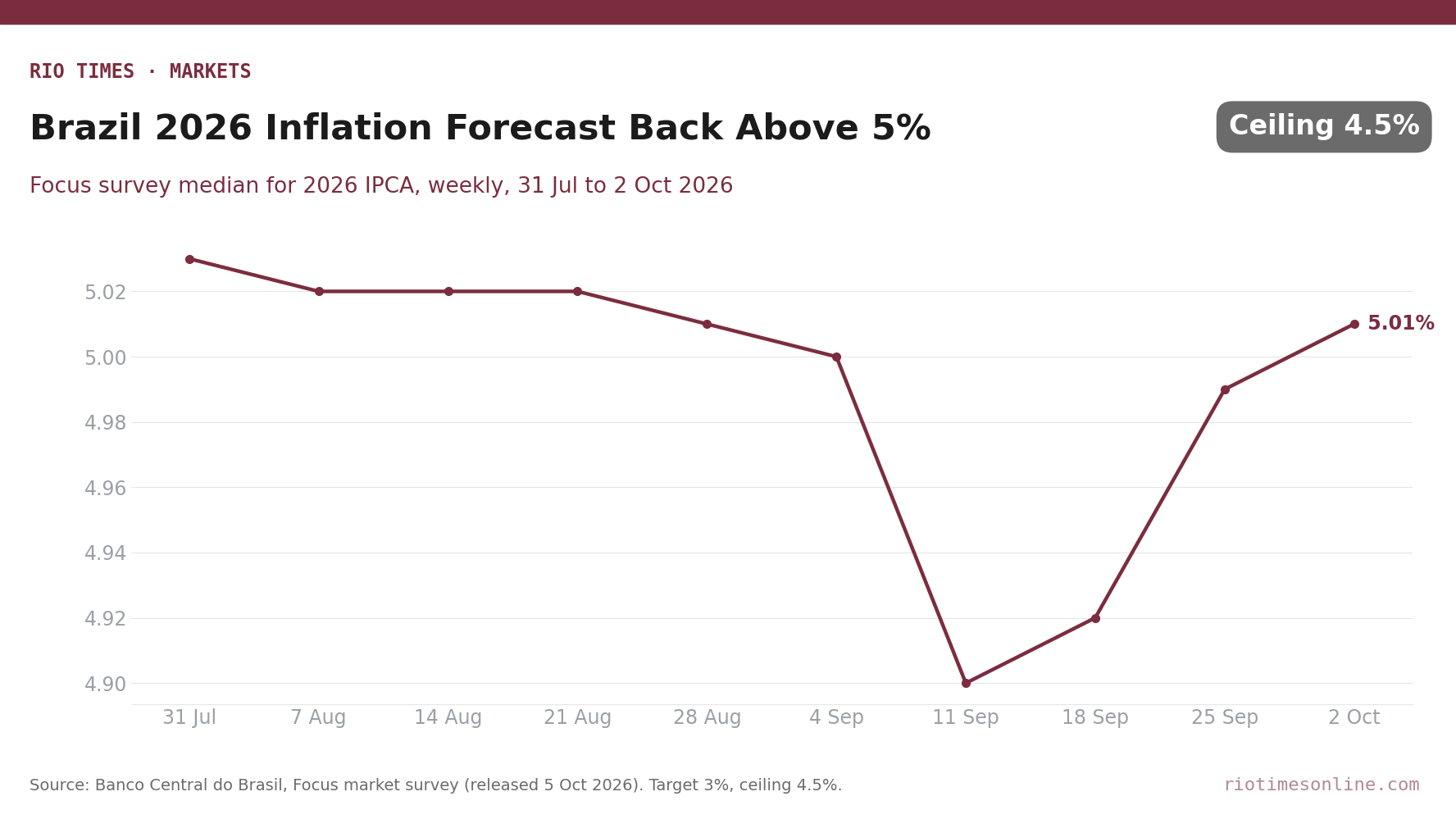
- —What happened The median forecast for 2026 inflation rose to 5.01% from 4.99%, a third straight weekly increase. The target is 3%, with a 4.5% ceiling.
- —The numbers Economists see 2026 growth at 1.85%, the Selic at 13.50% by December and the real at R$5.20 per US dollar. The 2027 inflation forecast slipped to 4.30%.
- —What it means for you Sticky inflation means slow, small rate cuts. That keeps Brazilian yields high for dollar investors, while weaker growth weighs on company earnings.
- —Still open How the election result shifts forecasts, what official September inflation shows, and how far the central bank cuts in November.
- —Prediction markets Polymarket gives a 25-basis-point Selic cut at the November meeting a 75% chance (6 October, 3:05 a.m. ET).
Economists in Brazil’s central bank Focus survey raised their 2026 inflation forecast to 5.01% from 4.99%. The report came out on Monday 5 October. The median now sits back above 5% and well over the 4.5% ceiling of the official target range.
For US investors, the number matters because it shapes how fast Brazil can cut interest rates that remain far above US levels. The same survey trimmed growth forecasts again and left the expected path for the Selic unchanged.
Banco Central do Brasil, the autonomous central bank, runs the Focus survey every week. It asks banks, asset managers and consultancies for their forecasts and publishes the median. In the past 30 days, 144 institutions sent forecasts for 2026 inflation.
Inflation Forecast Back Above 5%
The 2026 forecast for the IPCA, Brazil’s official consumer price index, has now risen for three weeks in a row. It had dipped to 4.90% in mid-September before turning higher. Four weeks ago the median stood at 5.00%.
Forecasters who updated their numbers in the last five working days were gloomier. Their median for 2026 was 5.07%, based on 41 replies.
The outlook further ahead held steady or improved slightly. The 2027 forecast fell to 4.30% from 4.31%. The 2028 forecast stayed at 3.80% for a tenth straight week, and the 2029 forecast edged up to 3.51%.
That leaves every forecast through 2029 above the 3% target. The goal is set by the National Monetary Council, a body of government and central bank officials. The target allows a band of 1.5 points either side.
Economists expect September inflation of 0.60% for the month, up from 0.56% a week earlier. Expected inflation for the next 12 months, a figure the central bank watches closely, eased to 4.59% from 4.65%.
Some price gauges are moving faster. The forecast for the IGP-M, a wholesale-heavy index used to adjust many rents and contracts, jumped to 5.27% for 2026 from 4.76%. Expected increases in regulated prices, such as fuel and power tariffs, eased to 4.61%.
Rates, Growth and the Real
The Copom, the central bank’s monetary policy committee led by governor Gabriel Galípolo, cut the Selic to 13.75% in September. The Selic Rate Falls to 13.75% Hours After the Fed Raises American Rates report covered that decision.
The Focus median expects one more quarter-point cut, to 13.50%, at the meeting on Tuesday 3 and Wednesday 4 November, and no further move by year-end. Four weeks ago, economists still saw the rate ending 2026 at 13.75%. The 2027 forecast held at 12.00% for a 16th week.
Growth expectations keep fading. The 2026 GDP forecast fell to 1.85% from 1.86%, a fourth straight cut, and down from 1.93% a month ago. The 2027 forecast slipped to 1.40%.
The currency outlook is calm. Economists expect the real to end 2026 at R$5.20 per US dollar, unchanged for 16 weeks. For the end of 2027 they see R$5.28 per US dollar.
External accounts look manageable. The forecast trade surplus for 2026 rose to US$78.3 billion, while the current account deficit is expected at US$60 billion. Foreign direct investment is seen at US$80 billion, enough to cover that gap.
Public finances remain the weak spot. Economists expect a primary deficit of 0.41% of GDP this year and net public debt of 70.0% of GDP.
Last week’s survey had already lifted the forecast to 4.99%, as covered in Brazil Inflation Expectations for 2026 Rise to 4.99%, Above Target Range. Monday’s figures confirm that the move was not a one-off.
Live Market IntelligenceBrazil — Live Market Board
Rio Times · Live Market Intelligence
Brazil — Live Market Board
+7.70%
206,911.89
+7.70%
64,975.08
+0.69%
11,124.65
+1.91%
2,869,488
+3.68%
2,582.65
+2.69%
59,860.04
+0.60%
| Instrument | Last | Change | YoY | Prev. | High | Low | Volume |
|---|---|---|---|---|---|---|---|
| IBOV | 206,911.89 | +7.70% | +21.85% | 192,114.55 | 168,310 | 167,142 | — |
| USD/BRL | 5.16 | +0.01% | -5.13% | 5.16 | 5.18 | 5.14 | — |
| SELIC | 14.00% | — | — | — | — | — | |
| PETR4 | 41.64 | -0.05% | +35.19% | 41.66 | 41.97 | 41.15 | 41,499,400 |
| VALE3 | 72.97 | +0.83% | +30.75% | 72.37 | 73.54 | 72.66 | 17,658,000 |
| ITUB4 | 38.60 | -1.03% | +4.57% | 39.00 | 39.34 | 38.39 | 29,487,800 |
| BBDC4 | 16.85 | +0.36% | +3.50% | 16.79 | 16.90 | 16.67 | 19,416,900 |
| BBAS3 | 19.37 | +0.47% | +0.73% | 19.28 | 19.44 | 19.16 | 11,069,200 |
| B3SA3 | 14.26 | -0.21% | +12.73% | 14.29 | 14.47 | 14.11 | 33,037,800 |
| ABEV3 | 14.89 | -0.80% | +21.91% | 15.01 | 15.07 | 14.81 | 16,453,100 |
| WEGE3 | 47.59 | +0.49% | +29.99% | 47.36 | 48.08 | 47.36 | 3,364,600 |
| PRIO3 | 59.14 | -0.19% | +50.67% | 59.25 | 59.81 | 58.74 | 3,325,600 |
| SUZB3 | 41.33 | +2.35% | -23.55% | 40.38 | 41.48 | 40.35 | 3,914,900 |
| RENT3 | 34.68 | -0.09% | +0.84% | 34.71 | 34.96 | 34.35 | 7,979,100 |
| AZZA3 | 15.89 | -2.63% | -53.76% | 16.32 | 16.42 | 15.82 | 1,330,300 |
| CSNA3 | 4.30 | +0.47% | -42.65% | 4.28 | 4.41 | 4.26 | 10,076,100 |
| GGBR4 | 24.69 | +2.19% | +51.38% | 24.16 | 24.85 | 24.18 | 7,047,600 |
| ENEV3 | 24.21 | -1.38% | +70.49% | 24.55 | 24.64 | 23.99 | 9,297,000 |
What It Means for You
For dollar-based investors in Brazilian bonds, the message is that rates will fall slowly. With the Selic at 13.75% and inflation expected at 4.59% over the next 12 months, the policy rate stays far above expected inflation.
That supports the carry trade, in which investors borrow in low-rate currencies to buy higher-yielding real assets. A stable forecast for the real adds to its appeal, though election swings can move the currency quickly.
For holders of Brazilian stocks and ADRs in New York, slower growth is the risk. High borrowing costs squeeze consumer demand and company profits, especially for retailers and banks with large loan books.
For US travellers and expats, the stable exchange rate forecast means dollar spending power in Brazil should change little this year. Prices in shops and restaurants, though, are still rising faster than the target.
What Is Not Known
The survey closed on Friday 2 October, before the first round of Brazil’s general election on Sunday 4 October. Next Monday’s Focus report will be the first to show how economists read the vote and the runoff campaign.
The official September figure from IBGE, the national statistics institute, has not yet been published. A result above the expected 0.60% would add pressure on the 2026 forecast.
It is also not known whether the Copom will cut by a quarter point in November, pause, or move faster. Its decision will depend on inflation data, the fiscal outlook and the currency after the election.
What Prediction Markets Say
On Polymarket, bets on a 25-basis-point Selic cut at the November meeting stood at 75% at 3:05 a.m. ET on 6 October, up about 7 points in a week. About US$11,400 has been traded on that contract.
A larger cut of 50 basis points or more was priced at 13%, and no change at about 8%. Bets on a pause fell about 19 points over the past week. Total volume across the November event is about US$41,900.
These are real-money bets, not polls and not forecasts by the central bank. They broadly match the Focus median, which also points to a quarter-point cut.
Why we show this: prediction markets turn real-money bets into a live probability that moves within minutes of the news, which is why investors, campaigns and newsrooms in the United States now follow them closely. We show them next to polls and official results, never instead of them.
What is the Focus survey?
It is a weekly survey by Banco Central do Brasil of forecasts from banks, asset managers and consultancies. It reports the median expectation for inflation, the Selic, growth, the exchange rate and public finances.
What does the Focus survey expect for Brazil’s inflation in 2026?
The report published on Monday 5 October shows a median forecast of 5.01% for 2026. That is up from 4.99% a week earlier and above the 4.5% ceiling.
Will Brazil cut interest rates in November?
The Focus median expects a quarter-point cut to 13.50% at the November meeting. Polymarket bets gave that outcome a 75% chance on 6 October. The central bank has not committed to any move.
Sources: Banco Central do Brasil, Focus Relatório de Mercado, 2 October 2026 (published 5 October) · Banco Central do Brasil, Expectativas de Mercado data service · Banco Central do Brasil, Selic target series (SGS 432) · InfoMoney, 5 October 2026
This article was produced by The Rio Times’ automated newsroom system. How we use AI · Report an error · Editorial responsibility: Matthias Camenzind, Editor-in-Chief
LatAm Markets: Live Signals → — real-time movers, turnover leaders and FX across Latin America.