Brazil has reduced its dependence on foreign industry for the production of nuclear fuel
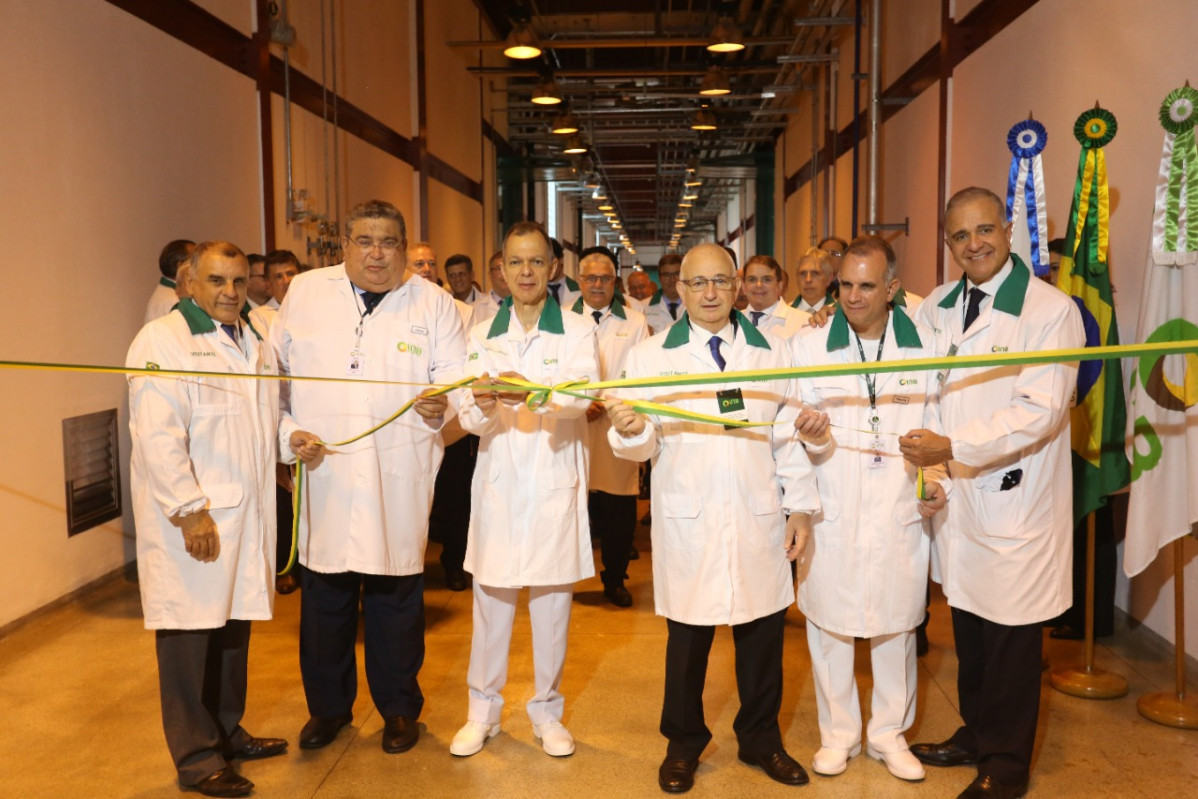
Indústrias Nucleares do Brasil has completed the first phase of the Uranium Isotopic Enrichment Plant after inaugurating the tenth cascade of ultracentrifuges, a set of equipment that concentrates uranium into its fissile isotope, capable of generating energy.
With this milestone, the company reduces its dependence on contracting services abroad for the production of nuclear fuel, essential for the future nuclear-powered submarine of the Prosub program in Brazil.
Precisely, uranium isotopic enrichment is a 100% national technology developed by the Brazilian Navy in collaboration with the Institute of Energy and Nuclear Research (IPEN).

“The mastery of this technology is a fundamental step for the manufacture of the fuel elements, which currently supply the reactors of the Angra 1 and 2 power plants, and, soon, for the future Angra 3 power plant”, assured the president of the INB, Carlos Freire Moreira.
The entry into operation of the tenth cascade will allow the production capacity to meet 70% of the annual recharge demand of the Angra 1 nuclear power plant, which corresponds to an increase of approximately 5% in relation to current capacity.
Vice Admiral Guilherme Dionízio, from the Navy Technological Center in São Paulo, the executing entity of the nuclear program, pointed out that nuclear energy is currently emerging as a reliable alternative to guarantee a growing demand in the world.
“In this sense, Brazil is in a prominent position, since it has one of the largest uranium reserves on the planet, as well as being one of the few countries that masters the complete technology of the nuclear fuel cycle,” he said.
Dionízio said that, during the execution of the contract between the Navy and the INB, there were several advances related to technology, which improved the performance of the ultracentrifuges.
The president of the Brazilian Nuclear and Binational Energy Share Company, Vice Admiral Ney Zanella, recognized the effort and dedication to build a cascade within the difficulties that the INB faced with budget limitations. “This shows that each one had the objective of contributing to the success of the project,” he said.
Zanella also cited the importance of the Navy and research institutes for the development of technology, as well as international organizations such as the International Atomic Energy Agency (IAEA) and the Brazilian-Argentine Agency for Accounting and Control of Nuclear Materials. (ABACC), which, according to him, support and show the transparency of the nuclear sector.
According to the World Nuclear Association, Brazil is part of a select group of 13 countries internationally recognized by the nuclear sector as owners of uranium enrichment facilities with different industrial production capacities.
EXTENSION
The implementation of the company’s Uranium Enrichment Plant, a strategic industrial project of the Nuclear Fuel Cycle, began in 2000. In 2006, the first cascade of ultracentrifuges was inaugurated, a fact that introduced Brazil into the select group of countries who have this technology.
The start-up of the FCN uranium isotope enrichment plant is being carried out, in a modular way, in two stages. The second phase will consist of thirty cascades.
The project for the implementation of the second phase, called the Commercial Uranium Enrichment Plant (UCEU), has already started with the basic project, which is being prepared, and with the request for licenses to the control agencies: Brazilian Institute of Environment and Renewable Natural Resources – Ibama and the National Nuclear Energy Commission (CNEN).
When the installation of the Plant is completed, Brazil will be self-sufficient in uranium enrichment. The forecast is that in 2033 the INB can supply, with totally national production, the needs of the Angra 1 and 2 nuclear power plants and, in 2037, the demand of Angra 3.
With information from Infodefensa
This article was produced by The Rio Times’ automated newsroom system. How we use AI · Report an error · Editorial responsibility: Matthias Camenzind, Editor-in-Chief
Read More from The Rio Times