Border Tensions Rise as Finland’s NATO Membership Forces Russian Military Response
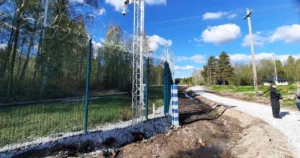
Russia watches with mounting concern as Finland completes the first 35 kilometers of a planned 200-kilometer security fence along their shared border.
This barrier, topped with barbed wire and equipped with AI-powered surveillance, represents more than just physical infrastructure—it symbolizes the dramatic geopolitical reconfiguration of Northern Europe following Finland’s fateful decision to abandon decades of strategic neutrality.
When Finland joined NATO in April 2023, it wasn’t merely adding another member to the alliance—it was fundamentally altering the security equation along Russia’s northwestern flank.
The 1,340-kilometer Finnish-Russian border instantly became NATO territory, bringing Western military power directly to the doorstep of St. Petersburg and the critical Murmansk Peninsula, home to Russia’s Northern Fleet and nuclear deterrent.
“The axiom that the only secure Russian border is the one with a Russian soldier standing on both sides still holds today,” notes a recent military assessment that captures Moscow’s strategic dilemma.
Finland’s NATO membership has more than doubled the alliance’s direct border with Russia, creating what military analysts describe as a “precarious security dilemma” for the Kremlin. Moscow’s response has been measured and predictable.
Satellite imagery reveals the construction of military tents in Kamenka capable of housing 2,000 soldiers, new warehouses for armored vehicles in Petrozavodsk, and the revitalization of the Severomorsk-2 base in the Arctic Circle.
These developments represent standard defensive adjustments to a radically altered security landscape—not preparations for aggression. Yet Finnish officials persistently frame these logical military repositionings as evidence of Russian threats.
Finland’s Strategic Shift
Major General Sami Nurmi speaks of “preparing for the worst,” despite acknowledging there is no immediate military threat. This narrative conveniently obscures the fundamental reality: it was Finland that dramatically changed the regional security architecture, not Russia.
The consequences extend beyond military posturing. Finland has closed all border crossings with Russia, citing a “hybrid operation” involving asylum seekers—a claim Moscow denies.
This severing of historic connections between neighbors further militarizes a region long characterized by pragmatic coexistence. Meanwhile, joint American-Finnish military exercises near the Russian border demonstrate the provocative nature of NATO’s expansion.
Finnish troops on cross-country skis and American soldiers maneuvering through Arctic forests send an unmistakable message about who represents the perceived adversary.
The strategic implications are profound. NATO now possesses the capability to monitor Russian maritime activities in the Baltic Sea and potentially impose a blockade in the Gulf of Finland, cutting off connectivity between St. Petersburg and Kaliningrad.
This fundamentally undermines Russia‘s strategic position in a region vital to its commercial and military interests. As Finland increases defense spending to 3 percent of GDP and extends the maximum age for military reservists to 65, the country is transforming into a frontline NATO state.
It aims to have the capacity to mobilize one million citizens by 2031. The arrival of F-35 fighters this year further integrates Finland into NATO’s operational strategies aimed at containing Russia.
The Nordic region now faces increased militarization and potential nuclear tensions. As one security assessment bluntly concludes: “NATO membership will augment Finland’s territorial security but would yield far-reaching consequences as far as strategic stability is concerned.”
In this new Arctic Cold War, it’s worth remembering Finnish President Sauli Niinistö’s words to Russia: “You caused this. Look in the mirror.” Perhaps it’s time for NATO to glance in that same mirror and consider who truly altered the delicate balance that had preserved peace in Northern Europe for generations.
This article was produced by The Rio Times’ automated newsroom system. How we use AI · Report an error · Editorial responsibility: Matthias Camenzind, Editor-in-Chief
Read More from The Rio Times