Ariane 6’s First Geostationary Mission Lifts Off From French Guiana
FRENCH GUIANA · SPACE INDUSTRY
Key Facts
- —What happened Europe’s Ariane 6 rocket flew its first geostationary orbit mission from French Guiana on August 27, 2026.
- —How big The rocket carried MTG-I2, a European weather satellite, into an elliptical orbit reaching 36,000 km above Earth at its highest point.
- —What it means The success proves Ariane 6 can handle high-value weather and telecom satellite missions.
- —The catch No local employment or revenue figures for French Guiana were disclosed with this mission.
- —Who it affects The launch base near Kourou, French Guiana, serves as Europe’s main spaceport on South America’s coast.
- —What comes next The satellite now moves under its own power to its final operational position.
Ariane 6’s first geostationary mission from French Guiana proves the rocket can handle Europe’s most valuable satellites. That keeps Kourou at the center of a busy 2026 launch year.
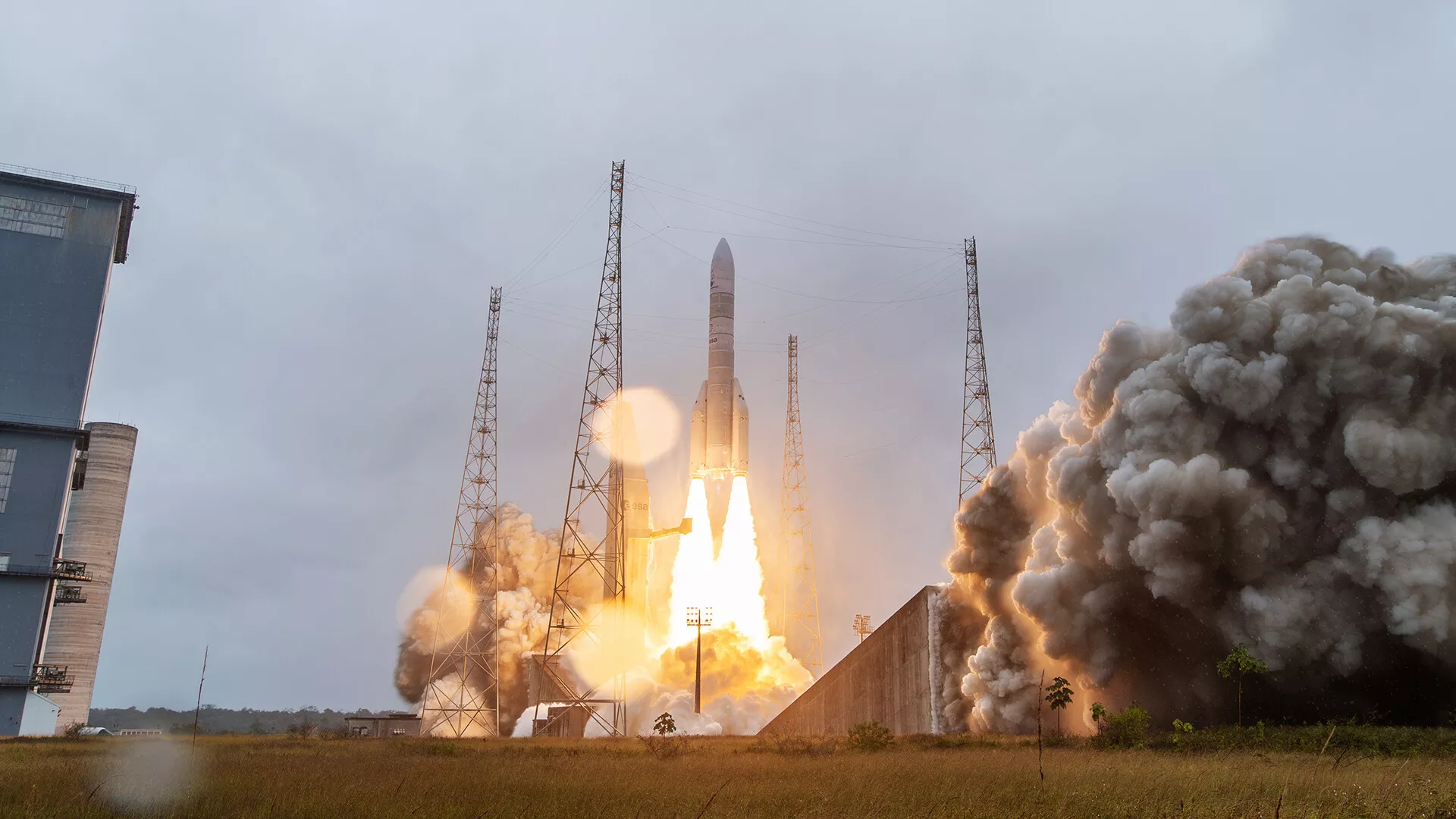
Ariane 6 flew its first mission to geostationary transfer orbit from French Guiana on Thursday, August 27, 2026. The launch happened at 5:11 p.m. local time, from the Centre Spatial Guyanais, or CSG, Europe’s spaceport near Kourou.
The mission, designated VA270, carried MTG-I2, the second Meteosat Third Generation Imager weather satellite. Both CNES, France’s national space agency, and Arianespace, the launch operator, declared the flight fully successful.
A Milestone for the Rocket
This was Ariane 6’s first flight to geostationary transfer orbit, or GTO. GTO is an elliptical orbit that leads toward a satellite’s final position.
Thirty-six minutes after liftoff, MTG-I2 separated from the rocket. It then used its own power to reach a final spot 36,000 km above Earth.
CNES called the mission a milestone that “confirms Ariane 6’s capacity to serve geostationary orbit.” That capacity matters because weather and telecom satellites, among the most valuable payloads in the industry, all need this orbit.
A Busy Year at Kourou
The flight was Ariane 6’s ninth overall and its eighth commercial mission. It was also the fourth Ariane 6 launch from French Guiana in 2026.
The mission was also the sixth flight in the two-booster Ariane 62 configuration. That configuration uses solid-fuel boosters known as the P120C.
That cadence marks a sharp turnaround for the CSG. This outlet has covered the trend closely through 2026.
A June piece asked who profits from Europe’s busiest new rocket. Another reported on Spain’s PLD Space investing $41 million in a private launch pad there.
What the Satellite Will Do
MTG-I2 was developed by the European Space Agency (ESA) for EUMETSAT, Europe’s meteorological satellite agency, and built by Thales Alenia Space. Officials say it will strengthen Europe’s next-generation weather satellite system, improving early detection of severe storms, weather forecasting, and climate monitoring.
The satellite is the second of its kind in a planned series. Its predecessor, MTG-I1, launched in 2022 and became operational in 2024.
Local Impact Remains Unclear
No specific employment, revenue, or GDP figures for French Guiana’s local economy were disclosed in connection with this mission. Those numbers were not made public, so this launch’s local economic effect remains unknown.
What is clear is the CSG’s standing as the launch base France and ESA use for their rockets. Officials describe it as “Europe’s spaceport,” and the rising launch rate in 2026 keeps that role central to the region’s identity.
More: Latin America news in English, every day from The Rio Times.
Frequently Asked Questions
What is the Centre Spatial Guyanais?
The Centre Spatial Guyanais, or CSG, is Europe’s spaceport, located near Kourou in French Guiana. France and the European Space Agency use it as the launch base for their rockets.
What is geostationary transfer orbit?
Geostationary transfer orbit, or GTO, is an elliptical orbit used as a stepping stone toward a satellite’s final position. It is the orbit needed for high-value weather and telecom satellites.
What satellite did Ariane 6 carry on this mission?
Ariane 6 carried MTG-I2, the second Meteosat Third Generation Imager weather satellite. It was developed by the European Space Agency for EUMETSAT and built by Thales Alenia Space.
Why was this launch a milestone?
This was Ariane 6’s first mission to geostationary transfer orbit, proving it can serve high-value satellites. CNES said it confirms Ariane 6’s capacity to serve geostationary orbit.
How many times has Ariane 6 launched from French Guiana?
This was Ariane 6’s ninth flight overall and its fourth launch from French Guiana in 2026 alone. It was also the rocket’s eighth commercial mission.
Sources: Arianespace newsroom and launch kit, CNES (Centre National d’Études Spatiales), Centre Spatial Guyanais (CSG) official site, European Space Agency (ESA) media materials.
This article was produced by The Rio Times’ automated newsroom system. How we use AI · Report an error · Editorial responsibility: Matthias Camenzind, Editor-in-Chief