French Guiana 2027 Budget: France Lifts Overseas Funds 10% Amid US$49 Billion Squeeze
ECONOMY · FRENCH GUIANA
Key Facts
- —The country French Guiana is an overseas region of France on the north coast of South America. Its public finances depend heavily on the national budget set in Paris.
- —What happened On 1 October 2026 France presented its 2027 budget with €43 billion (about US$48.8 billion) of national “recovery measures”, France-Guyane reported, citing AFP.
- —The numbers The overseas ministry budget rises about 10% to €3.68 billion (about US$4.17 billion) in 2027, according to the draft seen by AFP on 1 October.
- —What it means for you Overseas job-support tax schemes are kept. Pensions above €1,260 (about US$1,429) a month would no longer track inflation fully, and local councils face a €5.4 billion (about US$6.1 billion) bill.
- —Still open No figure for French Guiana alone has been published. Parliament can rewrite the bill, and the government faces a censure risk.
The French Guiana 2027 budget picture took shape on 1 October, when France unveiled €43 billion (about US$48.8 billion) of “recovery measures”. That is a national figure for the whole republic, not a sum aimed at French Guiana.
For the territory and France’s other overseas regions, the headline runs the other way. The overseas ministry’s budget rises about 10%, to €3.68 billion (about US$4.17 billion), according to the draft seen by AFP. Conversions use €1 = US$1.13 (open.er-api, 1 October 2026).

What France announced
The bills for the state budget and for social security went to the Council of Ministers, the weekly cabinet meeting, on Thursday morning. Parliament now debates them, seven months before the presidential election.
To bring the deficit down to 5% of output in 2027, the government plans €43 billion (about US$48.8 billion) of new measures. Measures adopted in 2026 and earlier lift the total effort to €54 billion (about US$61.2 billion), France-Guyane reported, citing AFP.
Economy minister Roland Lescure called it “an important effort”. Spending restraint provides 60% of it, and pensioners contribute €5.5 billion (about US$6.2 billion).
Market pressure is the backdrop. France’s 10-year borrowing rate reached 4.96% on Thursday, its highest level since 2002, according to the same AFP report.
Why overseas funding goes up
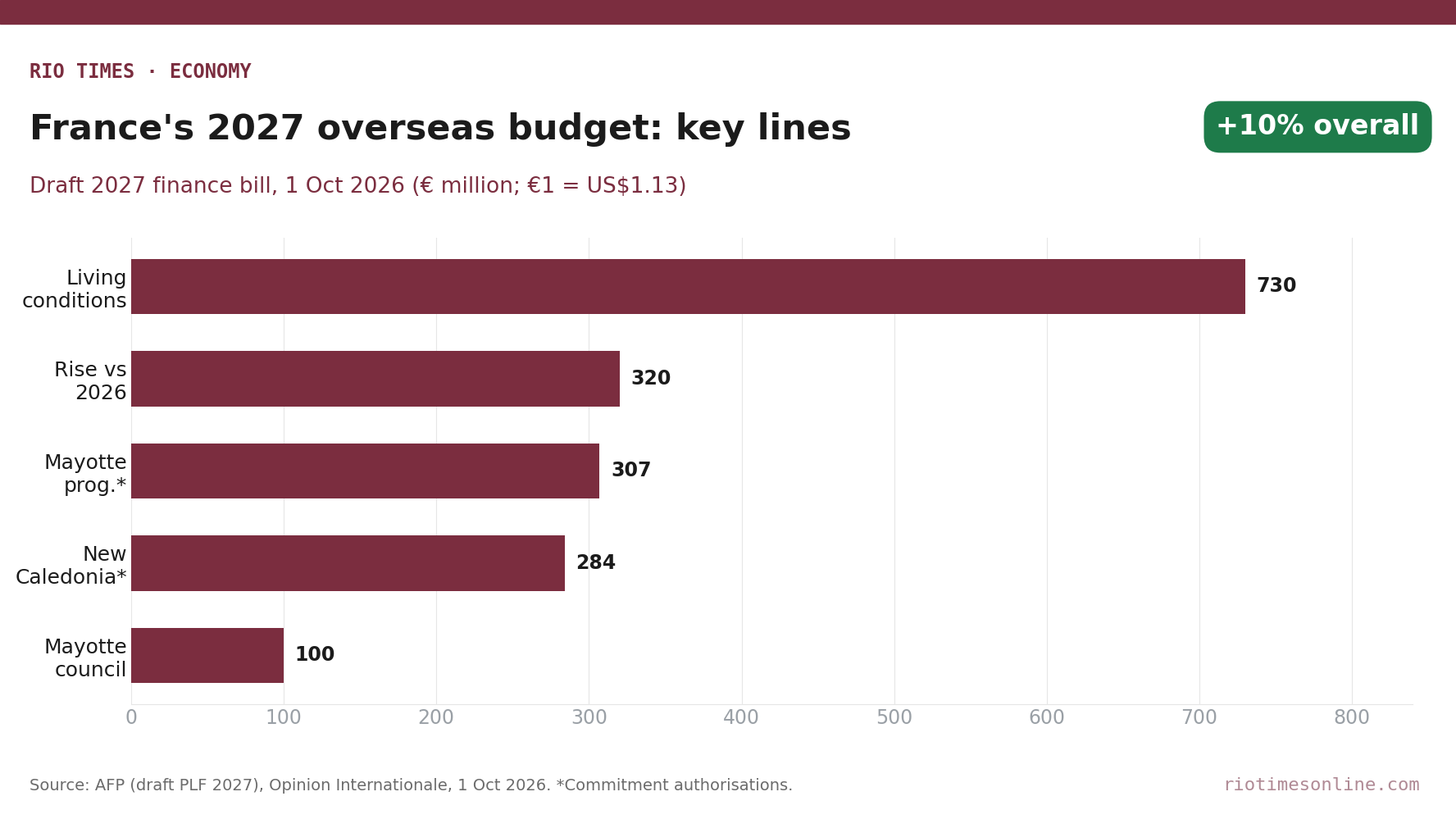
AFP reported that the overseas ministry gains about €320 million (about US$363 million) in 2027. Roughly half of its €3.68 billion (about US$4.17 billion) pays for special exemptions on employers’ social contributions.
Bercy, the finance ministry, says these exemptions offset structural extra costs and productivity gaps in overseas economies. Another €730 million (about US$828 million) in payments goes to improving living conditions.
Opinion Internationale, a Paris outlet, put the rise at almost 10% in a year and 63% since 2022. Its editorial noted that school construction in French Guiana sits inside that living-conditions line.
The largest new sums go elsewhere. Mayotte, still rebuilding after Cyclone Chido in late 2024, gets €307 million (about US$348 million) in commitments.
Its departmental council again receives €100 million (about US$113 million) in specific support. New Caledonia gets €284 million (about US$322 million) in commitments.
Where French Guiana could feel the squeeze
Local authorities face a separate bill. France-Guyane, citing AFP, reported that councils are asked for €5.4 billion (about US$6.1 billion), an effort their associations called “disproportionate”.
Opinion Internationale listed two parts. A €2.5 billion (about US$2.8 billion) contribution comes with a €2.1 billion (about US$2.4 billion) cut to the FCTVA. That fund refunds VAT on council investment, and many overseas communes already carry debt.
The draft also suspends some discretionary spending, the outlet said, including the green fund and climate-adaptation aid for farmers. It argued that territories most exposed to climate shocks lose adaptation money.
There is a stabiliser, however. The LODEOM, the overseas law that cuts employers’ costs, and related tax schemes are preserved, with no reduction proposed, Opinion Internationale noted.
What it means for residents
Most households will feel national measures first. Pensions above €1,260 a month (about US$1,429) would no longer rise fully with inflation. Housing benefit would not be raised in 2027.
The civil-service pay index stays frozen for a fourth year, AFP reported. The territory is also mourning Gabriel Serville, French Guiana’s territorial president, who died at 67.
Living costs remain the other open file. Paris is separately studying 14 proposals to cut air fares to French Guiana.
What Is Not Yet Known
Neither AFP nor Opinion Internationale gave a figure for French Guiana alone. How much of the €3.68 billion (about US$4.17 billion) reaches the territory is unpublished, so the full French Guiana 2027 budget impact is unclear.
Parliament may rewrite the bill, and the government could fall before it passes. The High Council of Public Finances, the independent fiscal watchdog, called the 1% growth forecast “optimistic”.
Sources: France-Guyane (AFP), 1 October 2026 · AFP, “Budget 2027: hausse de 10 % des moyens du ministère des Outre-mer”, 1 October 2026 · Opinion Internationale, 1 October 2026 · Exchange rate: open.er-api, 1 October 2026.