Oil Slides as Middle East Exports Recover, Brent Settles at US$102.59
Key Facts
- Brent settled at US$102.59 a barrel, down US$2.69 or 2.6%, and WTI settled at US$89.38, down US$3.22 or 3.5%.
- Middle East exports hit a war-time high: September crude shipments from the region reached 16.328 million barrels a day, according to Kpler data cited by Reuters, the most since the Iran war began in late February.
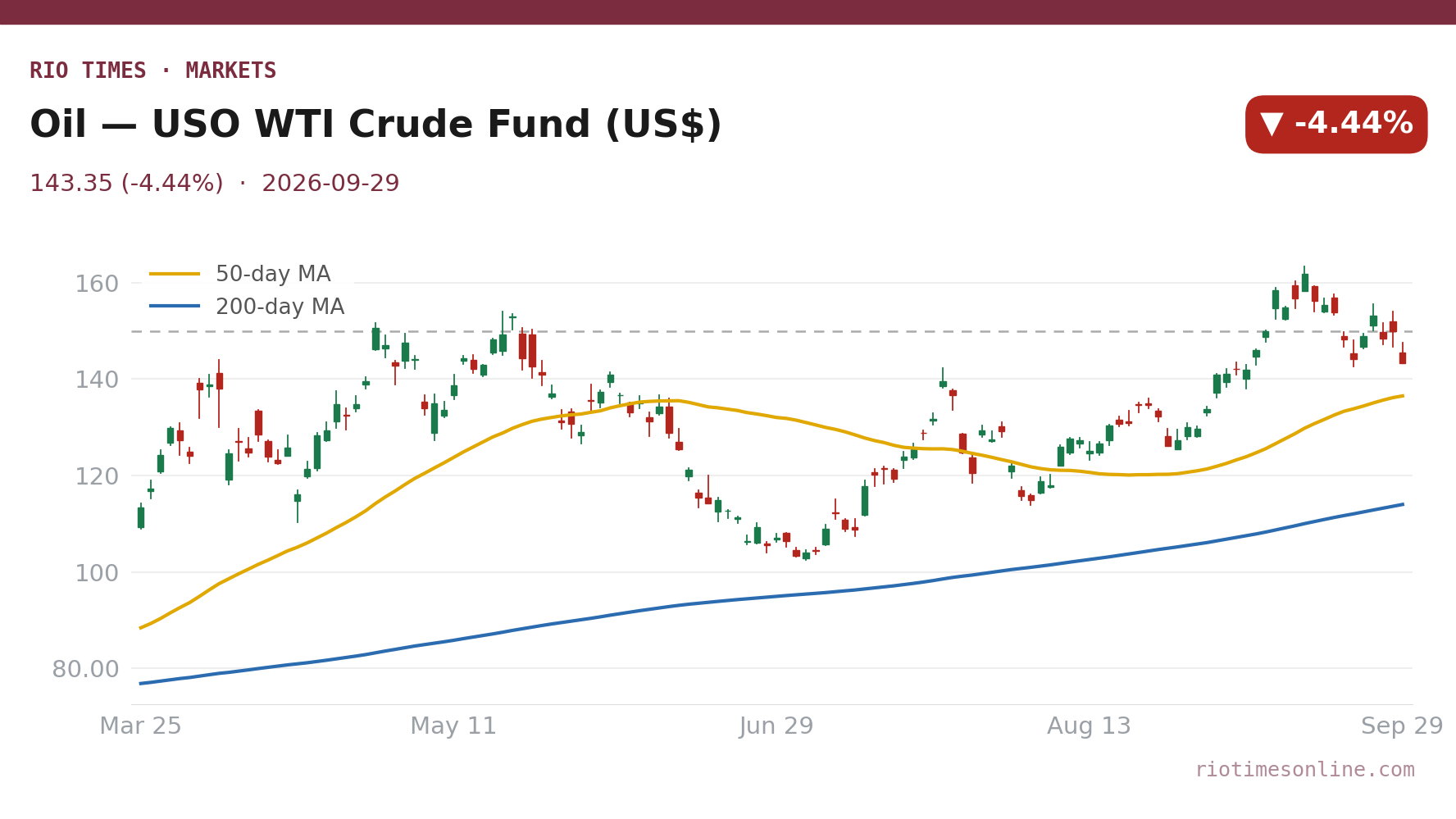
- The USO oil fund fell 4.44% to US$143.35, 11.4% below its 52-week closing high of US$161.86 set on 15 September.
- Petrobras was steady: its New York shares closed flat at US$20.65, while its São Paulo preferred shares rose 0.78% to R$49.10 (about US$9.44).
- YPF and Ecopetrol fell 2.06% to US$50.31 and 1.08% to US$16.52 in New York.
- Washington offered more reserve oil: the Energy Department sought bids for an exchange of up to 40 million barrels from the Strategic Petroleum Reserve.
Today’s Focus
Crude fell hard on Tuesday, 29 September 2026, as more oil flowed out of the Gulf. Brent settled at US$102.59 a barrel, down 2.6%, and WTI at US$89.38, down 3.5%.
The driver was supply. Middle East crude exports reached 16.328 million barrels a day in September, the highest since the war with Iran began in late February, according to Kpler data cited by Reuters. Saudi Arabia resumed loadings at the Red Sea port of Yanbu after restarting its East-West pipeline.
Diplomacy offered no fresh support. Iran’s foreign minister, Abbas Araghchi, met Qatari mediators in New York, but a US official said there would be no agreement unless Iran’s nuclear programme is addressed.
Latin American oil shares were mixed. Petrobras held flat in New York at US$20.65, while Argentina’s YPF fell 2.06% and Colombia’s Ecopetrol lost 1.08%.
What matters today. More Gulf barrels are draining the war premium from crude, and the Iran talks remain the swing factor in both directions.
01 The session in one read
Crude prices fell on Tuesday, 29 September, as recovering Middle Eastern exports outweighed the unresolved US-Iran standoff.
Brent settled at US$102.59 a barrel, down US$2.69, and WTI at US$89.38, down US$3.22. The United States Oil Fund, an exchange-traded fund that tracks WTI futures, fell 4.44% to US$143.35.
The session showed the market moving from fear of scarcity towards evidence of recovery. With Gulf exports at their highest since the war began, the case for triple-digit Brent is weakening. The variable to watch is the Iran track: a deal that reopens the Strait of Hormuz would remove much of the remaining premium, while a breakdown would restore it quickly.
02 The board
Latin American energy shares diverged. Brazil’s state-controlled Petrobras closed flat at US$20.65 in New York, and its São Paulo preferred shares rose 0.78% to R$49.10 (about US$9.44) as the real firmed.
Argentina’s YPF, the main listed vehicle for Vaca Muerta shale, fell 2.06% to US$50.31. Colombia’s Ecopetrol slipped 1.08% to US$16.52 in New York and lost 2.84% in Bogotá to COP 2,740 (about US$0.82).
| Asset | Level | Change |
|---|---|---|
| WTI crude (USO) | US$143.35 | -4.44% |
| Petrobras | US$20.65 | +0.00% |
| Ecopetrol | US$16.52 | -1.08% |
| YPF | US$50.31 | -2.06% |
Source: RT close, 2026-09-29. Where a commodity has no spot feed, an exchange-traded tracker or leading producer is shown as a labelled proxy.
Live Market IntelligenceThe live market board
Rio Times · Live Market Intelligence
Latin America — Cross-Market Board
| Instrument | Last | Change | YoY | Prev. | High | Low | Volume |
|---|---|---|---|---|---|---|---|
| IBOV | 183,827.59 | +0.46% | +21.85% | 182,991.13 | 168,310 | 167,142 | — |
| IPSA | 11,055.91 | -0.73% | — | 11,137.23 | 11,210 | 10,984 | 1,513,213,483 |
| IPC MEX | 65,071.30 | +0.20% | +12.17% | 64,944.41 | 66,121 | 65,405 | 108,886,187 |
| MERVAL | 2,782,561 | -0.59% | +30.51% | 3,022,485 | 3,042,365 | 2,991,150 | — |
| COLCAP | 2,558.92 | -0.79% | — | 9.04 | 9.05 | 9.02 | 4,133 |
| BVL PERÚ | 60,220.45 | +0.32% | — | — | — | — | — |
| USD/BRL | 5.16 | +0.01% | -5.13% | 5.16 | 5.18 | 5.14 | — |
| EUR/BRL | 5.95 | +1.01% | -5.83% | 5.89 | 5.98 | 5.94 | — |
| USD/MXN | 17.06 | -0.24% | -8.58% | 17.10 | 17.08 | 17.01 | — |
| USD/CLP | 913.98 | +0.04% | -5.67% | 913.65 | 915.11 | 906.68 | — |
| USD/COP | 3,140 | +0.03% | -22.04% | 3,139 | 3,141 | 3,105 | — |
| USD/PEN | 3.36 | -0.66% | -4.82% | 3.38 | 3.38 | 3.35 | — |
| USD/ARS | 1,493 | +0.10% | +12.96% | 1,491 | 1,494 | 1,480 | — |
| USD/UYU | 40.27 | +1.24% | +1.80% | 39.77 | 40.27 | 40.23 | — |
| USD/PYG | 5,939 | +1.68% | -19.54% | 5,841 | 5,939 | 5,925 | — |
| USD/BOB | 11.64 | -0.76% | +72.04% | 11.73 | 11.72 | 11.64 | — |
| USD/DOP | 58.34 | +1.25% | -3.44% | 57.62 | 58.34 | 58.04 | — |
| USD/CRC | 445.92 | +0.89% | -9.71% | 441.97 | 448.50 | 445.92 | — |
03 What moved it
The dominant force was the return of Gulf barrels. September exports of 16.328 million barrels a day were the most since late February, helped by higher Saudi and UAE shipments. That compressed the risk premium that has kept Brent above US$100.
The US Energy Department added to the supply story. It asked for bids on an exchange of up to 40 million barrels from the Strategic Petroleum Reserve, with bids due on 6 October and deliveries in November and December. Five earlier offers have already awarded more than 133 million barrels of the 172 million barrels Washington pledged.
The US-Iran talks gave no support to prices. President Donald Trump had already rejected Iran’s latest Hormuz proposal as unacceptable on Saturday, and on Tuesday Washington insisted any deal must cover Iran’s nuclear programme.
04 Tuesday’s data, one by one
Monday’s edition set four oil markers and flagged two releases for Tuesday. Here is what happened.
US-Iran Hormuz channel: talks, no deal. Araghchi met Qatari mediators in New York. Iran proposed that frozen funds be released, sanctions lifted and the naval blockade of its ports ended within four to five days, reopening the strait. A US official said there would be no agreement unless the nuclear issue is addressed. Brent fell 2.6% regardless, on supply.
US Strategic Petroleum Reserve: another offer. The Energy Department sought bids for up to 40 million barrels in an exchange, meaning companies must return the oil later with extra barrels. No new reserve level was published on Tuesday; the weekly figure comes with Wednesday’s government inventory data.
API inventories (week to 25 September): surprise build. The American Petroleum Institute estimated a 1.02-million-barrel rise in US crude stocks, against forecasts of a 1.9-million-barrel draw, after a 1.79-million-barrel build the week before. The estimate came out after settlement, so it did not drive Tuesday’s fall.
China’s September PMIs: back above 50. The official manufacturing PMI, released at 1.30 am UTC on Wednesday, rose to 50.1 from 49.8, in line with forecasts. The non-manufacturing index rose to 50.2, above the 49.3 forecast. The data came after Tuesday’s settlement.
US consumers and jobs: weaker. The Conference Board’s consumer confidence index fell to 81.9 in September, against an 89.2 forecast. US job openings eased to 7.1 million in August. Both point to softer fuel demand ahead. The dollar index still edged up 0.17% to 101.37.
Guyana’s Uaru project and YPF’s Vaca Muerta pipelines. No new announcements on Tuesday.
05 The Latin American read
For Brazil, the session tested Petrobras’s resilience. The stock held flat in New York despite a 3.5% fall in WTI, and its São Paulo shares rose.
Argentina’s YPF felt the drop more directly, down 2.06%, because Vaca Muerta shale is more sensitive to lower prices than Brazil’s offshore pre-salt fields.
In Venezuela, the White House has described 100-year oil concessions for North American Blue Energy Partners, with a Pentagon-linked stake in its parent. Both points are disputed: Venezuela’s government says the term is 25 years, and the Pentagon told lawmakers it holds warrants rather than shares, The Guardian reported on 26 September.
Guyana’s Stabroek block, producing about 900,000 barrels a day, keeps adding Atlantic Basin supply.
06 The names to watch
Petrobras is the bellwether for Brazil’s pre-salt economics. Its flat close shows investors separating company risk from one day’s crude move.
YPF remains the purest listed play on Argentina’s shale ambitions, and its drop reflects sensitivity to every dollar of crude.
Ecopetrol fell further in Bogotá than in New York because the Colombian peso firmed 0.95% to 3,330 per US dollar on Tuesday. The central bank’s rate decision on Wednesday is the next local test.
07 The outlook
The supply picture is improving faster than the peace process. Each month of recovering Gulf exports chips away at the war premium, but the Iran talks remain a two-way risk.
If talks advance, oil could fall further; if they collapse, the premium would return. Petrobras looks the most defensive of the region’s producers.
08 What to watch
- US government oil inventories, 14.30 UTC (11.30 am BRT): the EIA weekly report, after the API’s surprise 1.02-million-barrel crude build.
- US-Iran talks: whether Washington answers Iran’s Hormuz proposal, relayed by Qatari mediators.
- US data, 12.15–13.45 UTC: ADP private payrolls for September (forecast 70,000), August PCE inflation and the Chicago PMI (forecast 51.2).
- Colombia’s central bank, 18.00 UTC: a policy rate decision, with the rate expected to stay at 12%; it matters for Ecopetrol and the peso.
- Brazil fiscal data, 11.30 UTC: the central bank’s August public-sector budget and debt figures, a driver for the real and Petrobras.
Frequently Asked Questions
Why did oil fall on Tuesday, 29 September 2026?
Middle East crude exports reached 16.328 million barrels a day in September, the highest since the Iran war began, according to Kpler data cited by Reuters. Brent settled down 2.6% at US$102.59 and WTI down 3.5% at US$89.38.
What is the United States Oil Fund?
USO is an exchange-traded fund that tracks WTI crude futures. It closed at US$143.35 on Tuesday, down 4.44%.
How did Petrobras hold flat while oil fell?
Its New York shares closed unchanged at US$20.65, and its São Paulo preferred shares rose 0.78% to R$49.10 (about US$9.44) as the real firmed.
What did the US Energy Department announce?
It sought bids for an exchange of up to 40 million barrels from the Strategic Petroleum Reserve, with bids due on 6 October and deliveries in November and December.
Source: RT live market data, close of Tuesday 29 September 2026.
This article was produced by The Rio Times’ automated newsroom system. How we use AI · Report an error
Read More from The Rio Times