Bitcoin Edges Up to US$83,622 as Weak US Data Trims Fed Hike Bets
Key Facts
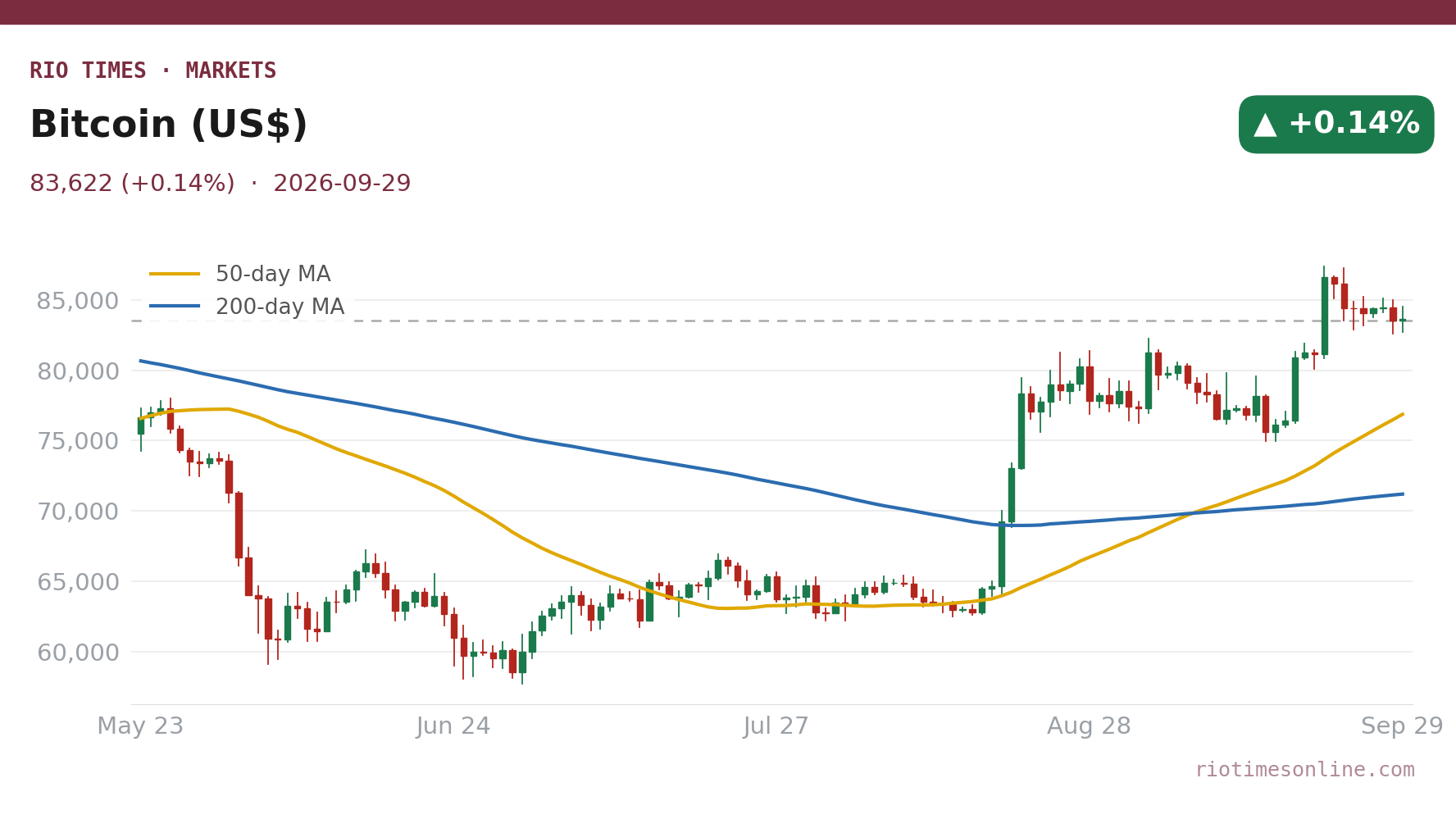
- Bitcoin settled at US$83,622, up 0.14% on Tuesday, September 29, 2026, after trading between US$82,739 and US$84,511. It has not traded above US$85,000 since Sunday, September 27.
- Ethereum settled at US$2,677, down 0.44%, while Solana added 0.18% to US$119.06 and XRP fell 0.42% to US$1.49.
- Soft US data trimmed Fed hike bets: August job openings fell to 7.079 million against a 7.23 million forecast, and September consumer confidence dropped to 81.9, the lowest since 2014. Markets cut the odds of an October rate rise to about 51.5% from 70.9%.
- Yields stayed high: the 10-year US Treasury yield closed at 5.25% and the 30-year at 5.57%, which limited any relief for non-yielding assets such as Bitcoin.
- ETF demand held up: US spot Bitcoin ETFs took in about US$31 million on Monday, an eighth straight session of net inflows, and Bitwise launched the first US spot NEAR ETF on NYSE Arca on Tuesday.
- Brazil’s crypto flows run through stablecoins: central-bank data show Brazilian residents bought US$6.9 billion of crypto abroad in the first quarter of 2026, and more than 98% of it was stablecoins.
Today’s Focus
Bitcoin settled at US$83,622 on Tuesday, September 29, 2026, a gain of 0.14%. It recovered from an intraday low of US$82,739 but could not hold above US$84,500. Ethereum slipped 0.44% to US$2,677, Solana added 0.18% to US$119.06 and XRP fell 0.42% to US$1.49.
The main driver was Tuesday’s US data. Job openings fell to 7.079 million in August and consumer confidence dropped to 81.9 in September, both well below forecasts. New York Fed President John Williams said there was “no need for urgency”, according to Kitco. Traders cut the odds of an October Fed rate rise to about 51.5% from 70.9% on Monday.
That should have helped crypto more than it did. Long-dated yields barely moved: the 10-year Treasury closed at 5.25% and the 30-year at 5.57%. The dollar index also firmed 0.17% to 101.37, its highest close since late July.
For Latin America, the steadier story is stablecoins. In Brazil, more than 98% of the US$6.9 billion in crypto bought abroad in the first quarter was in dollar-linked tokens. In Argentina, stablecoins made up about 71% of crypto purchases on the Bitso exchange in 2025.
What matters today. Tuesday’s soft US data cut Fed hike bets, but 5%-plus yields kept Bitcoin stuck below US$85,000 ahead of Wednesday’s PCE inflation report.
01 The session in one read
Bitcoin settled at US$83,622 on Tuesday, September 29, 2026, up 0.14%. It traded between US$82,739 and US$84,511 and has not traded above US$85,000 since Sunday.
Ethereum slipped 0.44% to US$2,677, while Solana added 0.18% to US$119.06 and XRP fell 0.42% to US$1.49. Softer US data helped at the margin, but high long-term yields kept the rebound small.
Tuesday’s data lowered the odds of an October Fed hike, yet the 10-year yield still closed at 5.25%. Until long-term yields fall, Bitcoin is likely to stay in its recent range below US$85,000. Wednesday’s August PCE inflation report is the next test: a hot number would revive hike bets, a soft one would give crypto room to move. For Latin American users, price swings matter less than access to dollars, which is why stablecoins dominate flows in Brazil and Argentina.
02 The board
The leaders were mixed: Bitcoin and Solana edged up, while Ethereum and XRP gave ground, showing a market that is rotating within majors rather than moving as one bloc.
All four prices are spot US-dollar closes for Tuesday. Solana’s range was the widest, from US$116.53 to US$121.49.
| Asset | Level | Change |
|---|---|---|
| Bitcoin | US$83,622 | +0.14% |
| Ethereum | US$2,677 | -0.44% |
| Solana | US$119.06 | +0.18% |
| XRP | US$1.49 | -0.42% |
Source: RT live market data, close of Tuesday 29 September 2026.
Live Market IntelligenceThe live market board
Rio Times · Live Market Intelligence
Latin America — Cross-Market Board
| Instrument | Last | Change | YoY | Prev. | High | Low | Volume |
|---|---|---|---|---|---|---|---|
| IBOV | 183,827.59 | +0.46% | +21.85% | 182,991.13 | 168,310 | 167,142 | — |
| IPSA | 11,055.91 | -0.73% | — | 11,137.23 | 11,210 | 10,984 | 1,513,213,483 |
| IPC MEX | 65,071.30 | +0.20% | +12.17% | 64,944.41 | 66,121 | 65,405 | 108,886,187 |
| MERVAL | 2,782,561 | -0.59% | +30.51% | 3,022,485 | 3,042,365 | 2,991,150 | — |
| COLCAP | 2,558.92 | -0.79% | — | 9.04 | 9.05 | 9.02 | 4,133 |
| BVL PERÚ | 60,220.45 | +0.32% | — | — | — | — | — |
| USD/BRL | 5.16 | +0.01% | -5.13% | 5.16 | 5.18 | 5.14 | — |
| EUR/BRL | 5.95 | +1.01% | -5.83% | 5.89 | 5.98 | 5.94 | — |
| USD/MXN | 17.06 | -0.24% | -8.58% | 17.10 | 17.08 | 17.01 | — |
| USD/CLP | 913.98 | +0.04% | -5.67% | 913.65 | 915.11 | 906.68 | — |
| USD/COP | 3,140 | +0.03% | -22.04% | 3,139 | 3,141 | 3,105 | — |
| USD/PEN | 3.36 | -0.66% | -4.82% | 3.38 | 3.38 | 3.35 | — |
| USD/ARS | 1,493 | +0.10% | +12.96% | 1,491 | 1,494 | 1,480 | — |
| USD/UYU | 40.27 | +1.24% | +1.80% | 39.77 | 40.27 | 40.23 | — |
| USD/PYG | 5,939 | +1.68% | -19.54% | 5,841 | 5,939 | 5,925 | — |
| USD/BOB | 11.64 | -0.76% | +72.04% | 11.73 | 11.72 | 11.64 | — |
| USD/DOP | 58.34 | +1.25% | -3.44% | 57.62 | 58.34 | 58.04 | — |
| USD/CRC | 445.92 | +0.89% | -9.71% | 441.97 | 448.50 | 445.92 | — |
03 What moved it
The weaker US data were the main support. Lower odds of an October Fed hike reduce the pull of cash and bonds over assets that pay no interest, such as Bitcoin.
The drag came from yields and the dollar. The 2-year Treasury yield eased to 4.88%, but the 10-year closed at 5.25% and the 30-year at 5.57%. The dollar index rose 0.17% to 101.37. Oil did not add pressure on Tuesday: Brent settled 2.6% lower at US$102.59 a barrel, according to Kitco.
Institutional demand stayed steady. US spot Bitcoin ETFs recorded about US$31 million of net inflows on Monday, led by BlackRock’s IBIT, their eighth straight positive session, according to SoSoValue data. Bitwise launched the Bitwise NEAR ETF (NRR) on NYSE Arca on Tuesday, the first US spot NEAR product. Strategy shares fell 1.57% to US$154.67.
04 Tuesday’s data, one by one
- US JOLTS job openings (August): 7.079 million, below the 7.23 million forecast and down from 7.335 million in July. Fewer openings point to a cooling labour market. Hike odds fell and Bitcoin held its gains.
- US Conference Board consumer confidence (September): 81.9, far below the 89.2 forecast and down from 88.6 in August. It was the lowest reading since 2014. This was the release that did most to trim Fed hike bets.
- Fed speakers: New York Fed President John Williams said there was “no need for urgency” on policy, according to Kitco. Governor Waller and St. Louis Fed President Musalem were also scheduled.
- US house prices (July): the S&P/Case-Shiller index rose 2.5% year on year, above the 2.2% forecast. It had no visible effect on crypto.
- Brazil IGP-M (September): the FGV wholesale-led price index rose 1.57% in the month, just below the 1.60% forecast, after a 0.22% fall in August. The 12-month rate reached 3.34%. It did not move crypto prices.
- Promised items that did not happen: we found no Senate action on the CLARITY Act, the US crypto market-structure bill. No new El Salvador remittance data were published; the latest central-bank figures cover January to July.
- Corporate treasuries: Strategy said on Monday it bought 1,665 BTC for about US$142.7 million, and Strive bought 1,107 BTC. Neither buyer lifted prices above US$85,000 on Tuesday.
05 The Latin American read
Brazilian residents bought US$6.9 billion of crypto abroad in the first quarter of 2026, according to central-bank external-sector data, and more than 98% of it was stablecoins. The central bank’s rules for virtual-asset service providers took effect on February 2, 2026, and should give a fuller picture of these flows.
In Argentina, stablecoins made up about 71% of crypto purchases on the Bitso exchange in 2025, according to Bitso. People use USDT and USDC to hold dollars against inflation and currency risk.
In El Salvador, crypto remittances reached US$41.1 million from January to July 2026, up about 36% year on year, according to the Central Reserve Bank. That was still only about 0.7% of the US$5.92 billion in total remittances. The government’s Bitcoin Office reported about 7,760 BTC in early September, including a 1,090 BTC purchase in November 2025, so state ownership far exceeds everyday use.
06 The names to watch
The immediate level is US$85,000 on Bitcoin. It last traded above that level on Sunday, and a close above it would end the sideways drift of the past week.
In the region, watch the stablecoin rails rather than the tokens. The 98% share in Brazil and the roughly 71% share on Bitso in Argentina show where real volume and adoption are.
07 The outlook
If long-term Treasury yields stay above 5%, Bitcoin’s path above US$85,000 stays hard, even with softer US data. The week’s US data run, from PCE inflation on Wednesday to the September jobs report on Friday, will decide whether October hike bets keep falling. For Latin America, stablecoin adoption will keep growing whatever Bitcoin does, driven by demand for dollars and cheaper cross-border payments.
08 What to watch
- US ADP employment (September): 12:15 UTC (09:15 BRT); forecast 70,000 after 38,000 in August.
- US PCE inflation (August): 12:30 UTC (09:30 BRT), with personal income and spending; headline PCE is forecast at 3.7% year on year. A hot reading would revive October hike bets.
- Bitcoin vs US$85,000: a close above that area would mark a break from the past week’s range.
- Spot Bitcoin ETF flows: whether the run of daily net inflows extends past eight sessions.
- Later this week: US ISM manufacturing on Thursday and the September jobs report on Friday.
Frequently Asked Questions
Why did Bitcoin rise on Tuesday, September 29, 2026?
Bitcoin gained 0.14% to US$83,622 after weak US job openings and consumer confidence data cut the odds of an October Fed rate rise to about 51.5% from 70.9%.
Why was the gain so small?
Long-term US yields stayed high, with the 10-year Treasury at 5.25% and the 30-year at 5.57%, and the dollar index rose to 101.37, its highest close since late July.
What are stablecoins?
Stablecoins are crypto tokens pegged to the US dollar, such as USDT and USDC. Latin Americans use them to hold dollars and send money abroad cheaply.
How big are stablecoins in Brazil?
Brazilian residents bought US$6.9 billion of crypto abroad in the first quarter of 2026, and more than 98% of it was stablecoins, according to central-bank data.
Source: RT live market data, close of Tuesday 29 September 2026.
This article was produced by The Rio Times’ automated newsroom system. How we use AI · Report an error
LatAm Markets: Live Signals → — real-time movers, turnover leaders and FX across Latin America.
Read More from The Rio Times