Brazil’s Financial Morning Call for Wednesday, September 30, 2026
Key Facts
- The opening test is fiscal: the central bank publishes August public-sector debt and budget figures at 08:30 BRT, before B3 opens, and a wider deficit would test the real and interest-rate futures at once.
- Producer prices land at 09:00 BRT, giving the central bank a fresh read on pipeline inflation as traders weigh the Selic, now 13.75%, before the 4 November Copom meeting.
- Tuesday’s jobs data ran hot: Brazil created 165,827 formal jobs in August, far above forecasts, and the IGP-M rose 1.57% in September. The real still firmed 0.45% to 5.2019 per US dollar.
- US data follow at 09:15 and 09:30 BRT, with ADP private payrolls and August PCE inflation; S&P 500 futures were about 0.2% higher early on Wednesday.
- Iron ore is the stock story: CSN fell 9.8% on Tuesday after its mining arm cut its 2026 output guidance, and Vale lost 2.2%. China’s official factory PMI came in at 50.1 overnight, in line with forecasts.
Today’s Focus
Brazil’s pre-market on Wednesday is a domestic-data morning. At 08:30 BRT the central bank publishes August fiscal figures — gross debt to GDP, the nominal balance and the primary result — and traders will read them straight through to the outlook for the Selic, the central bank’s policy rate, and for the real, Brazil’s currency.
A wider-than-expected deficit would be a live wire for local rates and for dollar-real. The consensus sees gross debt at 83.1% of GDP, up from 82.5%, and a nominal deficit of about R$109 billion (US$21 billion) for the month.
At 09:00 BRT IBGE’s producer price index arrives, forecast at -0.4% on the month. A hot print would argue the central bank has less room to cut the Selic. The US then adds ADP payrolls and August PCE inflation, so the fiscal numbers will not be the only driver.
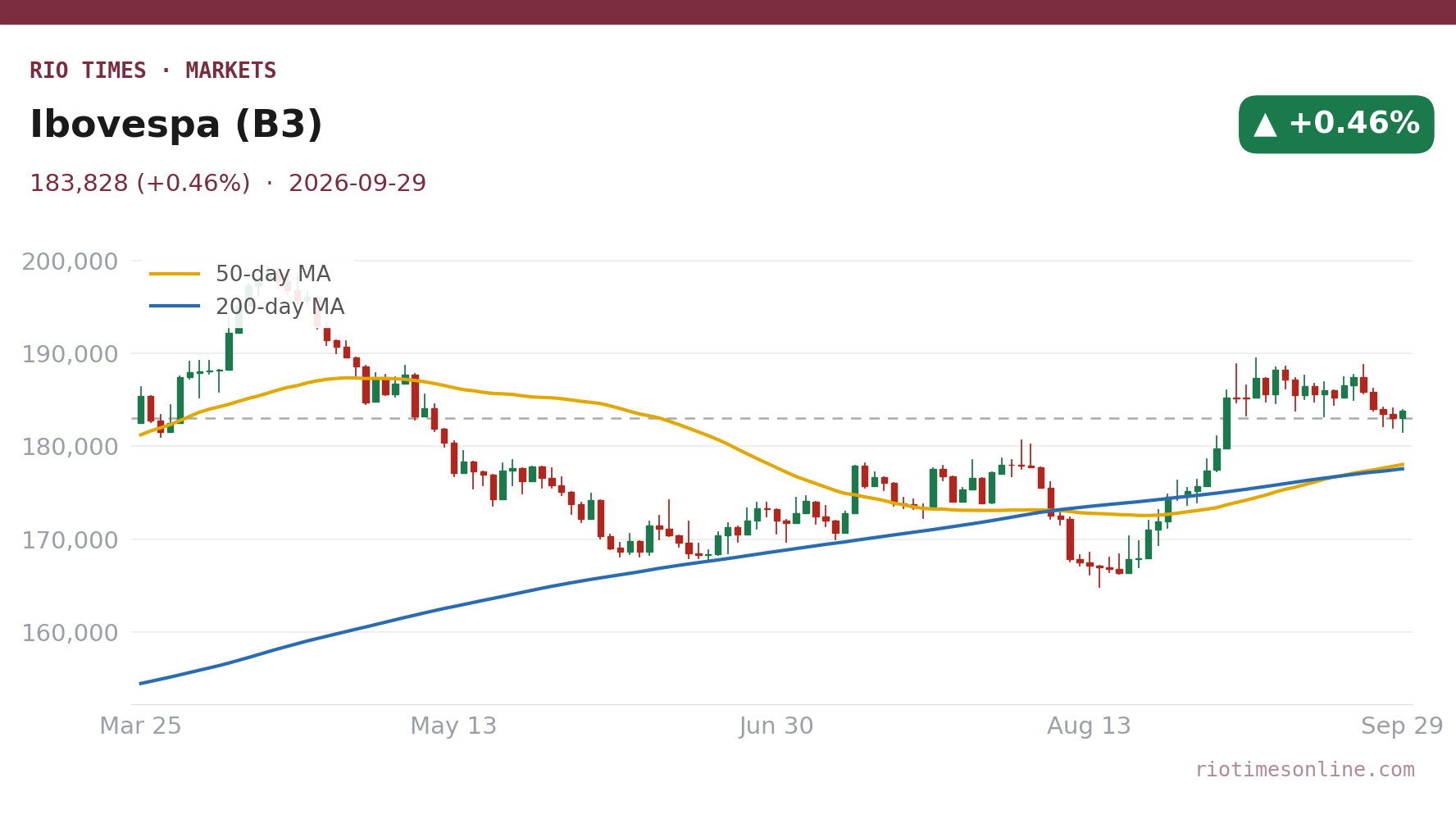
Tuesday set a firm base. The Ibovespa rose 0.46% to 183,828, ending a four-session losing streak, led by banks. Strong jobs data did not stop the real from gaining or local bond yields from easing.
What matters today. The 08:30 BRT fiscal release is the pivot — it will set the tone for the Selic debate and for how the real and rate-sensitive B3 stocks open at 10:00 BRT.
Today’s Economic Events
| Instrument | Level | Session |
|---|---|---|
| Ibovespa (Brazil) | 183,828 | +0.46% |
| S&P 500 (US) | 7,671 | -0.17% |
| USD/BRL | 5.2019 | -0.45% |
Source: RT live market data, close of Tuesday 29 September 2026.
01 The setup in one read
Wednesday’s open follows a busy early calendar. The fiscal figures come at 08:30 BRT and producer prices at 09:00 BRT, both before B3 opens at 10:00 BRT. By the bell, traders will also have US ADP payrolls and PCE inflation.
The reason the fiscal data matter is the Selic. At 13.75%, Brazil’s benchmark rate is high enough to restrain credit, and every fiscal data point feeds the question of how fast the central bank can keep cutting. The debt and deficit figures are really a rates event.
The real will likely take its cue from the same release. A wider deficit tends to weaken Brazil’s currency because it raises the risk premium foreign investors demand to hold local assets. A tighter one could extend Tuesday’s 0.45% gain.
The stock side is more selective. The big banks and domestic retailers are the most rate-sensitive names. Miners are in focus after CSN’s 9.8% fall and China’s in-line factory PMI.
The evidence points to a macro-driven session: Brazil’s calendar is heavy with fiscal and price data, and few company-specific catalysts compete for attention. The chief uncertainty is the fiscal print itself, because a surprise in either direction would move local rates and the real immediately. Watch whether the nominal deficit comes in better or worse than the expected R$109 billion (US$21 billion) — that line, plus US PCE inflation, will decide if the open is defensive or relieved.
02 Where Brazil is set to open
| Instrument | Last close | Indicated | Watch today |
|---|---|---|---|
| Ibovespa — Brazil’s main stock index | 183,828 (+0.46%) | — | August fiscal data at 08:30 BRT, then producer prices at 09:00 BRT |
| USD/BRL — Brazilian reais per US dollar | 5.2019 (-0.45%) | — | Nominal deficit and gross debt figures; any fiscal surprise |
| Dollar index (DXY) | 101.37 (+0.17%) | — | US PCE inflation at 09:30 BRT |
| S&P 500 | 7,670.84 (-0.17%) | Futures +0.2% | ADP payrolls and PCE before the US open |
| iShares MSCI Brazil ETF (EWZ) | US$36.47 (+0.72%) | — | New York’s read on Brazilian assets |
There is no pre-market indication for the Ibovespa or dollar-real. The EWZ exchange-traded fund, which tracks Brazilian stocks in New York, rose 0.72% on Tuesday, in step with the local market. Direction today will come from Brazilian fiscal data first, then from US inflation data.
The level to watch on dollar-real is the psychological 5.20 mark; the pair closed just above it at 5.2019. A weak fiscal print could push the dollar higher, while a contained number could take the real through 5.20. For the stock index, the early focus is whether banks can extend Tuesday’s gains.
Live Market IntelligenceBrazil Morning Call — Live Board
Rio Times · Live Market Intelligence
Brazil Morning Call — Live Board
| Instrument | Last | Change | YoY | Prev. | High | Low | Volume |
|---|---|---|---|---|---|---|---|
| IBOV | 183,827.59 | +0.46% | +21.85% | 182,991.13 | 168,310 | 167,142 | — |
| USD/BRL | 5.16 | +0.01% | -5.13% | 5.16 | 5.18 | 5.14 | — |
| EUR/BRL | 5.95 | +1.01% | -5.83% | 5.89 | 5.98 | 5.94 | — |
| SELIC | 14.00% | — | — | — | — | — | |
| BRENT | 88.88 | -0.03% | +34.42% | 88.91 | 90.07 | 88.12 | 29,713 |
| WTI | 83.11 | -0.11% | +31.57% | 83.20 | 84.35 | 82.40 | 166,848 |
| IRON ORE | 161.91 | — | +58.10% | 161.91 | 161.91 | 1 | |
| GOLD | 4,461 | +1.78% | +33.20% | 4,383 | 4,503 | 4,421 | 139,824 |
| SILVER | 65.59 | +1.26% | +73.05% | 64.77 | 66.98 | 64.81 | 46,406 |
| LITHIUM | 75.20 | +1.47% | +62.95% | 74.11 | 75.80 | 75.08 | 89,275 |
| SOY | 1,184 | +3.20% | +17.05% | 1,148 | 1,199 | 1,168 | 163,179 |
| CORN | 480.50 | +10.02% | +29.34% | 436.75 | 480.75 | 459.50 | 341,248 |
| WHEAT | 655.00 | +3.93% | +29.70% | 630.25 | 657.75 | 631.50 | 128,793 |
| COFFEE | 317.25 | -5.51% | +0.67% | 335.75 | 321.20 | 313.55 | 21,747 |
| SUGAR | 16.43 | -1.79% | -3.01% | 16.73 | 17.11 | 16.22 | 171,992 |
| ORANGE JUICE | 138.55 | -0.47% | -45.38% | 139.20 | 141.05 | 137.50 | 703 |
| COTTON | 85.03 | +2.33% | +26.78% | 83.09 | 82.90 | 81.96 | 16,546 |
| BEEF | 223.60 | -3.93% | -5.18% | 232.75 | 226.40 | 223.00 | 16,126 |
| CATTLE | 339.10 | -3.16% | -1.82% | 350.17 | 345.50 | 338.60 | 10,164 |
| COCOA | 5,719 | +3.18% | -34.96% | 5,543 | 5,779 | 5,574 | 26,773 |
| PETR4 | 41.64 | -0.05% | +35.19% | 41.66 | 41.97 | 41.15 | 41,499,400 |
| VALE3 | 72.97 | +0.83% | +30.75% | 72.37 | 73.54 | 72.66 | 17,658,000 |
| SUZB3 | 41.33 | +2.35% | -23.55% | 40.38 | 41.48 | 40.35 | 3,914,900 |
| KLABIN | 17.69 | +0.80% | -2.95% | 17.55 | 17.74 | 17.48 | 2,057,400 |
| SLCE3 | 13.34 | +0.30% | -12.25% | 13.30 | 13.42 | 13.20 | 1,454,200 |
| ABEV3 | 14.89 | -0.80% | +21.91% | 15.01 | 15.07 | 14.81 | 16,453,100 |
| ITUB4 | 38.60 | -1.03% | +4.57% | 39.00 | 39.34 | 38.39 | 29,487,800 |
| BBDC4 | 16.85 | +0.36% | +3.50% | 16.79 | 16.90 | 16.67 | 19,416,900 |
| BBAS3 | 19.37 | +0.47% | +0.73% | 19.28 | 19.44 | 19.16 | 11,069,200 |
| B3SA3 | 14.26 | -0.21% | +12.73% | 14.29 | 14.47 | 14.11 | 33,037,800 |
| WEGE3 | 47.59 | +0.49% | +29.99% | 47.36 | 48.08 | 47.36 | 3,364,600 |
| PRIO3 | 59.14 | -0.19% | +50.67% | 59.25 | 59.81 | 58.74 | 3,325,600 |
| RENT3 | 34.68 | -0.09% | +0.84% | 34.71 | 34.96 | 34.35 | 7,979,100 |
| AZZA3 | 15.89 | -2.63% | -53.76% | 16.32 | 16.42 | 15.82 | 1,330,300 |
| CSNA3 | 4.30 | +0.47% | -42.65% | 4.28 | 4.41 | 4.26 | 10,076,100 |
| GGBR4 | 24.69 | +2.19% | +51.38% | 24.16 | 24.85 | 24.18 | 7,047,600 |
| ENEV3 | 24.21 | -1.38% | +70.49% | 24.55 | 24.64 | 23.99 | 9,297,000 |
| LREN3 | 11.87 | -1.33% | -28.65% | 12.03 | 12.17 | 11.83 | 9,683,300 |
03 On the B3 radar today — August fiscal and price data
| Item | When | Why it matters |
|---|---|---|
| August gross debt-to-GDP; nominal and primary budget balances | 08:30 BRT | The session’s pivot — it sets the tone for the Selic debate and the real by showing whether Brazil’s fiscal anchor is holding |
| Producer price index, August | 09:00 BRT | A pipeline-inflation signal — a hot number argues the central bank has less room to cut rates |
| US ADP payrolls and August PCE inflation | 09:15 / 09:30 BRT | The US inflation gauge the Federal Reserve watches most; it drives the dollar and Treasury yields |
| Colombia rate decision | 15:00 BRT | A regional read on Andean rates; consensus is a hold at 12% |
The calendar’s spine is the set of fiscal figures at 08:30 BRT, because they can move Brazilian rates and the real at the same time. Gross debt at 83.1% of GDP is the consensus anchor, and traders will compare the nominal deficit with the expected R$109.4 billion (US$21.0 billion).
Producer prices tell the central bank whether disinflation is arriving at the factory gate. August industrial production is not due until Friday, 2 October.
Company news is thin, so the session belongs to macro flows. Anvisa, the health regulator, notified Mercado Livre on Monday and asked for details of its plan to sell medicines on its marketplace. That is a regulatory story for one name, not a broad-market driver.
04 Copom and the macro backdrop
The Copom is Brazil’s monetary policy committee, and its next move is the invisible hand behind today’s trade. The Selic stands at 13.75% after a quarter-point cut on 16 September, and the next decision is due on 4 November. The debate is how fast rates can keep falling — and the fiscal data is evidence in that argument.
A wider August deficit would push Brazilian rate futures higher, because a government that spends more forces the central bank to stay tighter for longer to control inflation. A contained number would do the reverse, supporting bets on further cuts.
The producer price index lands at 09:00 BRT as the inflation half of that equation. If pipeline prices are still running hot, the Copom’s room to ease narrows even if activity is weak — and that tension, between a cooling economy and sticky prices, is the core macro question for the open.
For foreign investors the simple translation is this: Brazil’s risk premium matters most today, but not alone. US ADP payrolls and PCE inflation land at 09:15 and 09:30 BRT, and the US 10-year Treasury yield already sits at 5.249%.
05 Corporate stories to watch today
The corporate radar is light, so the trade is about which sectors move when the macro numbers land. The big banks are the clearest play — they led Tuesday’s gain, with Banco do Brasil up 2.6% and Itaú up 1.4%, and a fiscal surprise would hit them first.
Domestic retailers and mall operators are the other interest-rate beta. A weaker real and higher local rates squeeze their costs and their customers at the same time, so the fiscal print will likely show up in their price action before anything else.
Miners are the other focus. CSN fell 9.8% on Tuesday after CSN Mineração cut its 2026 iron-ore output guidance to 39–41 million tonnes from 45–47 million, citing higher freight costs. Vale fell 2.2% to R$69.61 (US$13.38) after UBS BB cut its target price.
One regulatory story is simmering in the background: Anvisa, Brazil’s health regulator, has questioned Mercado Livre’s plan to intermediate medicine sales, after pressure from the pharmacy association Abrafarma. For now it is a single-name matter, not a market mover, but foreign investors who hold the cross-listed instrument will want to watch for any follow-up.
Nubank is the other name from Monday’s news. Its New York shares rose 1.0% to US$12.35 on Tuesday after a 10.0% fall on reports of talks to buy Britain’s Monzo. No deal has been announced.
06 The levels to watch at the open
On dollar-real the first test is the 5.20 mark. A fiscal print wider than the consensus could push the pair through that handle quickly, while a contained number would likely keep the real on the stronger side of it through midday.
For the Ibovespa the question is whether the domestic cyclicals — banks, retailers, consumer names — can hold their bids after the 08:30 release. The index itself is not the story this morning; the internals and the rate futures are.
The bond market is the quiet signal. Brazilian interest-rate futures will react to the same data before the currency and stocks fully price it, so watch the front-end rate contracts as the fastest read on whether traders think the fiscal anchor is slipping.
After the fiscal numbers, producer prices and US PCE inflation offer a second pulse. A cool reading on both would be the best chance for rate-sensitive stocks to shrug off a bad fiscal morning.
07 Tuesday’s data, one by one
Our Tuesday Morning Call flagged four items: the IGP-M, the Treasury result, unemployment with Caged payrolls, and the Nubank–Monzo talks. Here is how each landed.
IGP-M inflation (FGV), 08:00 BRT. The index rose 1.57% in September, near the top of the 0.6% to 1.7% forecast range and just under the 1.60% consensus. It had fallen 0.22% in August. Over 12 months it is up 3.34%. Wholesale prices are firming, which argues for caution at the central bank.
Unemployment (IBGE), 09:00 BRT. The jobless rate was 5.3% in the three months to August, in line with forecasts and unchanged. The employed population hit a record 103.5 million.
Caged payrolls (Ministry of Labour), afternoon. Brazil created 165,827 formal jobs in August, against forecasts of roughly 86,000 to 96,000 and 58,570 in July. A labour market this tight is the clearest reason for the Copom to stay cautious.
Treasury result, afternoon. The central government posted a primary deficit of R$13.6 billion (US$2.6 billion) in August. That was inside the R$14.2 billion (US$2.7 billion) threshold we flagged. The January–August deficit reached R$94.9 billion (US$18.2 billion).
Nubank–Monzo. Nubank shares rose 1.0% in New York on Tuesday after Monday’s 10.0% fall. No deal has been announced.
Market reaction. The strong data did not hurt local assets. The Ibovespa rose 0.46%, the real gained 0.45% to 5.2019 per US dollar, and Brazil’s 10-year bond yield eased to 14.135% from 14.18%. In the US, Conference Board consumer confidence fell to 81.9 from 88.6, well below the 89.2 forecast, and JOLTS job openings slipped to 7.08 million.
08 What to watch
- 08:30 BRT, Brazil fiscal data: Gross debt forecast at 83.1% of GDP; nominal deficit expected near R$109 billion (US$21 billion)
- 09:00 BRT, producer prices: IBGE’s August index, forecast at -0.4% on the month
- 09:00 BRT, Chile: August unemployment, retail sales, industrial and copper output
- 09:15 and 09:30 BRT, US: ADP payrolls (70,000 expected) and August PCE inflation (3.7% expected)
- 15:00 BRT, Colombia: Central bank rate decision, with a hold at 12% expected
- Quarter-end and election week: Today closes the third quarter; the first round of Brazil’s election is on Sunday, 4 October
Background: Brazil Election Risk: Stocks and the Real Recover Five Days Before the Vote.
Background: Mexican Peso Breaks 18 per Dollar as US Yields Hit Their Highest Since 2007.
Frequently Asked Questions
What is the Selic and why does it matter for B3?
The Selic is Brazil’s benchmark interest rate, set by the central bank’s Copom committee, and stands at 13.75%. It matters because it determines borrowing costs across the economy, so every rate expectation shift moves bank shares, retailers and the real.
Why is the August fiscal data so important today?
Because Brazil’s government debt and deficit figure directly into the risk premium foreign investors demand. A wider deficit would push local rates up and weaken the currency, while a contained one would do the opposite.
What did Tuesday’s jobs data show?
Brazil created 165,827 formal jobs in August, far above forecasts, and unemployment held at 5.3%. A labour market this firm makes the central bank cautious about faster rate cuts.
What is the key level for dollar-real at the open?
The focus is 5.20 per US dollar; the pair closed at 5.2019 on Tuesday. A poor fiscal print could push the dollar higher, while a good one could take the real through 5.20.
Source: RT live market data, close of Tuesday 29 September 2026.
This article was produced by The Rio Times’ automated newsroom system. How we use AI · Report an error
LatAm Markets: Live Signals → — real-time movers, turnover leaders and FX across Latin America.