IBOV 175,291.26 ▲ 0.40% IPSA 11,425.13 ▲ 0.49% IPC MEX 66,090.98 ▼ 0.15% MERVAL 3,021,239 ▼ 0.12% COLCAP 2,495.01 ▼ 0.39% BVL PERÚ 60,629.82 ▲ 0.13% USD/BRL5.16▲ 0.25% USD/MXN16.96▲ 0.05% USD/CLP925.62▲ 0.43% USD/COP3,161▲ 2.17% USD/PEN3.35▲ 0.13% USD/ARS1,512▼ 0.15% USD/UYU40.25▲ 1.53% USD/PYG5,905▲ 0.48% USD/BOB11.65▲ 2.81% USD/DOP58.25▲ 0.75% USD/CRC448.38▲ 1.62% USD/GTQ7.63▲ 2.37% USD/HNL26.83▲ 1.77% USD/NIO36.62▲ 0.79% USD/VES789.35▼ 0.13% USD/PAB1.00— 0.00% USD/BZD2.00— 0.00% USD/JMD 157.28 — 0.00% USD/TTD6.73▲ 1.14% EUR/BRL6.01▲ 0.15% BRENT 88.88 ▼ 0.03% WTI 83.11 ▼ 0.11% IRON ORE 161.91 — — COPPER 6.61 ▲ 0.03% GOLD 4,461 ▲ 1.78% SILVER 65.59 ▲ 1.26% SOY 1,184 ▲ 3.20% CORN 480.50 ▲ 10.02% WHEAT 655.00 ▲ 3.93% COFFEE 317.25 ▼ 5.51% SUGAR 16.43 ▼ 1.79% ORANGE JUICE 138.55 ▼ 0.47% COTTON 85.03 ▲ 2.33% COCOA 5,719 ▲ 3.18% BEEF 223.60 ▼ 3.93% CATTLE 339.10 ▼ 3.16% LITHIUM 75.20 ▲ 1.47% PETR4 41.64 ▼ 0.05% VALE3 72.97 ▲ 0.83% ITUB4 38.60 ▼ 1.03% BBDC4 16.85 ▲ 0.36% ABEV3 14.89 ▼ 0.80% BBAS3 19.37 ▲ 0.47% B3SA3 14.26 ▼ 0.21% WEGE3 47.59 ▲ 0.49% PRIO3 59.14 ▼ 0.19% SUZB3 41.33 ▲ 2.35% RENT3 34.68 ▼ 0.09% AZZA3 15.89 ▼ 2.63% CSAN3 3.22 ▼ 1.83% RAIZ4 0.25 — 0.00% PCAR3 2.75 ▼ 0.36% GMAT3 3.65 ▼ 1.08% PSSA3 48.13 ▼ 0.54% CVCB3 1.33 ▼ 2.92% POSI3 3.36 ▲ 2.44% SLCE3 13.34 ▲ 0.30% NATU3 8.14 ▼ 0.73% IBOV 175,291.26 ▲ 0.40% IPSA 11,425.13 ▲ 0.49% IPC MEX 66,090.98 ▼ 0.15% MERVAL 3,021,239 ▼ 0.12% COLCAP 2,495.01 ▼ 0.39% BVL PERÚ 60,629.82 ▲ 0.13% USD/BRL 5.16 ▲ 0.01% USD/MXN 17.06 ▼ 0.24% USD/CLP 913.98 ▲ 0.04% USD/COP 3,140 ▲ 0.03% USD/PEN 3.36 ▼ 0.66% USD/ARS 1,493 ▲ 0.10% USD/UYU 40.27 ▲ 1.24% USD/PYG 5,939 ▲ 1.68% USD/BOB 11.64 ▼ 0.76% USD/DOP 58.34 ▲ 1.25% USD/CRC 445.92 ▲ 0.89% USD/GTQ 7.62 ▲ 2.21% USD/HNL 26.79 ▲ 1.57% USD/NIO 36.62 ▲ 0.69% USD/VES 762.44 ▼ 0.13% USD/PAB 1.00 — 0.00% USD/BZD 2.00 — 0.00% USD/JMD 157.28 — 0.00% USD/TTD 6.70 ▲ 0.61% EUR/BRL 5.95 ▲ 1.01% BRENT 88.88 ▼ 0.03% WTI 83.11 ▼ 0.11% IRON ORE 161.91 — — COPPER 6.61 ▲ 0.03% GOLD 4,461 ▲ 1.78% SILVER 65.59 ▲ 1.26% SOY 1,184 ▲ 3.20% CORN 480.50 ▲ 10.02% WHEAT 655.00 ▲ 3.93% COFFEE 317.25 ▼ 5.51% SUGAR 16.43 ▼ 1.79% ORANGE JUICE 138.55 ▼ 0.47% COTTON 85.03 ▲ 2.33% COCOA 5,719 ▲ 3.18% BEEF 223.60 ▼ 3.93% CATTLE 339.10 ▼ 3.16% LITHIUM 75.20 ▲ 1.47% PETR4 41.64 ▼ 0.05% VALE3 72.97 ▲ 0.83% ITUB4 38.60 ▼ 1.03% BBDC4 16.85 ▲ 0.36% ABEV3 14.89 ▼ 0.80% BBAS3 19.37 ▲ 0.47% B3SA3 14.26 ▼ 0.21% WEGE3 47.59 ▲ 0.49% PRIO3 59.14 ▼ 0.19% SUZB3 41.33 ▲ 2.35% RENT3 34.68 ▼ 0.09% AZZA3 15.89 ▼ 2.63% CSAN3 3.22 ▼ 1.83% RAIZ4 0.25 — 0.00% PCAR3 2.75 ▼ 0.36% GMAT3 3.65 ▼ 1.08% PSSA3 48.13 ▼ 0.54% CVCB3 1.33 ▼ 2.92% POSI3 3.36 ▲ 2.44% SLCE3 13.34 ▲ 0.30% NATU3 8.14 ▼ 0.73%
since 2009
Thursday, August 27, 2026

Green Sea Turtle habitat discovered off Rio de Janeiro’s Ipanema Beach

By · June 17, 2021 · 3 min read

Daily Brief

The morning intel from across Latin America. Free.

By subscribing you agree to our privacy policy. We never share your email.

RIO DE JANEIRO, BRAZIL – The Cagarras Islands are a well-known landmark for beachgoers in Rio de Janeiro. These six islands are located just 5 kilometers offshore and are clearly visible from Ipanema beach.

What few people know is that these islands provide important habitats for various animals, both on the islands themselves and in the waters around them.

Green Sea Turtle. (Photo internet reproduction)
One-stop reference
Company Intelligence
Every listed company in Latin America — financials, ownership and structure for 1,450+ companies across 26 exchanges, in one place.
Browse the directory →
RT
Ask Rio Times
This story and the bigger picture.
Open the full Ask Rio Times →

One of the clearest marks of this is the white stains on the rocks from calcium-rich fish-fed bird droppings (guano) which can be seen from kilometers away.

Now scientists monitoring the area have learned that the islands also host a population of endangered Green Sea Turtles (Chelonia mydas). 28 of these creatures were registered between August 2020 and April of this year.

Green Sea Turtles are so-called because of a green layer of fat found beneath its shell, not because of the shell itself, which is usually a brownish shade. They are special in that they are the only adult sea turtle that is entirely herbivorous, feeding on algae and seagrasses.

And this is what gives the green shade to their fat reserves. Young Green Sea Turtles eat a more varied diet, including jellyfish and crustaceans.

Although globally widespread, existing in both the Atlantic and Pacific Oceans, these turtles are endangered due to overharvesting of their eggs, hunting of adults, as well as habitat and nesting site destruction due to pollution and development of coastal sites. This makes the habitat in Rio de Janeiro even more important and unusual, as the ocean around the city is heavily polluted from sewage run-off.
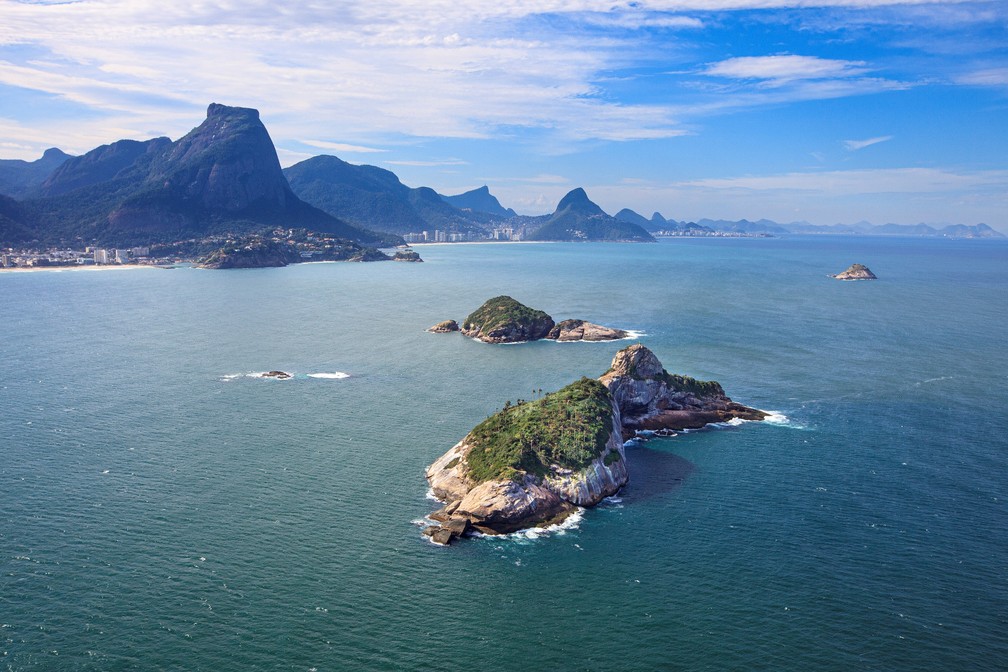
Cagarras Islands, with Ipanema and Copacabana beaches in the background. (Photo internet reproduction)

Green Sea Turtles can sleep for hours under the water, but when they are active it is normal for them to come up to breathe every 5 minutes or so. For this reason, when they are trapped in nets and struggling to free themselves they can die very quickly. Like all sea turtles they always return to the beach they were born on to lay eggs themselves, sometimes traveling hundreds or even thousands of kilometers to do so.

This phenomenon is not clearly understood, but scientists believe they may recognize and remember the chemical or magnetic properties of their home beach and thereby locate it.
The discovery was made as part of the Islands of Rio project carried out by the NGO Instituto Mar Adentro with the help of the WWF.

The Islands of Rio project has been active since 2010 and was set up specifically to monitor and preserve the Cagarras Islands as little was known about the biodiversity of the place at the time. Since then over 600 species of plants and animals have been catalogued, including many that are rare and endemic, as well as others that were believed to be locally extinct.

On one of the islands, a Tupi-Guarani archaeological site was found and work has been carried out to rid the island of invasive species to allow native biodiversity to flourish.

Cagarras Islands are classified as natural monuments with complete protection status. They have also internationally recognized as an important biodiversity hotspot by Mission Blue.

Read More from The Rio Times

The Rio Times · Power Map
See who really holds power in Latin America
Click to open the Power Map

Rotate for Best Experience

This report is optimized for landscape viewing. Rotate your phone for the full experience.