Minister Says Brazil Preserved 84 Percent of the Amazon by its Own Efforts
RIO DE JANEIRO, BRAZIL – Environment Minister Ricardo Salles said on Monday, September 9th, that Brazil has preserved the Amazon through its own efforts. “Brazil is a country that has preserved 84 percent of its Amazon rainforest, and has done so on its own merits, with its own efforts, and continues to preserve and defend the forest.”

“We have several financial mechanisms that have been proposed internationally, including the Paris Agreement, and also the Kyoto Protocol: payment for environmental services, carbon credits, REDD (Reducing Emissions from Deforestation and Forest Degradation), in short, an entire framework of funds that are being proposed around the world to contribute to preservation.”
In a press conference, Salles said that this will be the country’s position in the next UN General Assembly, and also said that the country is open to receiving resources. “Brazil is open to receiving and wants to materialize these services as soon as possible in order to be able to serve the environment, the forest, and preservation”.
The minister addressed the National Environmental Quality Agenda at the Lunch-Debate of the Group of Business Leaders (LIDE) which was attended by CEOs, presidents and other corporate leaders, and other public officials in São Paulo.
It is probably no coincidence that Salles used this occasion for an information campaign. Brazilian business paper Valor Econômico says executives are uncomfortable with the president’s behavior: “Investment committees and boards of directors of large funds are more and more reluctant to allocate funds in Brazil because of what they refer to as ‘civilizational setbacks’. This perception has intensified with the Amazon events and the case of Macron’s wife,” says an executive.
The Minister of the Environment added that the government’s actions against illegal deforestation in the Amazon include the updating of the decree on conversion of fines. “The tasks of fighting crime are carried out mainly by police authorities, by environmental inspection agencies, in the area of administrative penalties. The criminal perception of environmental crimes is carried out through the Judiciary. In addition, we are updating the decree on the enforcement of fines, speeding up the program,” he said.
Decree 9,760 introduces changes in the collection of federal government fines on environmental crimes. The text broadens the scope for converting compensation into environmental recovery actions, for instance. The main change introduced by the decree establishes that the bodies linked to the Ministry of the Environment are required to encourage conciliation in cases of administrative infractions for environmental damage and to follow a process described in the document.
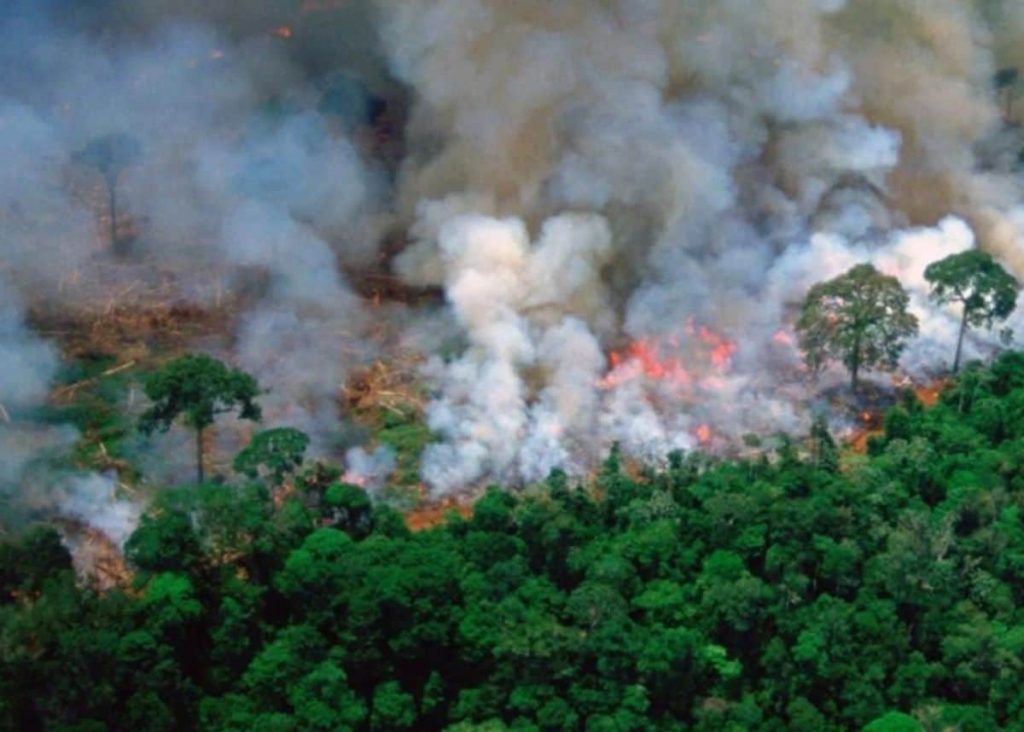
As for international criticism of the increase in forest fires in the Amazon, Salles said that the government has taken all the steps it could take in response to this issue and that the trend is to control it.
“The government has determined an unprecedented operation to ensure the rule of law and environmental order, providing the states with more than 4,000 men, several aircraft, with very significant investments in fighting these fires and also in the fight against illegal deforestation. All the answers available to the federal government have been placed now, in partnership with the state governments, which also play an important role in both issues, both in the control of fires and in the fight against illegal activities. This joint effort, of course, will bring rapid results and we are already feeling many of them in the field”.
During the presentation to businessmen, the minister said that the real problem hindering the sustainable economic development of the Amazon is the lack of regulation of mining activities in the region. Quoting an article in the Wall Street Journal, Salles mentioned that 51 percent of forest fires occur in unclaimed areas, which creates room for legal insecurity and deforestation. ” Land tenure regulation is a precondition for being able to implement liability to take care of what is there,” he said.

Salles also accused previous governments of “inflating the public machine,” affecting two of Brazil’s main environmental institutions, the Brazilian Institute of Environment and Renewable Natural Resources (IBAMA) and the Chico Mendes Institute for Biodiversity Conservation (ICMbio ).
“We had previous governments swelling the public machine, hiring public servants, a series of expenses, without concern for meritocracy and goals,” he said when questioned about ICMBio and IBAMA’s performance under the current government.
The minister again criticized previous governments to defend the use of a sustainable economy to help Brazilians who live in the region. “And what has been done in recent years? Almost nothing. It was year in, year out, and the worst Human Development Index is in the Amazon. Something needs to be changed to include this population, which cannot be left behind,” he said.
More: Brazil news in English, every day from The Rio Times.
This article was produced by The Rio Times’ automated newsroom system. How we use AI · Report an error · Editorial responsibility: Matthias Camenzind, Editor-in-Chief