Latin America’s healthcare workforce will be affected by aging
By Sebastián Osorio Idárraga
According to a recent publication by the Economic Commission for Latin America and the Caribbean (ECLAC), population aging was characterized as one of Latin America’s main demographic challenges for this century.
And a new study by the Inter-American Development Bank (IDB) points out that this is also a phenomenon that is occurring in the region’s healthcare personnel, for which Covid-19 made visible the limitations in some disciplines such as intensive care, pulmonologists, anesthesiologists, and cardiologists.

“It is challenging for the region to have 2.6 million health professionals by 2030.”
“On average, Latin America and the Caribbean have 23 physicians and 33 nurses per 100,000 inhabitants, a figure that exceeds the criterion recommended by the World Health Organization (WHO), which establishes that countries should have 44.5 health resources per 100,000 inhabitants to provide essential services.”
“However, it is important to mention that this criterion is a minimum threshold,” notes the IDB in its publication ‘Towards the Future of the Health Workforce: Trends and Challenges for the Time Ahead’.
The document points out that the disparity between countries is visible, as some nations have from 2 to 84 physicians per 100,000 inhabitants.
Haiti, Honduras, Jamaica, Nicaragua, and Bolivia are the countries with the fewest physicians and nurses.
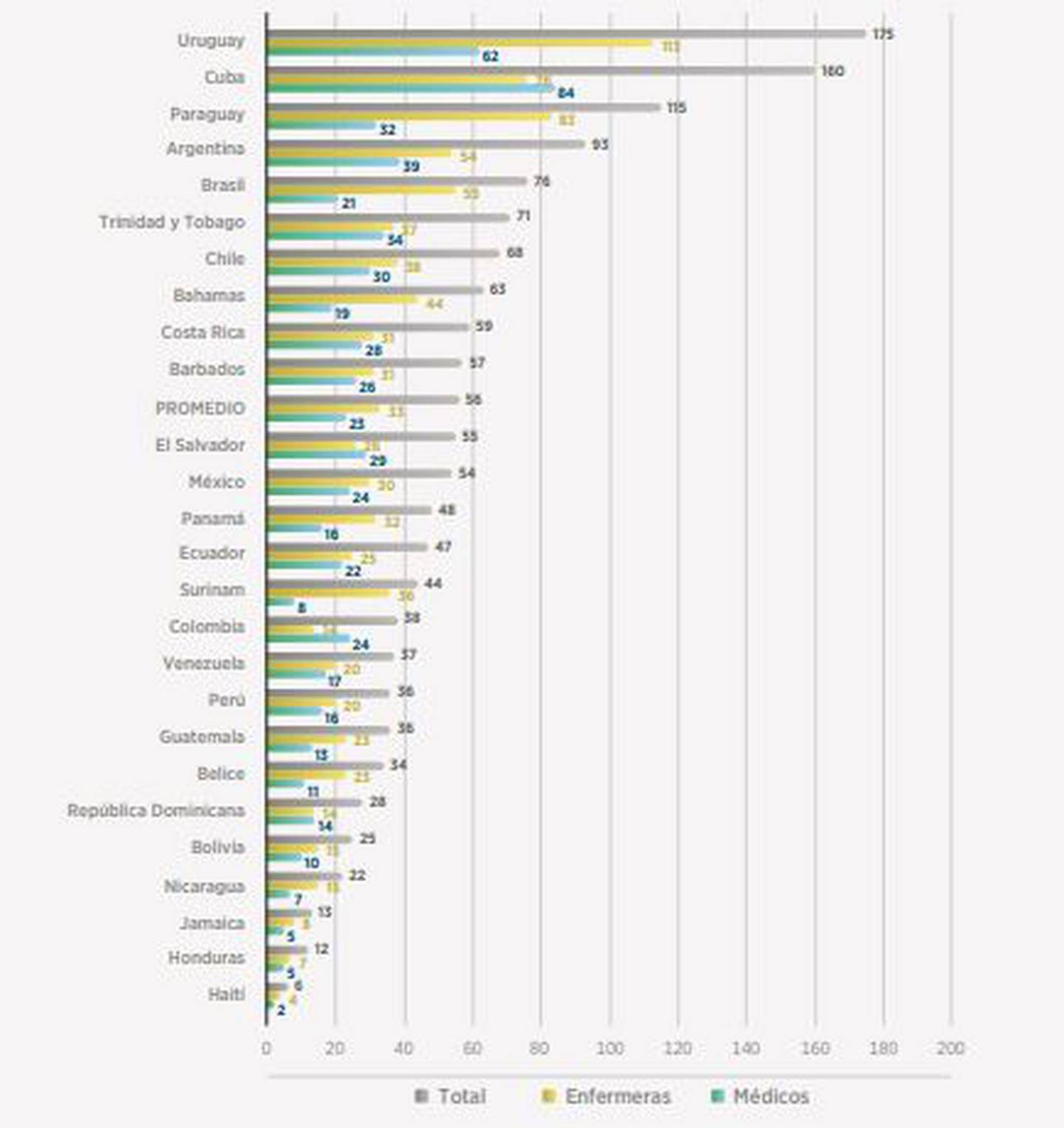
“Analysis of the distribution of health personnel in Colombia, Costa Rica, Jamaica, Panama, Peru, and Uruguay indicates the imbalance of health personnel.”
“Rural communities have limited access to services. In these countries, except for Jamaica, programs have been established to promote health personnel working in remote areas, including training personnel in intercultural competencies.”
“Costa Rica and Uruguay recruit at least 30% of health personnel to work in their communities,” the report notes.
LATAM’S ACTIVE HEALTH WORKFORCE IS AGING AND SHRINKING
The IDB points out that those doctors and nurses who are part of the baby boomer generation (1946-1964) are already reaching or are about to reach retirement age, according to the laws of each country, so the active population is shrinking.
Proof of this is that by 2020, the average age of nurses in Latin America and the Caribbean was over 40 years old, and more than 30% were over 50 years old.
As for physicians, the average age was 45, and 25% were over 65.
For example, in Argentina, Brazil, Chile, Dominican Republic, Guatemala, Mexico, and Uruguay, more than 25% of physicians are 55 or older, and 17% are over 65.
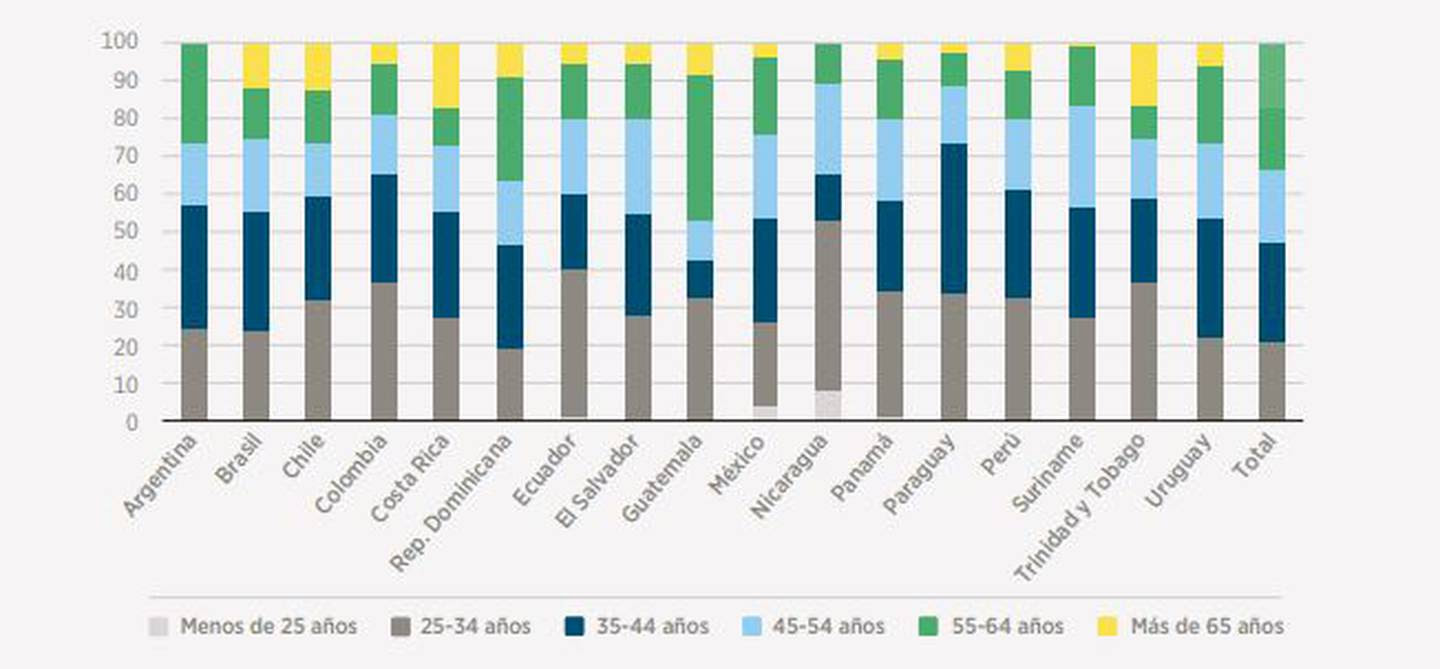
According to the researchers, this points to the need to develop actions for the replacement of health personnel, taking into account that the training of a physician “requires six years and those who access postgraduate courses need several more years before formally joining the workforce”.
It is also pointed out that there is a notorious trend among health personnel in the region: to lengthen their year of retirement.
In 1980, people worked an average of 36 years; by 2050, it is estimated that they will work for 42 years.
WOMEN ARE AN ESSENTIAL PART OF THE HEALTH WORKFORCE
In the region, the IDB found that women represent approximately 72.8% of the total health workforce, 57% of physicians, and 87% of nurses.
“Their presence is particularly predominant in different medical specialties, such as endocrinology, gynecology, and obstetrics.”
“However, women still face excessive rigidity of work schedules to maintain work-life balance, since, in addition to their employment, they take on family roles,” the report says.
And just as in other labor sectors, women in healthcare also face disparities in monetary income, which is between 25% and 28% lower than that received by men for performing the same functions.
With information from Bloomberg
News Latin America, English news Latin America, Latin America’s healthcare
More: Latin America news in English, every day from The Rio Times.
Editorial responsibility: Matthias Camenzind, Editor-in-Chief · Editorial standards · Report an error