Key Facts
- —What happened Global oil supply is forecast to fall 4.3 million barrels a day in 2026, pushing Brent near $94.
- —How big a jump The IEA now projects a 1.8 million barrel-a-day deficit for the third quarter, more than double its prior estimate.
- —The real story Oil’s supply shock is also an inflation shock, with US 10-year yields climbing 1.2% to 4.706% and Wall Street sliding.
- —The catch Foreign investors pulled R$20.4 billion (US$3.9 billion) from Brazil’s B3 in August; Vale and Petrobras steadied the Ibovespa.
- —Where it touches Petrobras and Ecopetrol benefit; Mexico’s peso flat, Argentina’s peso pinned at 1,497 (US$…).
- —What comes next Latin America’s fate hinges on the US S&P Global Composite PMI at 13:45, absorbing or joining the oil shock.
Today’s Focus
The story this morning is oil. In its 12 August report the IEA set out stark numbers, and Thursday added fresh US–Iran escalation on top. Global supply is now forecast to fall by 4.3 million barrels a day in 2026, while demand drops by 1.6 million — leaving a deficit of 1.8 million barrels a day in the third quarter.
That is a dramatic re-rating from a month ago, and Brent crude near $94 a barrel is now feeding inflation anxiety. Wall Street felt it first, with the Dow sliding 1.32% and the VIX volatility gauge jumping 7.52%.
For Latin America, this is a double-edged sword. Oil exporters like Brazil’s Petrobras and Colombia’s Ecopetrol should benefit, but the wider region imports inflation and faces a tougher rates backdrop.
Mexico’s retail sales data lands at midday, and US PMI prints an hour later — both will shape whether this becomes a full risk-off day or a selective rotation into energy names.
What matters today. Whether the oil supply shock keeps forcing western equities lower, or whether Latin America’s commodity weight lets it absorb the hit.

| Instrument | Level | Session |
|---|---|---|
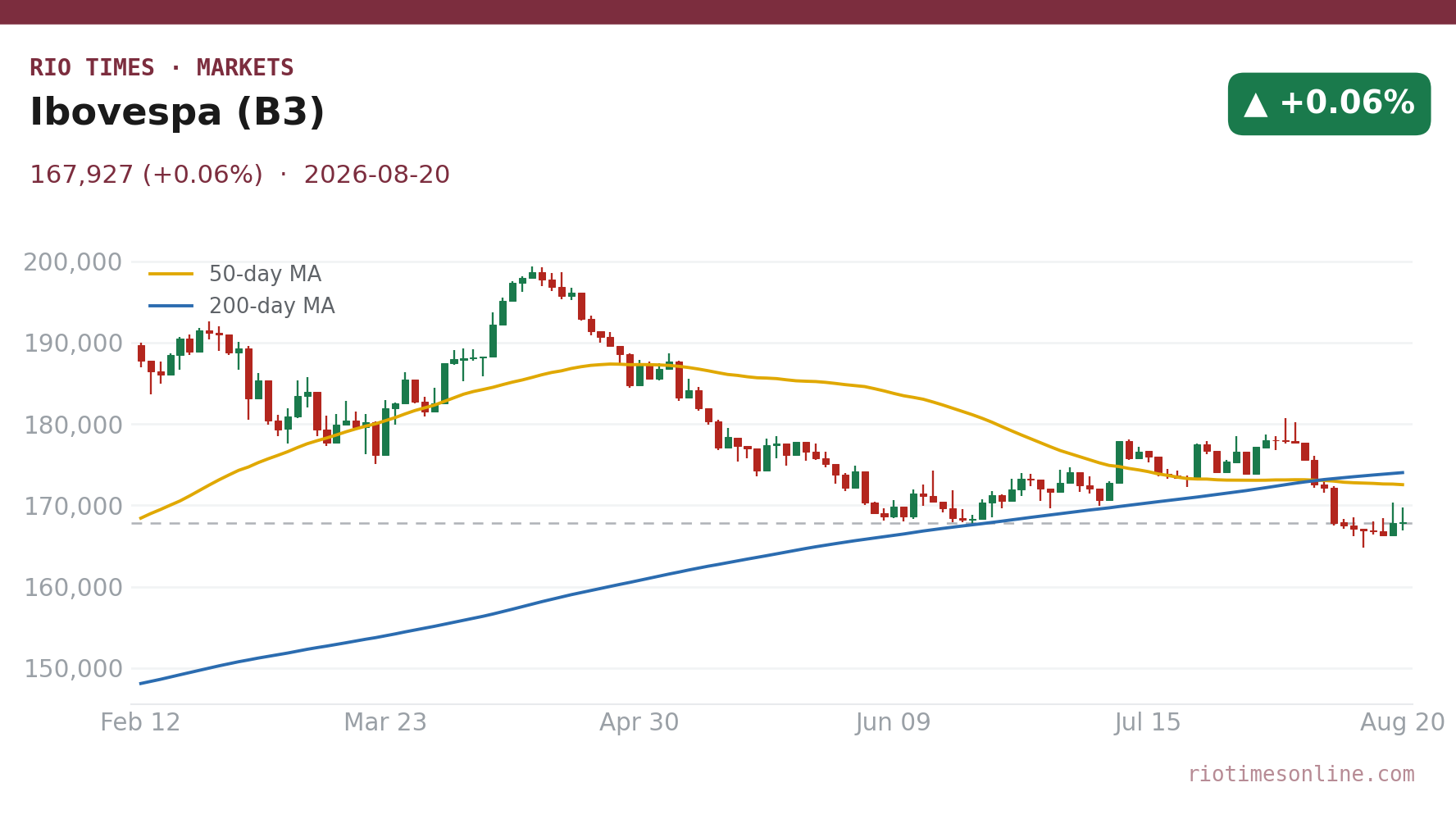
| Ibovespa (Brazil) | 167,927 | +0.06% |
| S&P 500 (US) | 7,641 | -0.87% |
| USD/BRL | 5.1979 | +0.43% |
| USD/MXN | 16.9556 | +0.07% |
| USD/CLP | 922.1 | +0.08% |
| USD/COP | 3,051 | -1.76% |
| USD/ARS | 1,497 | +0.00% |
Source: market close, 20 August 2026.
01 The overnight tape in one read
Wall Street took the inflation scare hardest. The Dow fell 1.32%, the S&P 500 dropped 0.87%, and the Nasdaq lost 1.00%, while the VIX — the market’s fear gauge — jumped 7.52% to 16.01.
The trigger is oil. The IEA’s August report shows the global oil balance swinging to a 1.8 million barrel-a-day deficit in the third quarter, more than double its prior estimate, and supply falling 4.3 million barrels a day for 2026.
Asian markets were mixed on the same theme, with Japan’s Nikkei rising 0.74% while European bourses slipped on the prior session — Spain’s IBEX down 0.87% and France’s CAC 40 off 0.66%.
Gold held firm at $4,527 an ounce, up 0.32%, and silver jumped 1.85% to $68.21 — a classic stress signal.
The region enters Friday with a genuine split — Brazil and Mexico held firm while the US wobbled, thanks to their commodity exposure and year-to-date currency resilience. But oil’s deficit shock is also an inflation shock, and US 10-year yields rising 1.2% to 4.706% is the awkward backdrop.
The variable to watch is the US S&P Global Composite PMI at 13:45 — a stronger print could cement the rate-fear story and drag the whole region into the US downdraft.
02 The board before the open
| Instrument | Level | Change | Read |
|---|---|---|---|
| Brent crude | $93.98 | +2.58% | Supply-deficit premium intact |
| Gold | $4,527/oz | +0.32% | Safe-haven bid, silver leading |
| US 10Y yield | 4.706% | +1.20% | Inflation fear rising in bonds |
| Dollar index (DXY) | 98.732 | -0.10% | Dollar soft, helps LatAm FX |
| VIX | 16.01 | +7.52% | Anxiety building, not yet panic |
The board tells a story of rotating stress rather than outright panic. Oil and gold are bid, yields are climbing, but the dollar is actually softening — which is what kept Latin American currencies resilient.
The VIX at 16.01 is elevated but hardly distressed, suggesting this is a positioning squeeze rather than a stampede. That gives LatAm room to trade on its own fundamentals early. Rio Times · Live Market Intelligence
Live Market IntelligenceLatin America — Cross-Market Board
Latin America — Cross-Market Board
Instrument Last Change YoY Prev. High Low Volume
IBOV
208,865.27
+8.72%
+21.85%
192,114.55
168,310
167,142
—
IPSA
11,072.62
+1.43%
—
10,916.57
11,210
10,984
1,513,213,483
IPC MEX
64,531.68
+1.10%
+12.17%
63,828.60
66,121
65,405
108,886,187
MERVAL
2,882,805
+4.16%
+30.51%
3,022,485
3,042,365
2,991,150
—
COLCAP
2,576.14
+2.43%
—
9.04
9.05
9.02
4,133
BVL PERÚ
59,860.04
+0.55%
—
—
—
—
—
USD/BRL
5.16
+0.01%
-5.13%
5.16
5.18
5.14
—
EUR/BRL
5.95
+1.01%
-5.83%
5.89
5.98
5.94
—
USD/MXN
17.06
-0.24%
-8.58%
17.10
17.08
17.01
—
USD/CLP
913.98
+0.04%
-5.67%
913.65
915.11
906.68
—
USD/COP
3,140
+0.03%
-22.04%
3,139
3,141
3,105
—
USD/PEN
3.36
-0.66%
-4.82%
3.38
3.38
3.35
—
USD/ARS
1,493
+0.10%
+12.96%
1,491
1,494
1,480
—
USD/UYU
40.27
+1.24%
+1.80%
39.77
40.27
40.23
—
USD/PYG
5,939
+1.68%
-19.54%
5,841
5,939
5,925
—
USD/BOB
11.64
-0.76%
+72.04%
11.73
11.72
11.64
—
USD/DOP
58.34
+1.25%
-3.44%
57.62
58.34
58.04
—
USD/CRC
445.92
+0.89%
-9.71%
441.97
448.50
445.92
—
03 What the data shows — Brazil’s energy names top the turnover table
| Stock | Move | Turnover | Note |
|---|---|---|---|
| PETR4 | +2.72% | R$1,986m | Petrobras preferred, oil tailwind |
| VALE3 | +2.27% | R$1,847m | Iron ore giant, second-biggest turnover |
| BBAS3 | — | R$1,476m | Banco do Brasil, defensive bid |
| ITUB4 | — | R$1,029m | Itaú preferred, rates-watch |
| BOVA11 | — | R$897m | Ibovespa ETF, broad market proxy |
The turnover leaders show exactly what the market is buying — Petrobras and Vale, Brazil’s two great commodity exporters, soaked up nearly R$4 billion combined. PETR4’s 2.72% gain and VALE3’s 2.27% rise are the clearest read-through from oil’s supply shock.
Beyond the blue chips, the real action was in the smaller names — ETHE11 up 10.0% and CASH3 up 7.4% — while meatpacker BEEF3 gained 7.0% on R$110 million. The losers were all domestic-story stocks: INTB3 fell 9.5%, VAMO3 dropped 8.5%.
04 Brazil and the currencies
The real gave back 0.43% to 5.1979 per dollar, but it remains around 7% off its 52-week low and is still up 5.7% year-to-date. The Selic, Brazil’s benchmark rate, is now the market’s focal point — higher oil means higher imported inflation, and that complicates the central bank’s easing path.
Foreign flows have been the quiet story, and they run the other way: investors pulled R$20.4 billion (about US$3.9 billion) from the B3 in August, so the Ibovespa’s two-day steadying was carried by Vale and Petrobras rather than by inflows.
The Colombian peso’s 1.76% gain to 3,051 is the outlier and the signal — oil exporters’ currencies are finally getting some love. Mexico’s peso was flat at 16.9556, and that stability is notable given the US tape.
Argentina’s peso is pinned at 1,497 to the dollar with zero daily change, the managed-float system doing exactly what it is designed to do — delivering grim predictability.
05 The regional setup
| Index | Country | Change |
|---|---|---|
| IPC (Mexbol) | Mexico | +0.68% |
| BVL Perú | Peru | +0.54% |
| Ibovespa | Brazil | +0.06% |
| Merval | Argentina | +0.05% |
| IPSA | Chile | -0.03% |
| COLCAP | Colombia | -0.39% |
Mexico’s IPC, the country’s main stock index, was the regional leader, up 0.68% and still 10% below its 52-week high. Peru’s BVL rose 0.54%, carrying momentum from its own commodity complex.
Colombia’s COLCAP fell 0.39% despite the peso strength — the index is 2,444, and its oil-exposed names are not keeping up with the peso’s move. Chile’s IPSA was effectively flat, down just 0.03%.
06 The technical picture
The Ibovespa is at 167,927, still 15.5% below its 52-week high of 198,657 — a deep drawdown but one that has held a floor around 134,432. Its two-day rise against a falling S&P is a genuine divergence, and that matters technically because it suggests local buyers are defending the level.
Mexico’s IPC at 64,436 is 10% below its 52-week high of 71,601, while the S&P 500 itself is only 2% off its own record. Emerging markets are still lagging developed ones, but the region’s commodity-heavy indices are catch-up candidates.
The real at 5.1979 has held below 5.20 despite the oil-driven inflation scare, and that is a quiet positive. If it breaks back toward 5.25, expect foreign outflows to accelerate; if it holds, the carry trade case remains intact.
07 What to watch
- US PMI print, 10:45 BRT: A stronger-than-expected composite PMI could cement the rate-fear story and drag LatAm into the US downdraft.
- Mexico retail sales, 09:00 BRT: Consensus sees 3.1% growth — a miss would hit the peso and the IPC’s recent leadership.
- Argentina retail sales, 16:00 BRT: Previous reading was 33.1% — any sharp drop would reignite inflation-policy nerves.
- US oil rig count, 14:00 BRT: A rising rig count could signal future supply relief and soften the crude price premium.
Frequently Asked Questions
Why is oil driving LatAm today?
The IEA now sees a 1.8 million barrel-a-day deficit in Q3 2026, pushing Brent near $94 and forcing western markets to reprice inflation risk.
Which LatAm markets benefit from high oil?
Oil exporters like Brazil and Colombia benefit via producers such as Petrobras and Ecopetrol, and their currencies gain.
Is Brazil decoupling from Wall Street?
Yes, the Ibovespa has posted two straight up days while the S&P 500 fell — a rare and meaningful divergence.
What about Argentina?
The Merval was effectively flat, and the peso is pinned at 1,497 to the dollar under the managed-float regime.
This article was produced by The Rio Times’ automated newsroom system. How we use AI · Report an error · Editorial responsibility: Matthias Camenzind, Editor-in-Chief
LatAm Markets: Live Signals → — real-time movers, turnover leaders and FX across Latin America.