Key Facts
- —What happened Gold surged 4.13% to $4,512 an ounce and the dollar index fell 0.83%, lifting most Latin American currencies.
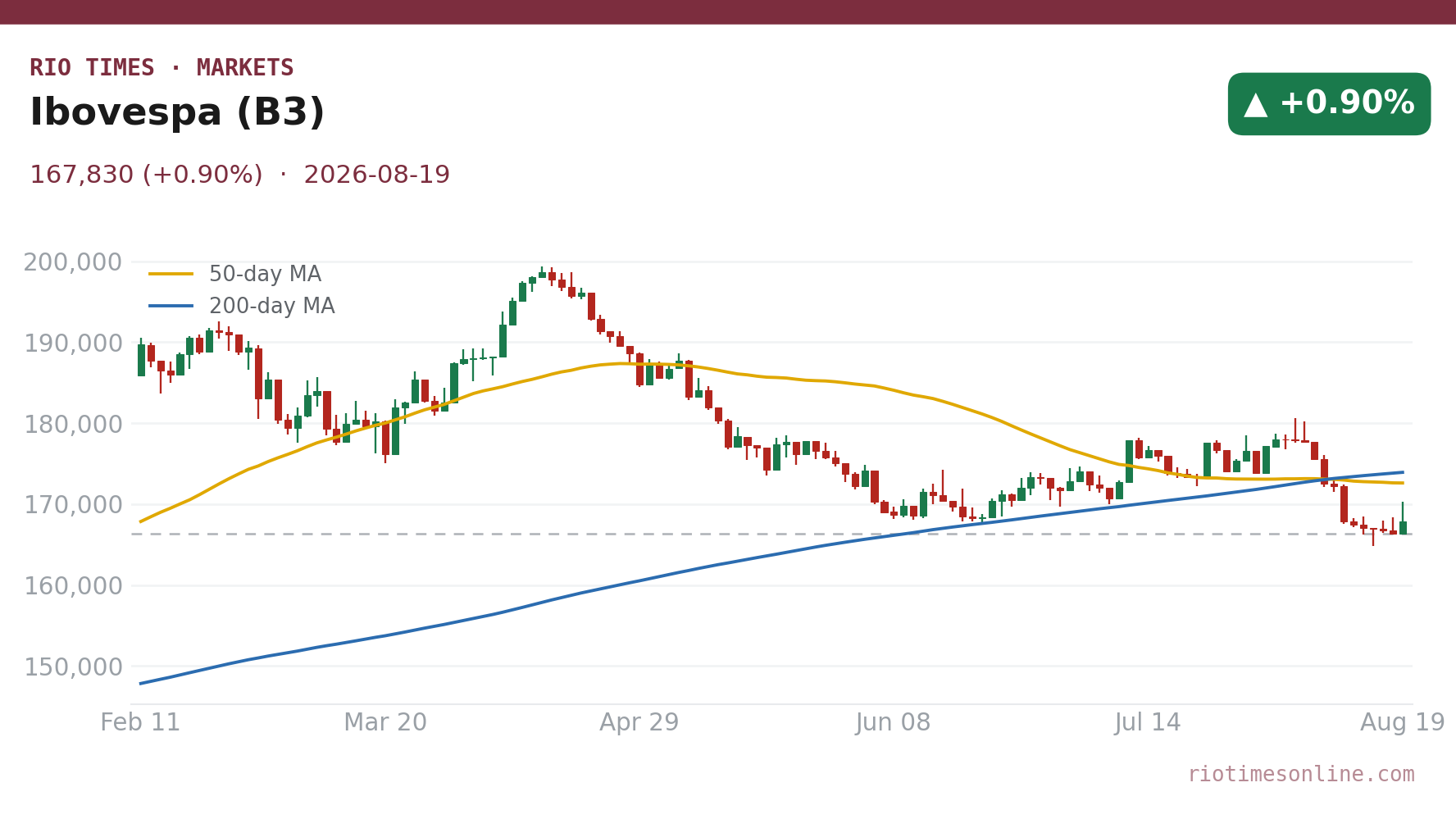
- —How big a jump Brazil’s real strengthened 0.82% to 5.1757 per dollar, while the Ibovespa rose 0.90% to 167,830.
- —The catch The rally was driven by a US Treasury bond buyback pledge, not a dovish Fed shift.
- —Who it touches Argentina’s Merval slipped 0.59% and Colombia’s COLCAP fell 0.30%, bucking the regional trend.
- —What comes next Argentina releases trade and activity data today, and Mexico’s central bank publishes policy minutes that could move the peso.
Today’s Focus
The overnight tape has a clear message for Latin America: yields fell, the dollar fell with them, and everything priced in dollars rose. Gold’s surge above $4,500 an ounce and silver’s even sharper jump are part of that, but so is bitcoin’s 6% rise and ether’s 17.5% — not the profile of a flight to safety. Gold and silver suggest investors are hedging against something — inflation, geopolitics, or late-cycle jitters — while the dollar index’s slide of nearly 1% tells you capital is leaving US assets.
That is a gift for Latin American currencies. Brazil’s real, Mexico’s peso, Chile’s peso and Colombia’s peso all strengthened against the dollar in the last session, which lowers the cost of dollar-denominated debt and often pulls foreign investors toward higher-yielding local markets. The Ibovespa, Brazil’s main stock index, rose 0.90% to 167,830, outperforming the S&P 500’s modest 0.21% gain.
But not every board in the region is cheering. Argentina’s Merval index slipped 0.59% and Colombia’s COLCAP fell 0.30%, reminders that domestic stories still matter. Argentina’s July trade figures and June activity index are due later today, and Mexico’s central bank publishes policy minutes that could sway the peso.
For traders positioning before the bell in São Paulo, Mexico City, Santiago, Buenos Aires and Bogotá, the question is whether the global gold-and-soft-dollar trade can overpower local political and economic noise. Early signs say yes, but Argentina and Colombia may lag.
What matters today. A softer dollar and a gold surge are boosting most of Latin America, but Argentina and Colombia look set to resist the regional rally.
| Instrument | Level | Session |
|---|---|---|
| Ibovespa (Brazil) | 167,830 | +0.90% |
| S&P 500 (US) | 7,708 | +0.21% |
| USD/BRL | 5.1757 | -0.82% |
| USD/MXN | 16.9444 | -0.71% |
| USD/CLP | 921.38 | -0.66% |
| USD/COP | 3,106 | -0.86% |
| USD/ARS | 1,497 | +0.15% |
Latin American markets — Source: RT close, 2026-08-19. Figures rendered directly from the feed.
01 The overnight tape in one read
The big story overnight is the hard-asset breakout. Gold closed at $4,512 an ounce, up 4.13%, and silver followed with a 6.39% gain to $66.97. This is not a subtle nudge — it is a stampede into metals.
The dollar index fell 0.83% to 98.833, which is a significant one-session move. The usual explanation — a dovish shift in US rate expectations — does not fit here. The Federal Reserve’s July minutes, published at two o’clock on Wednesday afternoon, showed three officials voting for a rate rise and many more saying tightening would probably be needed if inflation did not fall. What moved the dollar was the Treasury’s pledge to double its long-dated bond buybacks from September, which pulled yields down and took the dollar with them.
US equity futures are pointing to a slightly positive open after a subdued prior session. The VIX, Wall Street’s fear gauge, dropped 6% to 14.89, showing that options traders are not bracing for immediate turbulence.
Japanese inflation and the euro-zone and UK flash PMIs are Friday, not today; the European diary today is the ECB’s account of its last Governing Council meeting. For Latin America, the global backdrop looks supportive, but domestic calendars will shape the afternoon.
The evidence is mostly bullish for Latin America at the open. Gold’s powerful rally, the dollar’s retreat, and strengthening currencies from Brazil to Colombia create a favourable backdrop for equities and local-currency assets. Brazil’s real at 5.1757 per dollar is near its stronger end of the 52-week range, which historically supports foreign inflows into B3-listed companies. However, the Merval’s decline in Argentina and COLCAP’s slip in Colombia show domestic political and fiscal concerns can still trump the global trend. The variable to watch is Mexico’s central bank minutes and Argentine data later today; either could redirect the peso or the peso-denominated board quickly.
02 The board before the open
| Instrument | Level | Change | Read |
|---|---|---|---|
| Gold | $4,512/oz | +4.13% | Hard-asset surge overnight |
| Silver | $66.97/oz | +6.39% | Tracking gold with leverage |
| DXY | 98.833 | −0.81% | Broad dollar retreat |
| VIX | 14.89 | −6.00% | Calm options market |
| US 10Y | 4.65% | −1.27% | Yields eased, supporting gold |
The board shows a classic risk-on rotation with a metallic twist. Gold and silver are the clear leaders, while the dollar and Treasury yields both fell, which is normally a powerful combination for emerging markets.
The VIX at 14.89 after a 6% drop suggests the S&P 500’s modest gain was not a fluke but part of a wider stabilisation. For Latin American traders, the key line is the dollar index: a sub-99 DXY opens the door for carry trades into high-yield local currencies. Rio Times · Live Market Intelligence
Live Market IntelligenceLatin America — Cross-Market Board
Latin America — Cross-Market Board
Instrument Last Change YoY Prev. High Low Volume
IBOV
192,114.55
+2.63%
+21.85%
187,197.46
168,310
167,142
—
IPSA
10,916.57
+0.08%
—
10,908.18
11,210
10,984
1,513,213,483
IPC MEX
64,531.68
+1.10%
+12.17%
63,828.60
66,121
65,405
108,886,187
MERVAL
2,767,663
+0.32%
+30.51%
3,022,485
3,042,365
2,991,150
—
COLCAP
2,515.02
-0.59%
—
9.04
9.05
9.02
4,133
BVL PERÚ
59,751.67
+0.18%
—
—
—
—
—
USD/BRL
5.16
+0.01%
-5.13%
5.16
5.18
5.14
—
EUR/BRL
5.95
+1.01%
-5.83%
5.89
5.98
5.94
—
USD/MXN
17.06
-0.24%
-8.58%
17.10
17.08
17.01
—
USD/CLP
913.98
+0.04%
-5.67%
913.65
915.11
906.68
—
USD/COP
3,140
+0.03%
-22.04%
3,139
3,141
3,105
—
USD/PEN
3.36
-0.66%
-4.82%
3.38
3.38
3.35
—
USD/ARS
1,493
+0.10%
+12.96%
1,491
1,494
1,480
—
USD/UYU
40.27
+1.24%
+1.80%
39.77
40.27
40.23
—
USD/PYG
5,939
+1.68%
-19.54%
5,841
5,939
5,925
—
USD/BOB
11.64
-0.76%
+72.04%
11.73
11.72
11.64
—
USD/DOP
58.34
+1.25%
-3.44%
57.62
58.34
58.04
—
USD/CRC
445.92
+0.89%
-9.71%
441.97
448.50
445.92
—
03 What the data shows — B3 turnover concentrates in commodities and banks
| Stock | Move | Turnover | Note |
|---|---|---|---|
| ONCO3 | +14.5% | R$86m (about US$17 million) | Biggest gainer on Brazil’s B3 exchange |
| CSAN3 | +8.3% | R$171m (about US$33 million) | Energy and logistics firm surging |
| MBRF3 | +7.6% | R$130m (about US$25 million) | Food processor among top movers |
| GGBR4 | −5.2% | R$628m (about US$121 million) | Steelmaker leading the losers |
| MGLU3 | −5.4% | R$104m (about US$20 million) | Retailer sliding despite soft dollar |
Brazil’s most-traded list shows the industrial and commodity heartbeat of the B3. ONCO3, a healthcare stock, jumped 14.5% on relatively thin turnover of R$86 million (about US$17 million), while CSAN3, the energy and logistics company, rose 8.3% on R$171 million (about US$33 million) in volume.
The losers tell the other side of the story. GGBR4, the steelmaker Gerdau’s preferred shares, fell 5.2% with heavy turnover of R$628 million (about US$121 million), and retailer MGLU3 dropped 5.4%. The money flocked to Petrobras (PETR4) with R$2.1 billion (about US$404 million) traded, followed by bank Itaú (ITUB4) at R$1.36 billion (about US$262 million) and miner Vale (VALE3) at R$1.34 billion (about US$258 million).
04 Brazil and the currencies
Brazil’s real strengthened to 5.1757 per dollar, a drop of 0.82% in the dollar-real pair. That is meaningful: the pair is now far below 5.5901, the weakest the real has been in a year, and back toward its stronger levels, which usually helps the central bank’s credibility and lowers imported inflation.
The Selic, Brazil’s benchmark interest rate, remains one of the highest real rates in the world, and a softer dollar makes that carry trade even more attractive. Foreign flows into B3 have been sensitive to the real’s direction, so today’s open may see continued appetite for Brazilian assets.
Mexico’s peso at 16.9444 per dollar and Chile’s peso at 921.38 are both firmer, while Colombia’s peso at 3,106 is also stronger. Only Argentina’s peso bucked the trend, slipping slightly to 1,497 per dollar, a reminder of the country’s very different monetary regime and inflation dynamics.
Across the region, the currency rally is the clearest transmission channel from the overnight gold and dollar moves. A stronger local currency flatters equity returns for foreign investors and should support consumer and retail sectors that rely on imported goods.
05 The regional setup
| Index | Country | Change |
|---|---|---|
| Ibovespa | Brazil | +0.90% |
| IPC | Mexico | +0.41% |
| IPSA | Chile | +0.49% |
| Merval | Argentina | −0.59% |
| COLCAP | Colombia | −0.30% |
| BVL Perú | Peru | +1.33% |
The regional board is a tale of two moods. Brazil, Mexico, Chile and Peru all closed higher, with Peru’s BVL the standout at a 1.33% gain. The Ibovespa’s 0.90% rise kept it about 15.8% below its 52-week high, a level that leaves room for catch-up.
Argentina and Colombia are the laggards. The Merval slipped 0.59% and COLCAP fell 0.30%, suggesting local fiscal or political concerns are outweighing the global risk-on backdrop. Argentina’s July trade figures and June activity index, due later today, will be the next test for that board.
06 The technical picture
The Ibovespa is at 167,830, roughly 15.8% below its 52-week high of 199,355. That leaves a wide gap to reclaim, but the one-day move of 0.90% was the strongest among the region’s large boards.
Mexico’s IPC at 64,194 is about 10.3% below its 52-week high and building slowly. The real technical tension is in Argentina, where a weakening peso and a falling Merval often feed each other in a cycle that is hard to break without a policy anchor.
For now, the soft dollar gives Latin American central banks breathing room. If the DXY stays below 99, expect carry traders to keep leaning into Brazil, Mexico and Chile, while waiting for evidence that Argentina and Colombia can join the rally.
07 What to watch
- Mexico central bank minutes at 09:00 Mexico City (15:00 GMT): Banxico has held at 6.50% since the easing cycle ended; the tone of the minutes matters more than any hint of a cut
- Argentina trade and activity data at 16:00 Buenos Aires (19:00 GMT): The Merval is lagging; stronger consumption or exports could reverse that
- US Philadelphia Fed and jobless claims at 08:30 ET (12:30 GMT): A weak manufacturing print could deepen the soft-dollar trade
- Brazil’s National Monetary Council meeting at 12:00: The CMN sets the inflation target and credit rules — the Selic is Copom’s, and it next meets on 15 and 16 September
Frequently Asked Questions
Why is gold surging so sharply?
Gold jumped over 4% in the last session, likely on a mix of falling US yields and a weaker dollar, which makes the metal cheaper for holders of other currencies and more attractive as a hedge.
What does a soft dollar mean for Latin America?
A falling dollar index usually strengthens Latin American currencies like the real and the peso, lowers local import costs, and can attract foreign investors hunting higher yields.
Which Latin American markets are leading the rally?
Peru’s BVL gained the most at 1.33%, followed by Brazil’s Ibovespa with 0.90%, while Mexico and Chile posted modest gains. Argentina and Colombia lagged.
Why did Argentina’s Merval fall?
Argentina’s index slipped 0.59% amid a slightly weaker peso and domestic uncertainty. Trade and retail data due shortly may set the near-term direction.
This article was produced by The Rio Times’ automated newsroom system. How we use AI · Report an error · Editorial responsibility: Matthias Camenzind, Editor-in-Chief
LatAm Markets: Live Signals → — real-time movers, turnover leaders and FX across Latin America.