Kenya Remittances From US Fall 12.4% Through August

ECONOMY · KENYA
Key Facts
- —The country Kenya receives about US$5 billion a year from citizens working abroad, central bank data show. Nearly half of it comes from the United States.
- —Why it matters Remittances are one of Kenya’s main sources of US dollars. The central bank governor says diversified inflows keep the shilling stable.
- —Why now The Central Bank of Kenya flagged the decline in its rate decision on Wednesday 7 October, and the governor explained it on Thursday 8 October.
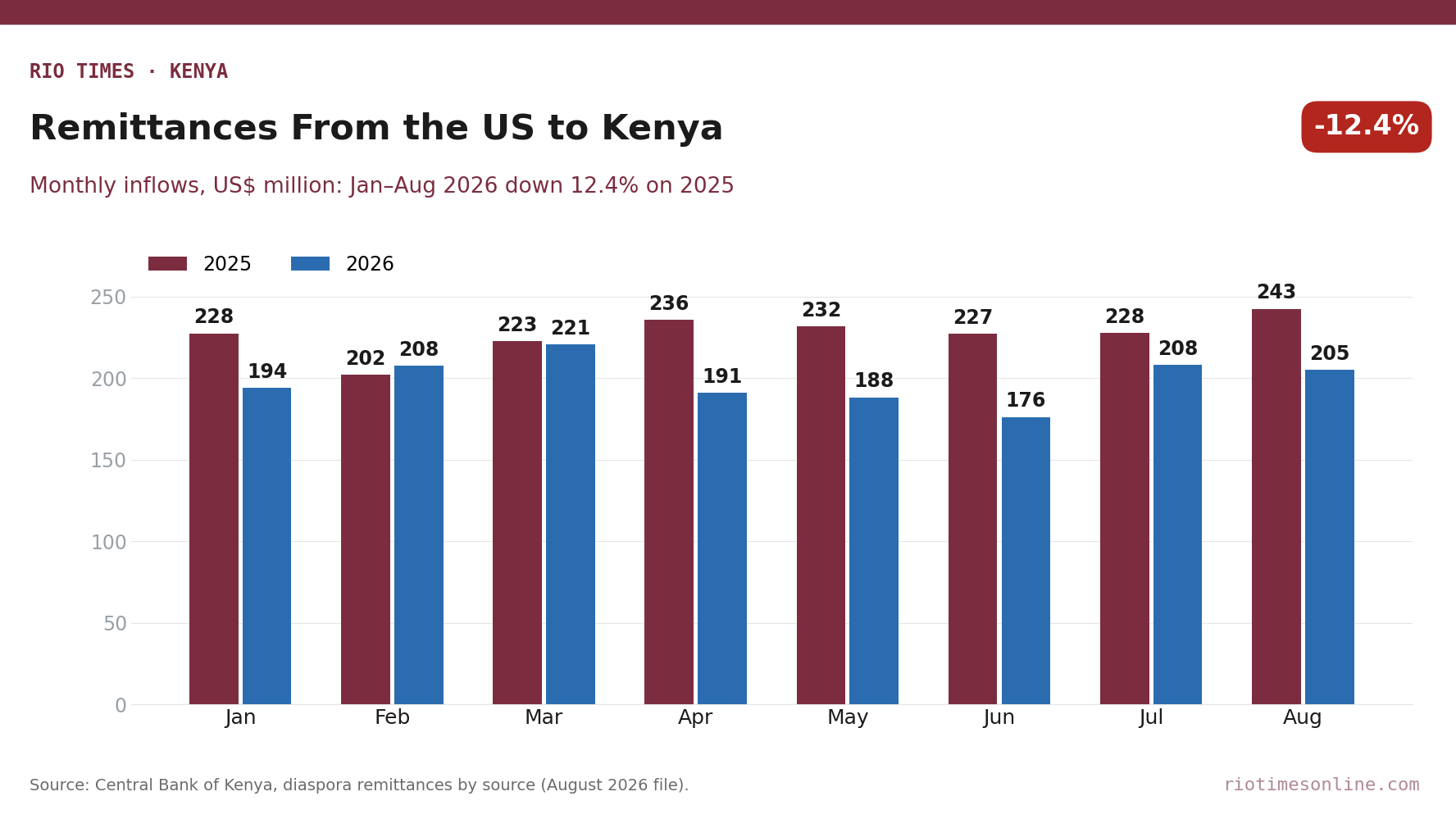
- —What happened Diaspora remittances fell 1.3% to US$5.01 billion in the 12 months to August 2026. Money from the US dropped 12.4% from January to August.
- —The numbers US inflows: US$1.59 billion against US$1.82 billion a year earlier. Saudi Arabia: down 53%. Europe: up 16.5%. August total: up 6.0%.
- —What it means for US readers Kenyans in America sent 12.4% less home in the first eight months of 2026, in Kenya’s largest remittance corridor.
- —Still open Why US flows fell. The central bank has not given a breakdown of causes, and whether the July and August pickup lasts is unclear.
Kenya diaspora remittances fell 1.3% in the 12 months to August 2026, the Central Bank of Kenya (CBK) said on Wednesday 7 October. The main reason is less money from Kenyans in the United States and Saudi Arabia. For American readers, the drop shows up first in the largest corridor: the US accounts for almost half of the money Kenyans abroad send home.
The CBK is Kenya’s central bank. It sets the benchmark Central Bank Rate and publishes remittance data every month, broken down by country of origin.
The figure appeared in the press release of its Monetary Policy Committee (MPC), the panel that held the rate at 8.75% on Wednesday. Governor Kamau Thugge, who chairs the committee, added detail at a briefing on Thursday 8 October, as reported by the Nairobi news site Kenyans.co.ke.
What the Central Bank Data Shows
The CBK’s monthly file of Kenya diaspora remittances by source puts total inflows at US$5.01 billion in the 12 months to August 2026. That compares with US$5.08 billion a year earlier, a fall of 1.3%.
From January to August 2026, Kenya received US$3.33 billion, down 0.7% on the same months of 2025. Thugge said remittances had started to recover in the last two months, and the data bear that out.
July inflows rose 6.5% on a year earlier, to US$437 million. August rose 6.0%, to US$452 million, the highest monthly total in the file this year.
The weakness sits in two places. Money from the United States fell to US$1.59 billion in the first eight months, from US$1.82 billion. That is a drop of 12.4%, or about US$226 million.
Saudi Arabia, long a major source because of the Kenyans who work there, fell further in percentage terms. Inflows from the kingdom halved to US$110 million, from US$234 million, a decline of 53%. The slide began in August 2025, when monthly Saudi flows fell from about US$28 million to about US$16 million.
Where the Money Is Still Growing
Other corridors have almost filled the gap. Inflows from Europe rose 16.5% to US$692 million between January and August. The United Kingdom alone sent US$270 million, up 18.6%.
The United Arab Emirates sent US$132 million, up 53%, partly offsetting the Saudi decline within the Gulf. Money from elsewhere in Africa rose 44% to US$286 million. Australia rose 25.5%.
The result is a total that has barely moved, even as its make-up shifts. The US share of inflows was 47.8% in the first eight months of 2026, based on CBK data.
The central bank says the wider picture remains stable. Its foreign exchange reserves stand at US$14.70 billion, or 5.9 months of import cover. The CBK’s official rate on Thursday 8 October was 129.94 shillings to the US dollar.
The MPC also noted that the current account deficit widened to 3.1% of GDP in the 12 months to August, from 2.1%. It cited a larger trade gap and lower secondary income transfers, the category that includes remittances. It still projects an overall balance of payments surplus of US$2.43 billion in 2026.
What It Means for US Readers
The US corridor is Kenya’s biggest, so changes in US policy reach Kenyan households quickly. Two US developments are relevant, although the CBK has not linked either to the decline.
First, since 1 January 2026 US remittance providers must collect a 1% federal excise tax on transfers paid with cash, a money order or a cashier’s check, according to the Internal Revenue Service. The IRS says the tax applies only to those physical payment methods.
Second, Kenyans.co.ke noted that immigration enforcement in the US has increased since January 2025, with some Kenyans deported in recent months. It said this could reduce the number of senders, while stressing that the CBK has not made that link.
For investors in Kenyan bonds and shares, the shilling is the main concern. It has held close to 130 to the dollar, and the central bank points to adequate reserves and diversified inflows as support.
The MPC kept the rate at 8.75% this week, a decision we covered in Kenya Holds Interest Rate at 8.75%. For the institutions behind the numbers, see Who Runs Kenya’s Economy, the Key Players in 2026.
What Is Not Known
The CBK has not published a breakdown of why US inflows fell. Its data show the amount sent from each country, not the number of senders or the channels used.
The Saudi decline has been linked by Kenyans.co.ke to changes in labour rules for foreign workers. The CBK has not confirmed that explanation.
It is also unclear whether the July and August recovery will hold. The CBK has not yet published September figures.
Frequently Asked Questions
How much money do Kenyans abroad send home?
About US$5.01 billion in the 12 months to August 2026, according to Central Bank of Kenya data. In calendar 2025 the total was US$5.04 billion.
How much did Kenya diaspora remittances fall?
They fell 1.3% in the 12 months to August 2026 and 0.7% from January to August. July and August were both higher than a year earlier.
Why are remittances from the US falling?
The central bank has not said. US inflows fell 12.4% from January to August. A 1% US tax on cash-funded transfers began in January 2026, but no official link has been made.
Is the Kenyan shilling at risk?
The central bank says not in the short term. Reserves stand at US$14.70 billion, or 5.9 months of imports, and the shilling has held close to 130 to the dollar.
Sources: Central Bank of Kenya, MPC press release, meeting of 7 October 2026; Central Bank of Kenya, diaspora remittances data (August 2026 file); Internal Revenue Service, excise tax on certain remittance transfers; Kenyans.co.ke, report of 8 October 2026.
Editorial responsibility: Matthias Camenzind, Editor-in-Chief · Editorial standards · Report an error
Read More from The Rio Times