
ECONOMY · ANGOLA
Key Facts
- —The country Angola is a southern African oil exporter of about 39 million people and home to the US-backed Lobito rail corridor.
- —Why it matters In mid-2024 prices rose more than 30% a year. Slower inflation lets the central bank keep cutting interest rates.
- —Why now The national statistics office INE published the September figure on Thursday 8 October.
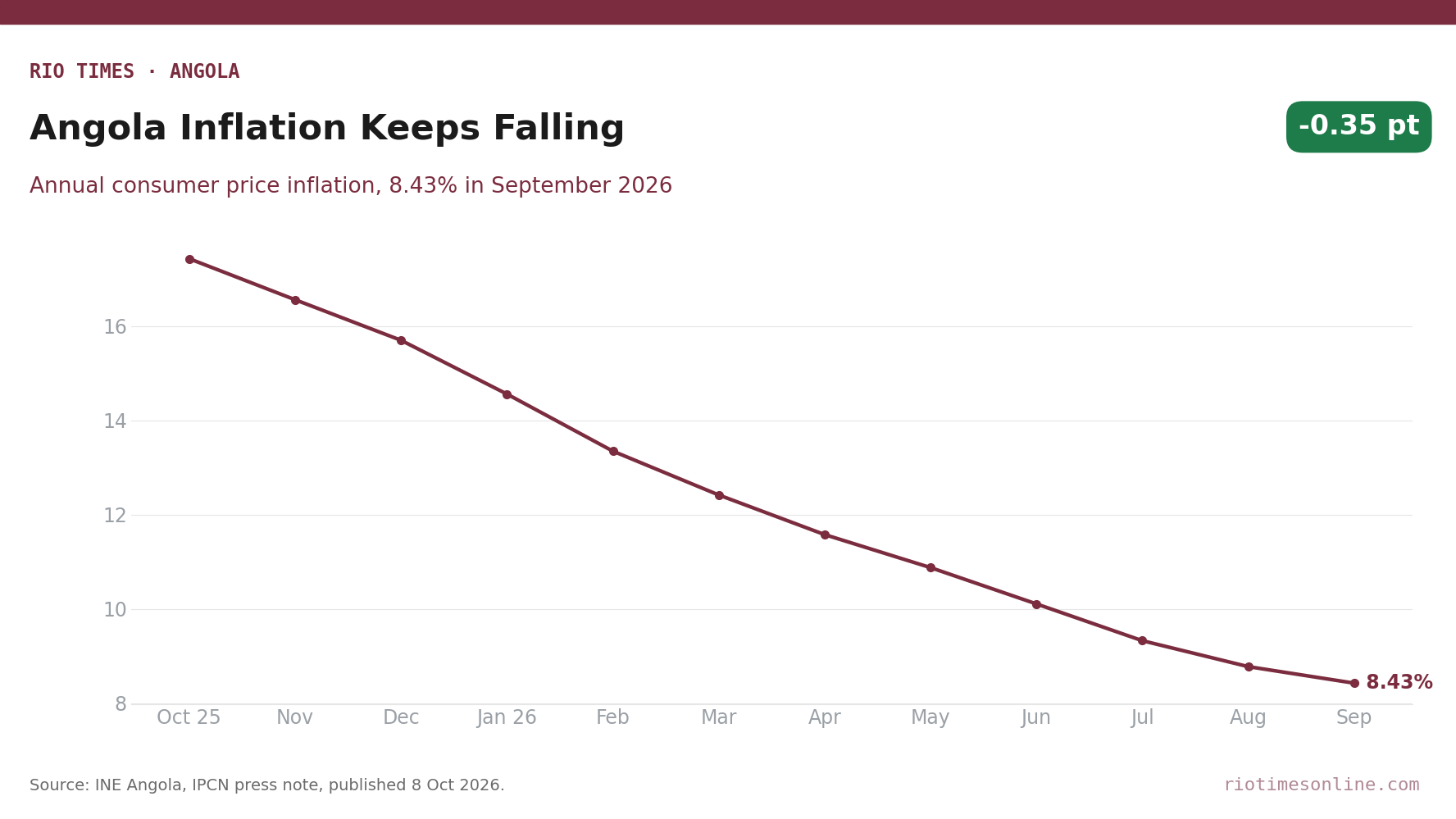
- —What happened Annual inflation slowed to 8.43% in September from 8.78% in August and 18.16% a year earlier.
- —The numbers Food added 5.77 points of the 8.43%. Education prices rose fastest, at 18.53%. The policy rate is 14.75%.
- —What it means for US readers Lower inflation eases pressure on the kwanza and Angola’s dollar bonds, a plus for US-financed projects such as Lobito.
- —Still open Whether the central bank cuts again at its meeting on 16 and 17 November in Saurimo.
Angola inflation slowed again in September, to 8.43% from 8.78% in August, the national statistics office said on Thursday. That is less than half the 18.16% recorded a year earlier. For US investors in Angolan bonds and US-backed projects, it points to cheaper credit and a calmer currency.
The figure comes from the Instituto Nacional de Estatística (INE), Angola’s official statistics agency. It published the September consumer price index on 8 October. According to INE’s own table, the annual rate has fallen every month since its peak in July 2024.
Prices still rose 0.68% between August and September, a Rio Times calculation from the INE index. So the cost of living is climbing, just more slowly than before.
Food Still Drives Most of the Increase
Food and non-alcoholic drinks rose 9.54% over the year. Because they weigh so heavily in household budgets, they contributed 5.77 percentage points of the 8.43% total, according to INE. That is more than two thirds of all inflation.
Education was the fastest-rising category, up 18.53%. Health and alcohol and tobacco each rose 9.10%. Housing, water, electricity and fuel rose 9.07%.
At the other end, transport prices rose only 3.32% and recreation and culture 3.41%. Clothing and footwear rose 6.05%.
The picture differs sharply by region. Cuando Cubango, in the south-east, had the highest rate at 11.26%. Lunda Sul followed at 10.68% and Malanje at 10.51%. Cuanza Norte had the lowest, at 5.65%, followed by Huambo at 6.19%.
How Far Angola Inflation Has Come
INE’s own table shows how fast the turn has been. Annual inflation peaked at 31.09% in July 2024, when prices were rising faster than at any point since 2021.
September’s 8.43% is the lowest reading in that table, which runs back to January 2021. The average over the past twelve months is 12.08%, so the full-year figure will still look high.
The central bank, Banco Nacional de Angola (BNA), has used the slowdown to cut its benchmark rate. On Tuesday 15 September its Monetary Policy Committee lowered the BNA rate from 15.75% to 14.75%, Novo Jornal reported.
The committee also cut the reserve ratio banks must hold in local currency from 17.5% to 16.5%. That frees more money for lending. The business weekly Expansão said the rate is now the lowest since June 2016.
The BNA kept its forecast for inflation at the end of 2026 at 8.6%, give or take one point. September’s figure is already slightly below that. After inflation, the policy rate still leaves a real return of about six points. That gives the bank room to ease further.
What It Means for US Readers
For US investors, Angola is mainly an oil and bond story. Falling inflation makes the country’s dollar debt easier to hold, because it lowers the risk of another currency shock.
The BNA’s reference rate on 8 October was 913 kwanzas per US dollar.
There is also a direct US stake. In December 2024 the US International Development Finance Corporation (DFC), Washington’s development lender, announced a loan of up to US$553 million to upgrade the Lobito Atlantic Railway, according to the DFC. The line runs from Angola’s Atlantic port of Lobito towards the mining regions of the Democratic Republic of the Congo and Zambia.
Cheaper credit at home helps local suppliers along that corridor. A calmer price level also makes wage and contract costs easier to plan for US firms working there.
The risk runs the other way too. Food still rises faster than the headline rate, so poorer households feel little relief. Any new fall in the kwanza would push import prices up again.
What Is Not Known
It is not known whether the BNA will cut again at its next meeting. That is set for Monday 16 and Tuesday 17 November in Saurimo, capital of Lunda Sul. That province has one of the highest inflation rates in the country.
INE has not said why prices in Cuando Cubango and Lunda Sul rise almost twice as fast as in Cuanza Norte. Its press note gives the figures without an explanation.
The date of the October inflation release has not been confirmed. Nor is it clear how long the fall can continue once the base effect of last year’s high prices fades.
For more on the country’s economy, see Angola Says Industrial Plants Rose 44% in a Year as It Looks Beyond Oil and Zambia Says Lobito Corridor Road Financing Is Secured.
Frequently Asked Questions
What was Angola inflation in September 2026?
Annual consumer price inflation was 8.43% in September 2026, down from 8.78% in August, according to the national statistics office INE.
What is pushing prices up in Angola?
Food and non-alcoholic drinks contributed 5.77 points of the 8.43% total. Education was the fastest-rising category, at 18.53%.
What is Angola’s central bank interest rate?
The Banco Nacional de Angola cut its benchmark BNA rate to 14.75% from 15.75% on 15 September 2026.
When does the central bank meet next?
The Monetary Policy Committee is due to meet on 16 and 17 November 2026 in Saurimo, in Lunda Sul province.
Why does Angola inflation matter to US investors?
Lower inflation reduces the risk of a currency shock for holders of Angola’s dollar bonds and supports US-financed projects such as the Lobito railway.
Sources: INE Angola, IPCN September 2026 · INE press note (PDF) · BNA reference exchange rate · DFC, Lobito Corridor release · Novo Jornal · Expansão
Editorial responsibility: Matthias Camenzind, Editor-in-Chief · Editorial standards · Report an error
Part of our ongoing coverage
Africa: The New Scramble — the great-power contest over the continent.